



As urban planning is becoming increasingly eco-conscious, there has been a significant rise in green infrastructure development and green cities. Yet, many of these initiatives focus on energy efficiency to combat emissions while failing to consider the principles of landscape ecology. Applying landscape ecology is necessary for urban planners to design environments that not only reduce emissions but also enhance habitat quality, ecological connectivity and resilience.
—
From a young age, we are taught about the importance of shapes. Whether it is connecting lego blocks together, building a Jenga tower or completing a puzzle. We learn how arches are stronger than squares and how triangles are even stronger than both. These are, of course, basic concepts that are embedded into architecture and civil engineering.
But shapes do not only play a vital role in constructing urban infrastructure; they are a key feature of landscape ecology, too.
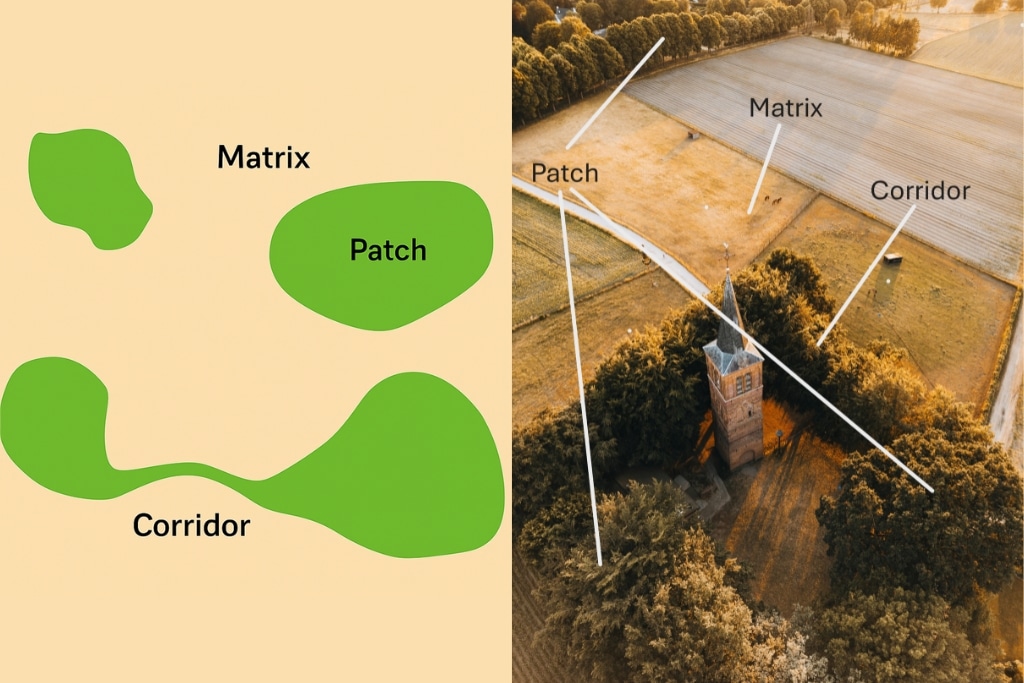
Landscape ecology investigates how the structure and features of a landscape affects the behavior of various species and the broader ecosystem over time and space. A landscape is a spatial area composed of a mosaic of patches, distinct areas that can be a habitat for a species, such as a cluster of shrubs or trees. The total patch area in a landscape is the most accurate metric of how much habitat and therefore green space it has.
Matrix, instead, refers to the spaces in between these patches, such as farmland, that are unusable for a species. When conducting city planning, it is necessary to not only consider how much green space is set aside for local ecosystems to grow, but also its shape and structure.
Shortcomings in Green Infrastructure
In the race to reach net zero, a growing number of cities worldwide are becoming greener by investing in green infrastructure, which typically leads to reduced pollution, waste and net carbon emissions compared to conventional infrastructure.
But while this is all essential, it is equally important to take ecological principles into consideration.
Landscape ecology allows for the preservation and enhancement of natural landscapes and habitats, and ultimately boosts biodiversity. It also assists in achieving the current goals of green cities as it reduces greenhouse emissions by optimizing land use.
Biodiversity represents the foundation of all ecosystems and life on the planet, making it crucial to conserve.
Improving Sustainability and Biodiversity Through Ecology
Increasing the quality of green areas, not just the quantity
Many global standards, policies and metrics designating a city’s “greenness”, typically only account for the quantity of green areas and not the quality. Forest cover or some equivalent metric is used to measure green space quantity without considering ecological structures and features such as patches and matrixes.
A good example of this is a United Nations Economic Commission for Europe (UNECE) guideline, which only emphasizes “significantly increase[ing] tree cover” to make cities greener. Similarly, a Global Biodiversity Framework consolidated guidance note mentions “ecological connectivity” but fails to include any metrics or specifics, listing tree cover as a metric but not patch area or patch size.
Green spaces are also often poorly defined in media and reports. They are generally defined too broadly to include both viable habitats (e.g. a garden for insects) as well as the matrix in between that is not viable for species – such as a footpath in a park. It is crucial that matrices and habitat areas be distinguished.

There is debate over whether habitat area or quality matters more, with some studies suggesting that habitat area might say more about overall species richness. However, other studies show that habitat quality is more important for species such as mammals. There are general factors which boost habitat quality, such as low levels of pollution, good patch geometry, fertile soil and dense vegetation.
But the literature is clear on one thing: both habitat quality and quantity are essential for rich and flourishing ecosystems.
Designing structures with natural boundaries and shapes
Generally speaking, animals and plants prefer rounder habitats with natural boundaries. This preference is not merely a matter of taste, but rather it affects their survivability. This is why patch geometry also plays a significant role in habitat quality.
The rise of urban environments, with their unnatural boundaries and shapes, have caused significant losses in species richness.
A meta-analysis of global biodiversity has revealed that most of the world’s species are edge averse, meaning they would actively avoid boundaries with hard edges. This effectively reduces their habitat area.

Although some animals are actually edge specialists, meaning they thrive in edges, they are generally much less likely to be of conservation concern. As urban environments are full of hard edges, edge-friendly species thrive in cities and often spread to other ecosystems, becoming invasive species. For example, brown-headed cowbirds, nest parasites, choose to lay their eggs in the nests of over 220 host species, leading to a decline of many birds who are already vulnerable. Urban sprawl has allowed this bird to expand across the US, Canada and Mexico.

Although landscape ecology has made it clear that reducing edge intensity and creating natural boundaries and shapes for patches will boost biodiversity, this has rarely been applied to urban design. It is vital for city planners and researchers to consider these concepts to ensure that green infrastructure promotes local habitats and the flourishing of native species.
Connecting patches to reduce fragmentation
One of the criteria used by the International Union for Conservation of Nature (IUCN), the global authority for nature conservation, for designating a species as threatened is to look at how fragmented its habitats are. Fragmentation refers to patches that are small, broken up and often disjoined, and it leads to animals being restricted in their movement and behaviors like mating and foraging, as well as being more exposed to predators and human threats.
Fragmentation can reduce biodiversity by up to 75% and is of key concern for conservationists, but it can be prevented by connecting patches through green corridors.
A New Future for Green Cities
As city planning and policy has grown more eco-conscious, there have been concerted efforts to design infrastructure that is more energy efficient and carbon friendly. However, much of green planning and infrastructure is yet to utilize landscape ecology principles to promote sustainability and biodiversity. Landscape ecology can provide insights into urban planning to create the cities of the future – ones that are truly green and teeming with life.
Featured image: Tom Fisk/Pexels.
This story is funded by readers like you
Our non-profit newsroom provides climate coverage free of charge and advertising. Your one-off or monthly donations play a crucial role in supporting our operations, expanding our reach, and maintaining our editorial independence.
About EO | Mission Statement | Impact & Reach | Write for us