


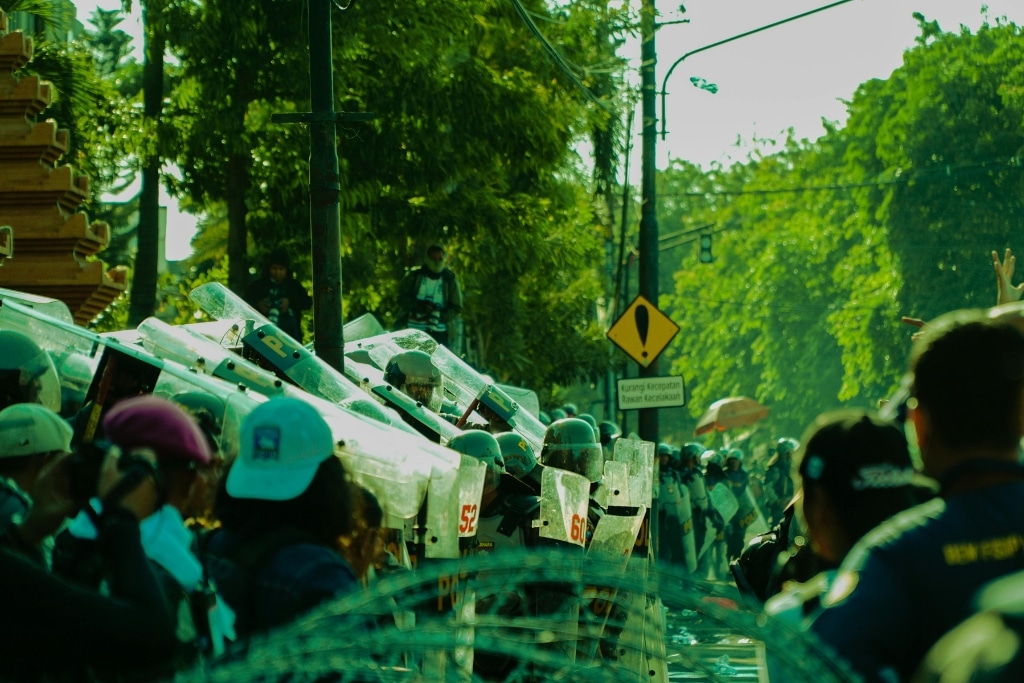
Climate activists in Indonesia face increasing suppression through Strategic Lawsuits Against Public Participation (SLAPP) and restrictive provisions in the new Criminal Code. While constitutional protections safeguard free expression, these rights are often undermined by vague defamation laws and a growing trend of authoritarian backsliding.
—
Since the downfall of General Suharto in 1998, Indonesia has been free from the clutches of violent dictatorship and military rule. A hopeful era of democracy followed, a period known as reformasi (reformation). Yet in recent years, Indonesian democracy has been backsliding into authoritarianism. Environmental activists in particular, such as Heri “Budi Pego” Budiawan, have had their voices suppressed through criminal action or malicious lawsuits. The latest iteration of the Criminal Code, which took effect in January 2026, upholds this restrictive regime.
Strategic-Lawsuits-Against-Public-Participation (SLAPP) are lawsuits used by the powerful to suppress the democratic rights of Indonesian people.
SLAPP is typically initiated by corporations or government entities to silence, threaten or intimidate persons who exercise their public rights against their interests, be it a political commentator who accuses the president of corruption or a concerned citizen who opposes a corporation’s mining project. The more powerful parties respond by initiating malicious lawsuits, such as civil or criminal defamation.
Background to the Indonesian Legal System
To understand how SLAPP operate in Indonesia, their effectiveness and the systems that can constrain SLAPP, it is necessary to discern the legal system.
As a former Dutch colony, Indonesia is broadly influenced by civil law, unlike the US, the UK, Australia or other former British colonies. This means that Indonesia was built on the inquisitorial system, where judges can participate in “fact-finding”, rather than the adversarial system, where judges operate as a referee whilst the conflicting parties battle out or resolve a dispute.
However, similarly to the US or Australia, Indonesia has a written constitution that operates as a check against its legislative body. Indonesia does not subscribe to the UK model of parliamentary sovereignty, where there is no written constitution to limit the law-making abilities of the legislature.
The Indonesian Constitution is central to combating SLAPP and the suppression of democratic and environmental rights. Article 28E(2) provides for the freedom of thought and conscience and Article 28E(3) for the freedom to associate, assemble and express opinions. Furthermore, Article 28F provides for the freedom to obtain and convey information through all types of channels. As a result, the freedom of expression, speech and protest is deeply entrenched into the Indonesian constitution.
Nevertheless, the text does not advocate for an unrestrained free expression as Article 28J ties the right to free expression with the duty to uphold morality, religious values, security and public order.
The Articles of the Constitution are implemented and given specificity through laws such as Law No. 9 of 1998 on Expressing Public Opinions and Law No. 39 of 1999 on Human Rights, Law No. 11 of 2008 on Electronic Information and Transactions.
The Effect of the Criminal Code on Democratic Rights
The founders of Indonesia may have envisioned extensive democratic rights through the constitution. Nevertheless, in practice, those rights can be limited by the Criminal Code, in particular Indonesia’s unique criminal defamation law framework.
In a general sense, defamation refers to false statements that harm a person’s or entity’s reputation. Defamation can either be enforced through civil or criminal law frameworks or both, across varying global jurisdictions.
Until 2022, Indonesia was governed by a colonial Dutch Criminal Code, known as Wetboek van Strafrecht, or KUHP. In December 2022, the Indonesia government passed a new Criminal Code, which has been in effect and has completely replaced the previous Criminal Code since January 2, 2026.
Like its predecessor, the new Criminal Code contains an extensive criminal defamation framework, providing fertile ground for developing SLAPP cases. Chapter 17 of the new code – the criminal defamation chapter – has provisions such as Article 433, which prohibits “verbally assaulting” a person’s honour or reputation with the intention to be made public, subject to a penalty of imprisonment up to nine months. There are nine other Articles in this chapter, such as libel or submitting false allegations.
The criminal defamation framework is also supported by Chapter 2 of the new Criminal Code, Crimes Against the Dignity of the President or Vice President, as another basis for SLAPP. Article 219 is the most restrictive, as it prohibits broadcasts, displays, writing or pictures that are made public which “assault” the honour, dignity or prestige of the president or vice president, with four years imprisonment as a maximum penalty.
The Rise of SLAPP
SLAPP is not unique to Indonesia. It is a weapon used globally, and legal academics have argued that filers of SLAPP cases “do not care that they cannot ultimately prove their allegations.” This is because SLAPP is designed to intimidate, to prevent their targets from fighting back due to fear of potential consequences such as imprisonment – even if the case itself is unlikely or impossible to succeed in court.
The core issue is not the concept of criminal defamation but rather that its presence can enable bad faith actors to report and allege criminal defamation unjustifiably. Given that imprisonment is a likely outcome, the allegations themselves are often sufficient to silence protest.
When the targets of SLAPP have the resources and the legal understanding to fight back or file counter lawsuits, they are often successful against a baseless SLAPP action. For example, in Australia, Australian Wool Innovation sued their critics – were members of People for the Ethical Treatment of Animals (PETA) – for torts of conspiracy and intimidation. The Court clearly held that these claims were “shapeless” and “embarrassing”, ultimately dismissing the allegations.
In a similar way, Indonesian courts have also ruled against SLAPP actions when the targets of SLAPP challenge a baseless lawsuit in court.
Can the Constitutional Court Restrict SLAPP and Restrain the Criminal Code?
The Constitutional Court of Indonesia has been able to somewhat restrict the Indonesian Criminal Code as a vehicle for SLAPP.
An example is the Court’s ruling on Article 134 of the old Criminal Code, which prohibited “deliberate insult” against the president or vice president. This was held unconstitutional and revoked by the Constitutional Court in 2006.
The court ruled that the president and vice president cannot have a “treatment” of “legal privilege”, as those provisions originally applied to the Dutch monarch – designed to shield the royal family from critique. Therefore, it was held that Article 134 of the Criminal Code contradicted Article 27(1) of the Indonesian Constitution, which translates to: “All citizens shall be equal before the law and the government and shall be required to respect the law and the government, with no exceptions.”
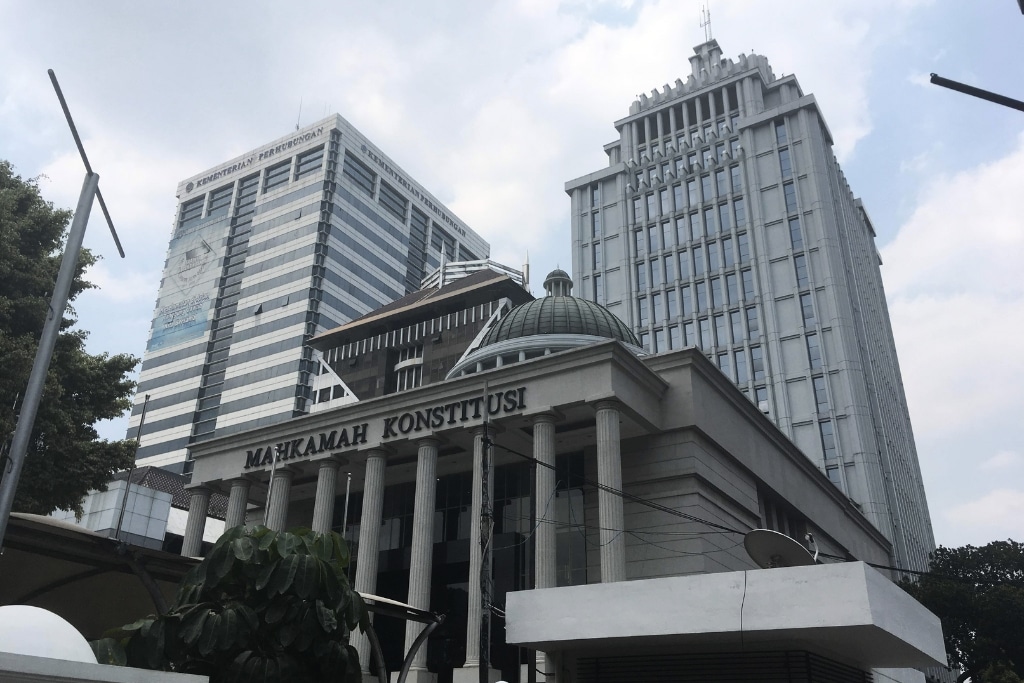
In a separate ruling by the Constitutional Court, Article 154 of the old Criminal Code ( “Any person who publicly gives expression to feelings of hostility, hatred or contempt against the Government of Indonesia, shall be punished…”) was overturned as well. The Article was held unconstitutional because citizens are entitled to critique the government, and such criticism would otherwise be regarded as hostility against the government.
Despite these rulings, the Indonesian government ultimately recreated very similar Articles in the new Criminal Code, such as the aforementioned Article 219. Until those new provisions are challenged in the Constitutional Court, they will operate to suppress Indonesian voices.
Indonesian environmental activists are especially vulnerable, as they challenge the interests of corporate and state actors.
SLAPP Lawsuits Target Environmental Protests
In 2024, according to the Economist Intelligence Unit, Indonesia’s democracy index was ranked 59th in the world, below countries such as Malaysia, Philippines and Namibia. Indonesia is considered a “flawed” democracy, below countries of full democratic status.
Between 2014 and 2024, according to WALHI, there were 1,131 cases of criminalization against environmentalists. Criminalization not only includes criminal cases, but also arrests, charges or other punitive legal action.
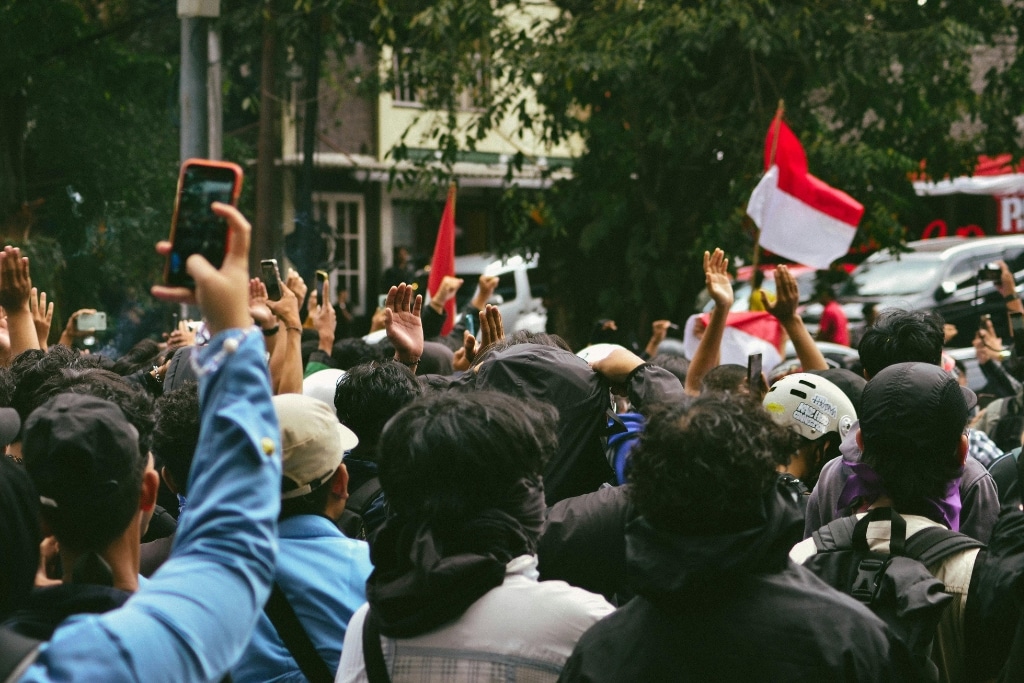
According to a journal article published by the University of Negeri Semarang, SLAPP is often used by corporations to suppress environmental protests.
An example of this is Budi Pego, a resident who protested the operation of a gold mining company in East Java. He was charged with spreading communism by allowing an anonymous person to draw a palu arit (hammer and sickle) on a banner rejecting mining activities. Pego was found to have committed crimes against state security and was initially sentenced to 10 months in prison, and then later four years upon appeal. On appeal, the Supreme Court reasoned that the symbol of the Indonesia Communist Party (PKI) is “still prohibited in Indonesia.” Moreover, the use of the logo was regarded as an effort to revive the teachings of communism. As communism is in complete opposition to Indonesia’s religious identity and prohibited by their constitution, it was considered to be an invalid means of environmental protest by the Supreme Court and the SLAPP was held as legally sound.
Nonetheless, there are many instances where corporate or government actors have illegally engaged in SLAPP to suppress environmental protests. A clear example is the Basuki Wasis case. Wasis, an environmental science lecturer, was invited by Indonesia’s Corruption Eradication Commission (KPK) to give expert testimony on environmental damage caused by a company that had obtained its operating permit from regional governor Nur Alam. Wasis testified that the company’s operations caused environmental harm, and the panel of judges relied on that testimony when calculating state losses. Afterward, Governor Alam brought a tort and criminal claim against Wasis, seeking Indonesian Rupiah (around US$83,000) in damages. The court rejected the lawsuit, holding that expert testimony adopted by judges becomes a legal opinion of the court and is thus protected.
Perhaps the most important victory for environmental protestors fighting SLAPP occurred in 2021 with the Robandi case. Robandi was head of a civil apparatus state (ASN) in Kenanga village. The plaintiffs were part of the Kenanga village community who filed a class action lawsuit against an Indonesian industrial company for alleged pollution by factory waste. The lawsuit was unsuccessful.
Following the failed civil suit, Robandi was reported to police on charges of violating the older Criminal code, such as for allegedly falsifying documents. During the appeal process, the Bangka Belitung High Court overturned the previous decision and acquitted Robandi. The court relied on Article 66 of an Indonesian Law on Environmental Protection, which states that any individual who fights for the right to a good and healthy environment cannot be prosecuted, through criminal or civil action.
Article 66 is undoubtedly one of the strongest anti-SLAPP provisions in Indonesian environmental law.
In Need for Reforms
Despite a chequered history, Indonesia overcame the clutches of dictatorship and military rule to become a democratic nation. A period of reformation was ushered in and Indonesian civil society and democratic participation flourished.
The recent years present the reverse trend, where the nation has backslided towards authoritarianism once more. SLAPP, facilitated by the Indonesian Criminal Code, is a key tool for corporate and political suppression of citizens. Although the Constitutional Court has acted to deem some of these lawsuits and their underlying criminal provisions as illegal or unconstitutional, SLAPP continues to remain pervasive. The Indonesian public must be made aware of their rights, to combat the illegal use of civil or criminal law to repress public participation. Beyond education, a second reformasi may be needed to pave the way for the future of an active democratic populace.
This story is funded by readers like you
Our non-profit newsroom provides climate coverage free of charge and advertising. Your one-off or monthly donations play a crucial role in supporting our operations, expanding our reach, and maintaining our editorial independence.
About EO | Mission Statement | Impact & Reach | Write for us