

In South Africa’s biggest city, urban heat risk is defined more by social inequality and coping capacity than by physical temperature alone.
—

Extreme heat has become a struggle shared by communities around the world. Yet for urban populations in much of the Global South, the threat of global warming is worsened by socio-economic inequality and limited healthcare access.
Johannesburg, South Africa’s biggest city, is a representative case. Within the city, the land surface temperature (LSD) varies by a few degrees (between 24C to 30.7), but vulnerability scores range from 0.23 in the green northern suburbs to 0.78 in the densely inhabited and poorer ones.
Heat vulnerability takes into account three interconnected dimensions: exposure, sensitivity, and adaptive capacity. The first refers to the degree and duration of heat stress, which is measured through land surface temperature. Sensitivity is how susceptible a population is to heat stress – socio-economic conditions, among other factors, can have a significant impact on this metric. Lastly, adaptive capacity refers to the capacity to cope with and recover from heat stress, which depends on access to healthcare services and infrastructure.
What’s Happening in Johannesburg?
Johannesburg is a stark example of the relationship between climate change-induced environmental risks and socio-economic inequalities. The inland highland city is expected to warm faster than the global average. In fact, the city hit its peak of 38C in 2016, and regional projections show an additional temperature increase of between 2.5C to 5.9C by the end of the century.
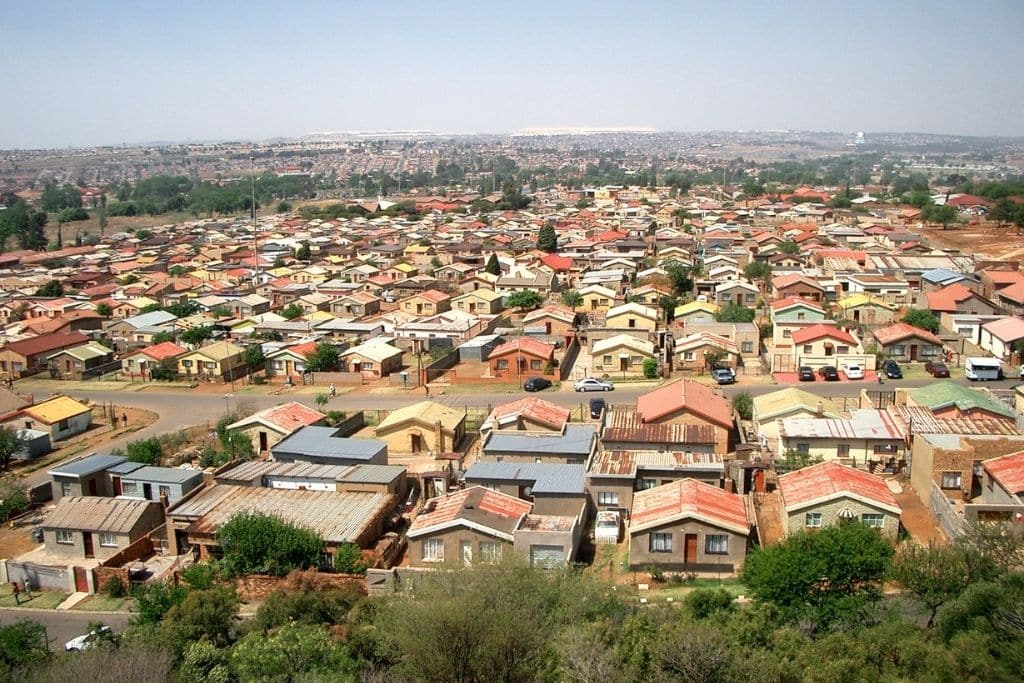
How differently heat is perceived by its residents is in part linked to and shaped by apartheid planning. Urban planning during apartheid amplified environmental injustice through forced removals and the deliberate siting of Black neighborhoods downwind and downstream of polluting sites. These areas are called townships – formal and informal human settlements characterized by high levels of poverty and distance from the main centers of economic activities. In Johannesburg, there are around 157 informal settlement or township areas.
This historic approach leads to dramatic inequality in heat exposure. As these areas have the highest housing density, leaving little space for green spaces, they are typically hotter than the surrounding countryside. A recent citizen-mapping campaign found that Johannesburg’s hottest areas are formerly segregated townships, which are roughly 6C hotter than the surrounding countryside (greener suburbs are around 3C to 4C hotter).
Within the city itself, however, the outdoor land surface temperature differences across Johannesburg appear modest, ranging between 24.0C and 30.7C during peak summer months. Highly vulnerable areas like Lenasia South and Soweto – predominantly Black communities Black community with poor infrastructure quality and where access to healthcare facilities is limited – even register slightly lower outdoor land surface temperatures than other wards.
However, focusing solely on outdoor surface temperature obscures the real crisis: low-income residents live in structures that trap this heat, turning minor outdoor temperature variations into severe indoor health hazards.
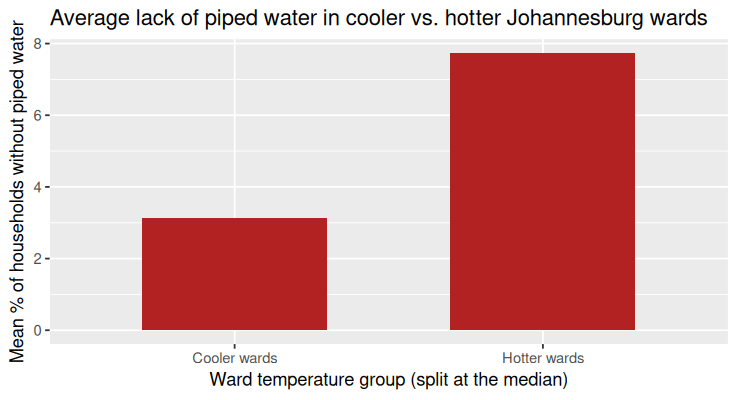
The decisive factor is the capability to cope, as data shows that poorer neighborhoods have less means of relief from heat. Figure 1 extends this picture using a simple comparison. By splitting wards at the median land surface temperature, it reveals that the hotter half of the city has, on average, a higher share of households without piped water than the cooler half.
To reinforce that adaptive capacity carries the greatest inequality, a 2025 study mapped the Heat Vulnerability Index (HVI) – a range from 0 to 1 that tells us how much a neighbourhood suffers during extreme heat. To build it, the researchers combined 22 different measures, from a ward’s temperature, its greenery and its access to health facilities.

The left map shows that the highest vulnerability scores (above 0.75) are concentrated in historically disadvantaged areas, especially those with limited healthcare access. In contrast, the northern suburbs consistently exhibit lower vulnerability scores (below 0.3), benefiting from greater vegetation cover and superior healthcare infrastructure.
A Nationwide Crisis
This gap is not unique to Johannesburg. Nationally, a 2014 monitoring tool built on 20 measures on environmental and social issues, revealed that South Africa made real progress on basic infrastructure between 1994 and the early 2010s. Water access deprivation fell by 33.8%, electricity access by 25.6%. Yet, the socio-economic deprivations most closely tied to adaptive capacity, like income, worsened over the same period. This asymmetry suggests that Johannesburg’s ward-level adaptive-capacity gap is not a localized planning failure but a national pattern.
Because systemic poverty limits a household’s ability to afford air conditioning, insulation, or reliable water, the physical dwelling becomes the primary line of defense against extreme heat. Yet, modern low-cost urban housing in South Africa fails precisely at this task – forcing a re-examination of how homes are designed and built.
Vernacular Design As A Reclaimed Alternative
This cycle of heat and social inequality is further compounded by a form of epistemic injustice – the systemic dismissal of traditional African architectural knowledge in favor of concrete-heavy, Western-style construction. Modern low-cost urban housing in South Africa performs exceptionally poorly during extreme weather. A 2017 study tracking indoor temperatures across Johannesburg found that government-built RDP homes and informal dwellings consistently run 4C to 5C hotter than outdoor temperatures. Subsequent research logged drastic daily indoor temperature swings, reaching up to 9C in post-apartheid public housing and 14C in informal shacks.
By contrast, traditional Sub-Saharan building practices offer a time-tested model for climate resilience. Vernacular structures rely on locally sourced, high-thermal-mass materials like stone, clay, and thatch, which absorb peak daytime heat and release it slowly overnight. In tests conducted in the Eastern Cape, traditional Xhosa earth-and-stone dwellings maintained a stable indoor temperature swing of just 4.3C, drastically outperforming modern concrete structures, which experienced swings up to 20C. Beyond thermal comfort, a 2017 continent-wide review concluded that earthen construction is significantly cheaper and carries a far lower carbon footprint.
Despite these clear microclimate benefits, modern South African urban development remains heavily reliant on imported, heat-trapping materials due to institutional rather than technical barriers. Outdated building codes lacking national standards for earthen materials prevent developers from securing project financing or official permits. Meanwhile, decades of marginalization have fostered a false perception that traditional African building techniques are primitive or temporary compared to concrete. While unstabilized earth can degrade under heavy rainfall and solar radiation, modern stabilization methods using natural fibers or small fractions of lime and cement easily resolve these structural limits.
Current research on South Africa’s vernacular architecture often treats it as historical heritage rather than active climate technology. To protect vulnerable populations from escalating extreme heat, urban planning must evolve beyond superficial environmental interventions like urban greening alone. Adapting traditional thermal principles into modern, high-density urban housing offers a path toward true climate justice, turning the physical home back into a sanctuary rather than a heat trap.
This story is funded by readers like you
Our non-profit newsroom provides climate coverage free of charge and advertising. Your one-off or monthly donations play a crucial role in supporting our operations, expanding our reach, and maintaining our editorial independence.
About EO | Mission Statement | Impact & Reach | Write for us