
More than 8 million tonnes of plastic waste flood the oceans every year, but the long-term threat lies in the invisible problem: microplastics. Like their larger counterparts, these minute fragments take centuries to break down, representing a persistent and looming ecological crisis that demands critical examination.
—
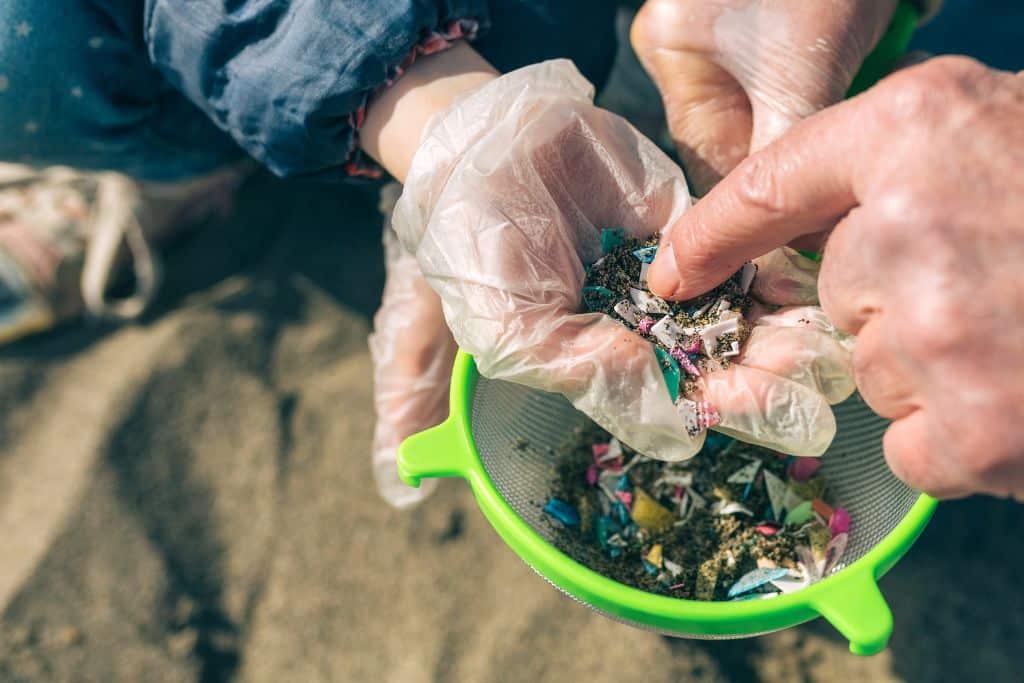
Microplastics are tiny plastic particles of plastic measuring less than five millimetres (0.2 inches) in diameter. They can be categorised into two types – primary and secondary. Primary microplastics are tiny particles and microfibers that are shed from commercial products such as cosmetics, clothing and other textiles, and also fishing nets. Secondary microplastics, which make up the majority of microplastics, are particles that result from the breakdown of larger plastic items, such as water bottles. This breakdown can be caused by exposure to environmental factors, such as sun’s radiation and ocean waves.
Microplastics have been lurking around in every little corner of the environment, including air, soil and water. Drinking water, oceans, freshwater and water in the polar region are some of have been all found to contain high amounts of these toxic particles.
You Might Also Like: Are Microplastics Harmful And How Can We Avoid Them?
Microplastics in Drinking Water
Microplastics have been detected in drinking water, including both tap and bottled sources. A 2017 study that tested 159 samples from 14 countries found that 83% contained plastic particles, with the US scoring the highest contamination rate (94%). European nations, including the UK, Germany, and France, had a lower rate, yet still scored a significant 72%.
While these findings are alarming, the World Health Organization (WHO) has reported that, to date, there is no conclusive evidence to support the claim that microplastics in drinking water pose a major health hazard to humans. As Jennifer de France, a technical expert at the WHO, noted: “Based on the conclusions of our report, while we think that the risks to human health are low, this is based on a limited evidence base and we recognise that there is need for more research.”
Current research, including guidance from the European Food Safety Authority, suggests that microplastics larger than 150 micrometers are unlikely to be absorbed and will instead pass through the gut. The uptake of even smaller particles is also expected to be limited. Furthermore, the risks of chemical toxicity from plastics and the “biofilm effect” – where microorganisms colonize microplastics – are generally reported as negligible due to low exposure levels in water.
Nevertheless, it is crucial to remember that microplastic exposure is not limited to drinking water; potential detrimental effects can still occur through inhalation and the consumption of food.
Microplastics in the Ocean
The ill-famed Great Pacific Garbage Patch – a collection of debris including microplastics in the North Pacific Ocean – has raised grave concerns regarding the dangers that microplastics pose to the marine ecosystem. A 2021 study estimated that there were 24.4 trillion pieces of microplastics in the world’s upper oceans, with a combined weight of 82,000 to 578,000 tons, equivalent to roughly 30 billion half-a-liter plastic water bottles.

While the direct impact of microplastics in drinking water on human health appears limited, the threat to aquatic species is known to be severe, if not fatal. The physical risk of entanglement is notorious: it threatens marine life by causing drowning, suffocation, or strangulation. Globally, 55% of documented incidents involving marine organisms are associated with entanglement, with sea turtles, seabirds, and crustaceans being among the most vulnerable species. Beyond physical trapping, the ingestion of microplastics further jeopardizes marine health, accounting for an additional 31% of all documented negative incidences.
Microplastics in Freshwater
Microplastic contamination has been found in natural freshwater systems, including wetlands, lakes and rivers around the globe. Lake Superior in North America, Swiss lakes in Europe, and Lake Taihu in China have been all found to contain microplastics. Their concentration, however, differs: the surface water of lakes in China and Saudi Arabia have been found to be much more contaminated than waterbodies in other countries in Europe, North America and Africa, suggesting that developing nations are dealing with a much more severe microplastic problem.
Organisms within freshwater systems face the same threats from microplastic entanglement and ingestion as their marine counterparts. What’s more, freshwater bodies—and rivers in particular—can favor the accumulation of microplastics, creating far-reaching implications for the entire ecosystem.
A 2022 study found that microplastics tend to concentrate in areas with low water velocity, such as slow-flow river sections or near the headwaters of streams. Under low-flow conditions, plastic debris can remain virtually stationary, taking up to seven years to move just one kilometer, which significantly promotes the piling up of microplastics. Organisms inhabiting these slow-moving zones are thus highly prone to ingesting these persistent particles.

Once stored in animal tissues, plastic debris enters the food web and human diets, potentially degrading the entire food chain. For example, a 2017 study by Loyola University Chicago sampled 74 fish from the Muskegon, St. Joseph, and Milwaukee rivers (part of the Great Lakes Basin) and found that 85% of the fish had microplastics in their digestive tracts, averaging 13 particles per fish. Further evidence of systemic contamination includes the 2020 finding of microplastic fragments in human placentas.
Regarding this retention, Aaron Packman, Director of the Northwestern Center for Water Research, explained: “The difference is that natural particles biodegrade, whereas a lot of plastics just accumulate.” He added that because plastics do not degrade, they remain in the freshwater environment for a long time, emphasizing the need for researchers to assess and understand the long-term, cumulative impacts of this persistent pollution.
Microplastic in Polar Regions
Further away from populated cities and commercial activities, polar regions may be thought to be free from microplastic pollution. Yet plastic debris has been spotted in the ice cores and snow within both the Arctic and Antarctic regions, and is found to be transported to those areas through dusts, wind, ocean currents, as well as other meteorological conditions.
In the Arctic region, an estimated 2.04 trillion cubic metres of ice will melt in the coming time span due to climate change, releasing at least one trillion pieces of stored plastic. As for Antarctica, microplastics had been found in freshly fallen snow for the first time in 2022, with 29 microplastic particles in each litre of melted snow, higher than the concentrations reported previously in Antarctic sea ice, which was an average of about 12 pieces of plastic per litre of water.
Microplastic pollution in the sea ice in Antarctica risks impeding, if not paralysing, the marine food chain.
“Sea ice is habitat for key foraging species,” said professor Delphine Lannuzel from the Institute for Marine and Antarctic Studies at the University of Tasmania. “Krill defines everything else in the food chain and it relies on sea ice algae to grow. When you think now that sea ice algae is associated to plastics, you can think about the bioaccumulation of the plastics in krill and in whales.”
Microplastics not only have catastrophic impacts on polar regions, but they also significantly exacerbate and accelerate global warming through an effect known as albedo reduction. Clean snowpacks, icefields, and glaciers naturally have high albedo, meaning they reflect most of the sun’s energy back into space. However, when dark-colored microplastics are deposited on these surfaces, they act like tiny heat absorbers. By absorbing sunlight instead of reflecting it, these contaminants cause the snow and ice to warm up faster, which directly accelerates melting and creates a dangerous feedback loop. [Image illustrating the albedo effect with clean ice reflecting sunlight and darkened ice absorbing sunlight]
How Can We Solve Microplastics Pollution in Water Bodies?
At the systemic level, upgrading existing infrastructure offers the most immediate defense. Modern wastewater and drinking water treatment facilities are highly effective removal measures, with the most efficient systems proven to filter out more than 90% of microplastics from wastewater effluent. Expanding the adoption of these advanced filtration systems is expected to have similar effectiveness in removing microplastics from drinking water sources.
Simultaneously, the development of new clean-up technologies and global policy are essential for source reduction and removal. Technological innovation offers groundbreaking tools, such as the prototype “robo-fish“, a self-propelled micro-robot designed to clean water surfaces. This device uses strong chemical and electrostatic interactions to latch onto microplastics contaminated with dyes, antibiotics, and heavy metals, effectively collecting them from the water. While scientists work to develop versions that can explore deeper waters, the innovation shows promise for targeted removal.
Furthermore, organizations like the UN Environmental Programme (UNEP) continue to lead global policy efforts, promoting reduced plastic use, encouraging investment in recycling infrastructure, and evaluating disposal facilities worldwide.
Finally, the crisis cannot be solved without a fundamental shift in consumer behaviour. Individuals play a critical role by minimizing their plastic footprint at the source. This involves actively favoring products made with bio-based and biodegradable plastics and choosing sustainable packaging alternatives. Furthermore, maximising the lifespan of plastic items through recycling and reuse remains a highly effective remedy. By tackling microplastics at the points of creation, management, and removal, we can secure the health and sustainability of our global water systems.
You Might Also Like: 10 Plastic Pollution in the Ocean Facts You Need to Know
This story is funded by readers like you
Our non-profit newsroom provides climate coverage free of charge and advertising. Your one-off or monthly donations play a crucial role in supporting our operations, expanding our reach, and maintaining our editorial independence.
About EO | Mission Statement | Impact & Reach | Write for us
This article was originally published on July 20, 2022.