



The announcement marks a stunning departure from national and international guidelines, which have long recommended to limit consumption of red and processed meat and high-fat dairy for both health and environmental reasons.
—
A newly unveiled food pyramid encourages Americans to consume more meat and dairy products for higher protein intake, ignoring their large contribution to planet-warming emissions and environmental degradation.
Health Secretary Robert F. Kennedy Jr. and Department of Agriculture Secretary Brooke Rollins unveiled the new food guidelines, including a reverted food pyramid, last week. Together with fruit and vegetables, meat and milk products figure at the top of the pyramid. “Protein and healthy fats are essential and were wrongly discouraged in prior dietary guidelines,” Kennedy said, adding that he was “ending the war” on saturated fats and highly processed foods.
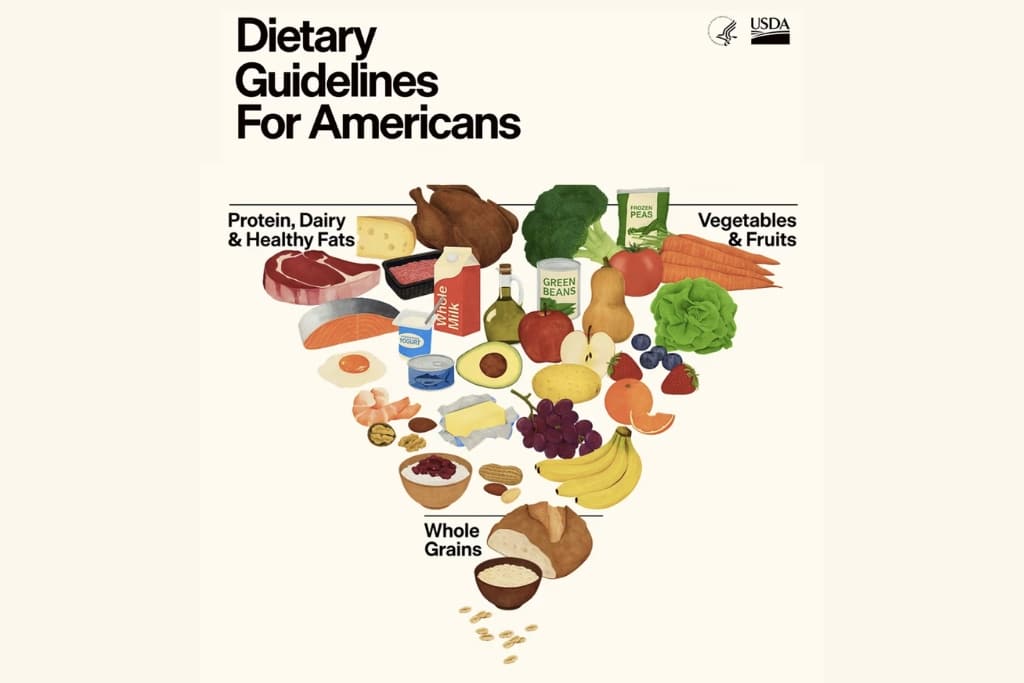
It marks a stunning departure from long-standing national and international guidelines, which have historically recommended to limit consumption of red and processed meat and high-fat dairy for both health and environmental reasons.
Stunning Reversal
The US Department of Agriculture’s first version of the food pyramid, unveiled in 1992, recommended six to 11 servings of bread, cereal, rice and pasta per day; three to five servings of vegetables and two to four of fruit per day; and two to three servings of milk products (milk, yogurt, cheese) as well as of meat, poultry, fish, dry beans, eggs and nuts per day. It recommended to consume fats, oils and candy sparingly.
The guidelines were criticized and adapted often thereafter. For example, critics said the pyramid did not distinguish among carbohydrates, whose nutritional profiles can vary dramatically. In 2011, the Obama administration abandoned the pyramid in favor of easy-to-follow recommendations illustrated on a plate.
Its return last week came with stunning changes. Full-fat dairy and red meat now figure at the top of the pyramid, despite experts warning that consuming them in high quantities can raise the risk of cardiovascular disease because of their high sodium and saturated fats content. The new framework recommends Americans to double their protein consumption but fails to provide evidence of protein deficits in most Americans’ diets.
The government’s food guidelines determine what food ends up on school meals and senior-meal programs and in military and federal cafeterias.
Kennedy, who has been vocal about his opposition to what he calls “poisonous” ultraprocessed foods, first hinted at a change in America’s food guidelines last year, warning nutritionists. Indeed, he has repeatedly contradicted experts’ recommendations, for example dismissing seed oils as the “driving causes of the obesity epidemic,” despite their well-known health benefits, and promoting beef tallow, which is high in saturated fat, as a replacement.
Environmental Concerns
The changes have also raised concerns among environmental experts and scientists, who point at dairy and meat’s huge share of global emissions. Livestock supply chains (meat, dairy and eggs) account for around 14.5% of global greenhouse gas emissions, according to the UN. The production of beef and cattle milk accounts for most of these emissions – 41% and 20% – while pig and poultry meat and eggs contribute 9% and 8% to the sector’s emissions., respectively.
In response to Kennedy’s announcement, the World Resources Institute (WRI) released figures showing how different protein sources have a different impact on the planet. Beef and lamb are among the highest environmentally damaging sources of protein, as they require huge amount of land, water, and feed as well as the conversion of natural ecosystems for pastures. Cows and sheep are also a huge source of planet-warming methane, the second-most abundant greenhouse gas after carbon dioxide.
As for milk, cow’s milk produces roughly three times more emissions than plant-based, protein-rich options like pea and soy milk, according to the WRI.
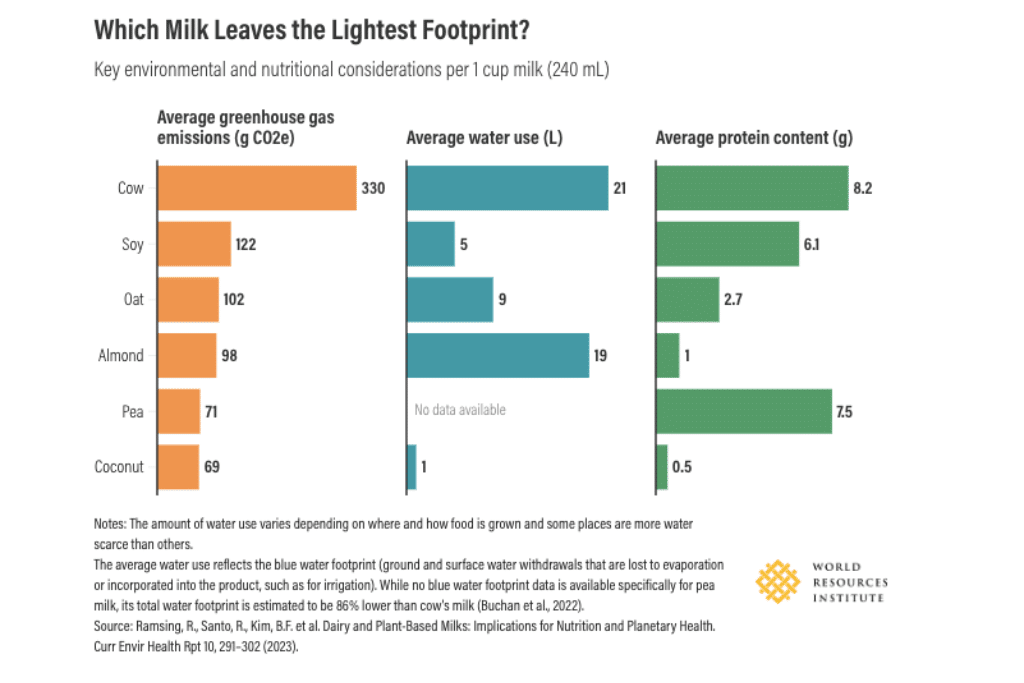
The new guidelines also directly contradict nutrition recommendations presented by the EAT-Lancet Commission last year, which account for the environmental impact of food production. They prioritize vegetables, fruits, whole grains, tubers and starchy roots as well as nuts and legumes (including beans, pulses, and soy) as major protein sources, instead limiting weekly consumption of red meat to one portion, of eggs, poultry and fish to two portions, and of dairy to one 250-grams serving per day at most.
“You had to look hard and almost knowingly to find any hint of plant protein source in that graphic,” said EAT-Lancet Commission Co-Chair Walter Willett. “If someone did care about environment or climate change, one would have a hard time signing onto these new dietary guidelines.”
For environmental reporter Emily Atkin, a diet requiring ecological destruction to sustain it cannot be called healthy. “The climate, water, soil, and land that produce our food are as important to our health as the food itself. Without them, all our talk of ‘healthy eating’ becomes a kind of denial—pretending we can thrive while the systems that keep us alive break down,” she wrote in her newsletter HEATED.
Featured image: Gage Skidmore/Flickr.
You might also like: How Meat and Dairy Subsidies Are Driving Climate Change
This story is funded by readers like you
Our non-profit newsroom provides climate coverage free of charge and advertising. Your one-off or monthly donations play a crucial role in supporting our operations, expanding our reach, and maintaining our editorial independence.
About EO | Mission Statement | Impact & Reach | Write for us