

As more species go extinct, and forests continue to suffer from abuse by timber and palm oil companies, restoring degraded lands can seem like an insurmountable problem. However, a German NGO active in Southeast Asia is proving that a science-based approach to reforestation can create an outsized impact.
—
The Rhino Forest Fund began its mission in 2009 with an effort to save the 50-100 endangered rhinoceroses then remaining in Sabah, Malaysia, on the northern part of the island of Borneo. “We wanted to use [the rhino] as a flagship, an umbrella species, to create a big protected area of undisturbed forest that’s good for everyone else,” Robert Risch, the organization’s founder, told Earth.Org. They have kept their name until today, although there is no evidence of any rhinos in Malaysia: “We try to do what we can,” Risch said.
In particular, combating habitat fragmentation is now at the top of the agenda for the organization. The smaller an isolated area is, the fewer species it can support. The longer it is disconnected, the greater number of species it will lose over time. In Sabah, large intact lowland areas are crucial to preserve species such as large mammals, which are mainly restricted to lowland ecosystems.
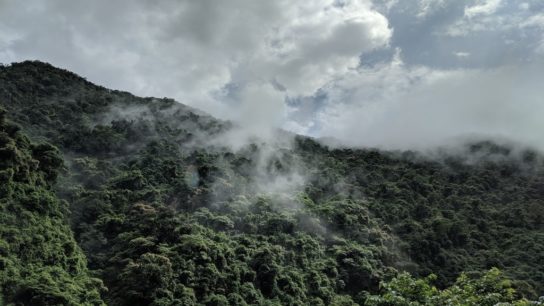
“Tabin, the largest lowland forest area, is isolated like an island. Elephants and other animals can’t cross the swamp – they’re trapped,” said Risch. Borneo is among the top three biodiversity hotspots worldwide in terms of conservation priority. The Southeast Asian forest is up to 140 million years old, with as many tree species per hectare as Europe has on its entire continent.
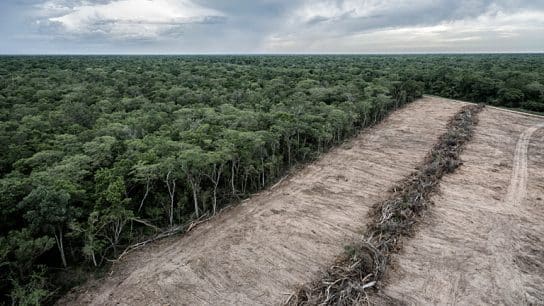
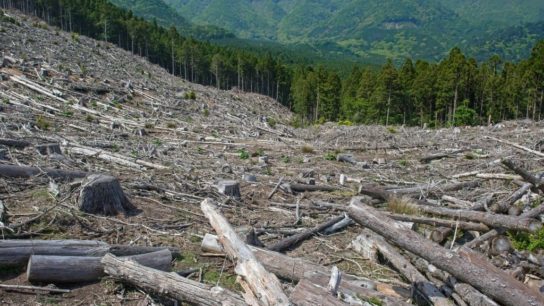
“If you look at a map it’s easy to understand,” Risch explained. “In the 1950s and 1960s, almost all of it was virgin jungle, but the lowlands especially were turned into plantations or used for logging. Between 1985 and 2000, Borneo exported more timber than Africa and South America combined.” Even today, most of the 100 most significant tropical timber and pulp companies do not publicly commit to protecting biodiversity.
On a budget supported entirely by donations that range between US$230,000–470,000 per year, the Rhino Forest Fund set out to restore degraded land back into native rainforest. Rather than engaging in one-and-done tree-planting efforts, the group decided to take a science-based approach, using surgical precision that would leverage nature’s own restorative power.
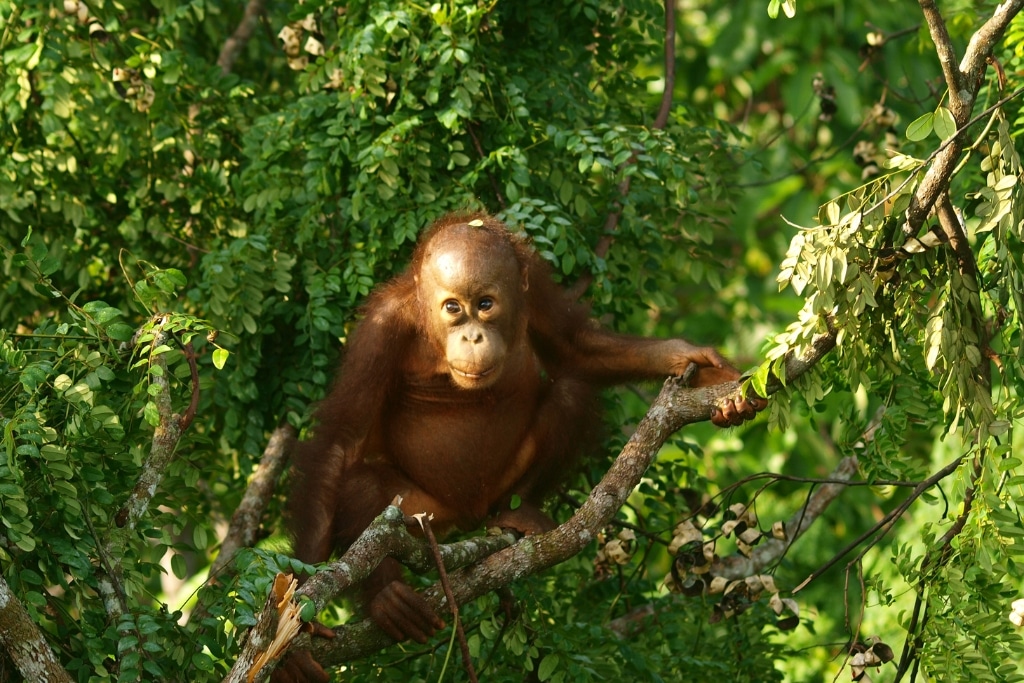
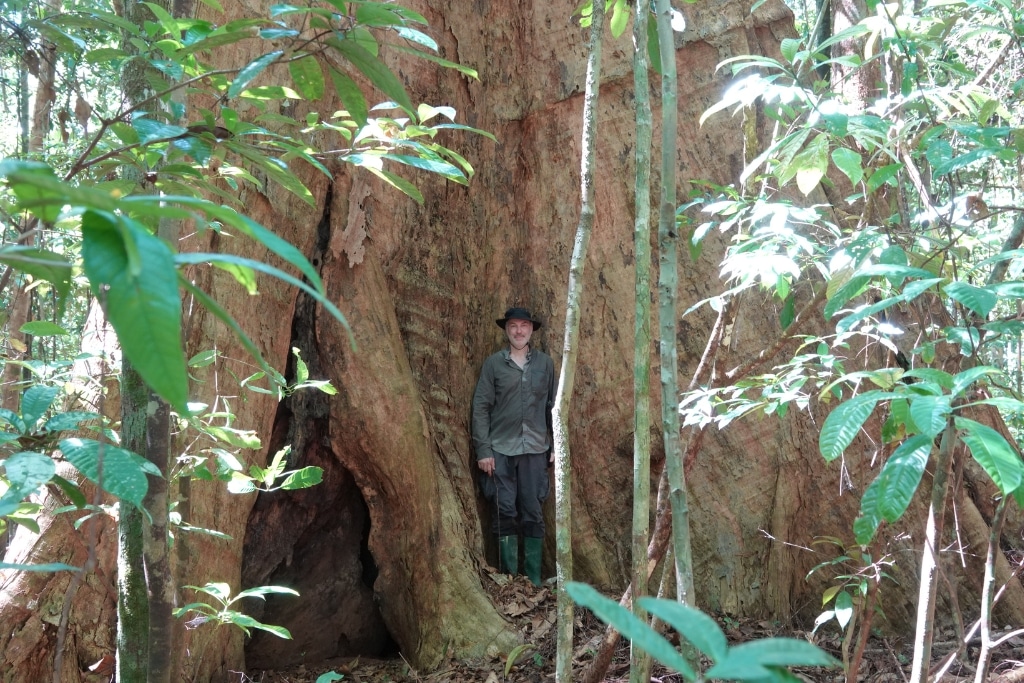
Dipterocarp tree species lie at the heart of the restoration efforts. These hardwood trees, which can reach 100 meters, are mostly branchless at the lower level. In the lowland forests of Sabah – home to 182 species of dipterocarp – these trees make up 80% of the canopy and form the backbone of the ecosystem. The trees are the lowland habitat for iconic species: orangutans, the proboscis monkey, gibbons (which depend on a closed canopy to move from tree to tree), and elephants, which are restricted to the east coast of Sabah. Rare animal inhabitants include the flat-headed cat, one of the least recorded cat species on the planet, and the even rarer bay cat.
However, after mass logging events, when up to 70 trees are removed per hectare, their natural cycle is disrupted: seedlings – which pause their growth at waist height, waiting for an older tree to fall – are impeded by competing vegetation that thrives in the plentiful sunlight made available by destruction of the canopy. Thus, even when the mother tree is spared, its offspring will be unable to recreate the original forest conditions.
The Rhino Forest Fund focuses on reuniting fragmented forest areas through a combination of political pressure and outright land purchase, while simultaneously relying on long-term forest cultivation techniques to ensure newly planted trees have a chance to form a new canopy. This also includes the creation of tunnels to reverse the fragmentation by highways, and the purchase of abandoned restoration projects where insufficient maintenance left the new planting overgrown.
“You cannot stop the restoration until you have reached a closed canopy. We plant seedlings into the secondary vegetation,” Risch explained. “Then, we have to maintain the trees for five years and we have to release these trees every few months. People have to go there every few months to cut creepers.” Eventually, enough of the regenerating canopy grows back to shade out the weeds.
“Our vision is to connect what is left, the whole landscape,” he said.
Specialists from the Rhino Forest Fund identify 33 points per hectare for replanting, and at every point plant five trees. The seedlings are raised at local nurseries in the community, based on samples collected from the surrounding forest. These include dipterocarps, endangered tree species, and wild fruit trees to enhance the carrying capacity for wildlife, including many fig species that provide a year-round basic food supply to a wide variety of animals. Contrary to assumption, oil palms on plantations that the group purchases are not chopped down, since shade-seeking seedlings can make use of the oil palm canopy.
New lakes also form part of the approach, with contractors and seasonal workers supporting the team to dig lakes that can provide a source of water and food for wildlife, insects, fish, and amphibians. Some areas are designated as grassland for herbivores that prefer to feed on grass. Combined with natural regeneration, it takes about 10 years to have a functional forest.

The group reached a number of milestones this year, stating in its annual report, “Based on our own experience, we can now confidently say that it is possible to transform treeless monocultures into near-natural forest within a decade, creating habitats that once again attract and sustain a wide range of wildlife.” In northern Tabin, where the group created in 2012 the only forest connection to adjacent forest areas, the canopy finally closed in 2024. Since then, gibbons have returned to the northern areas, clear evidence that the corridor is functioning.
The group is now proposing the creation of a new wildlife corridor in Segama to improve ecosystem connectivity in the greater Tabin landscape. “It’s not about trying to do it,” Risch told Earth.Org. “It’s about finishing the job.”
Featured image: Photo: Rhino Forest Fund.
This story is funded by readers like you
Our non-profit newsroom provides climate coverage free of charge and advertising. Your one-off or monthly donations play a crucial role in supporting our operations, expanding our reach, and maintaining our editorial independence.
About EO | Mission Statement | Impact & Reach | Write for us