



“Carbon dioxide (CO2) levels in the atmosphere soared by a record amount to new highs in 2024, committing the planet to more long-term temperature increase,” said the World Meterological Organization. Concentrations of methane and nitrous oxide, two potent greenhouse gases, also reached record levels.
—
Human activities and an upsurge from wildfires were responsible for the relentless rise in global carbon dioxide (CO2) levels in the atmosphere in 2024, the World Meteorological Organization (WMO) said on Thursday.
Atmospheric concentrations of CO2, a by-product of burning fossil fuels, biomass, land-use changes, and industrial processes such as cement production, reached record levels last year, committing the planet to more long-term warming.
Greenhouse gases including CO2, methane and nitrous oxide, which are naturally occurring but significantly increased by human activities, are the primary drivers of global warming. They trap heat in the atmosphere, raising Earth’s surface temperature and contributing to climate change and air pollution.
CO2 is the principal greenhouse gas in the atmosphere, responsible for about three-quarters of planet-warming emissions.
Current CO2 levels are over 425 parts per million (ppm), which is 50% higher than pre-industrial levels of around 280 ppm. Much of this rise – about 60% – took place since 1990, driven by continues fossil fuel burning.
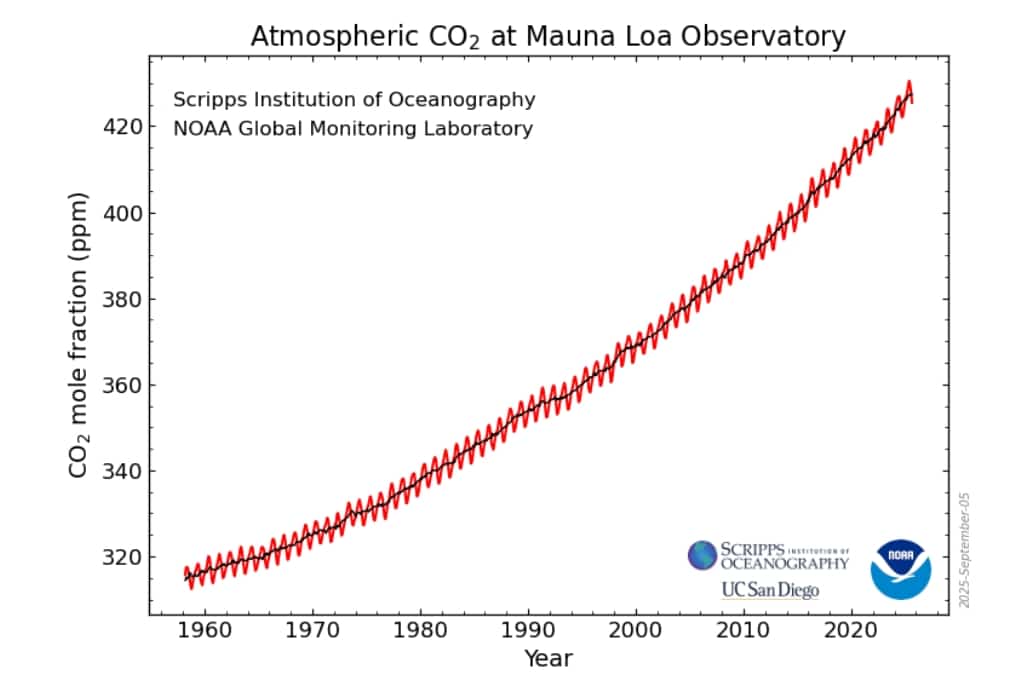
“The heat trapped by CO2 and other greenhouse gases is turbo-charging our climate and leading to more extreme weather. Reducing emissions is therefore essential not just for our climate but also for our economic security and community well-being,” said WMO Deputy Secretary-General Ko Barrett.
Carbon Sinks at Risk
About half of all CO2 emitted each year remains in the atmosphere and the rest is absorbed by Earth’s carbon sinks: land ecosystems and oceans. But scientists worry that global warming is reducing their absorption capacity, as forests become drier and more prone to wildfires and warm ocean waters hold less dissolved gas.

“There is concern that terrestrial and ocean CO2 sinks are becoming less effective, which will increase the amount of CO2 that stays in the atmosphere, thereby accelerating global warming,” said Oksana Tarasova, a WMO senior scientific officer.
Record Levels of Methane and Nitrous Oxide
Atmospheric concentrations of methane and nitrous oxide also reached record levels last year, WMO said.
Despite making up just a minuscule fraction of the atmosphere (~0.0002% by volume), methane’s impact on the Earth’s climate is significant. The greenhouse gas is responsible for 25% of global warming, with concentrations now 166% higher than pre-industrial levels.
Some 60% of all methane emissions come from human sources, including leaks from fossil fuel production and transportation; landfills; livestock; digestion and manure; rice farming; natural gas; wildfires and biomass burning. The rest comes from natural sources, including plant-matter breakdown in wetlands, lakes and ponds; wildfires and biomass burning; termites; ocean; sediment; volcanoes; and permafrost.
Nitrous oxide is the third-most significant human-caused greenhouse gas. It is mainly associated with the use of nitrogen fertilizer and manure from the expansion and intensification of agriculture. Atmospheric concentrations of this gas are now 25% higher than the pre-industrial level of 270 ppb, reaching 338 parts per billion (ppb) in 2024.
You might also like: A Graphical History of Atmospheric CO2 Levels Over Time
This story is funded by readers like you
Our non-profit newsroom provides climate coverage free of charge and advertising. Your one-off or monthly donations play a crucial role in supporting our operations, expanding our reach, and maintaining our editorial independence.
About EO | Mission Statement | Impact & Reach | Write for us