


Falklands Conservation is leading an ambitious restoration project on New Island, one of the region’s wildest western outposts. The goal is to remove invasive predators that have put the island’s native species at risk. If successful, New Island could become a model for large-scale ecosystem recovery across the Falklands, where less than 0.15% of pristine habitat remains.
—
By Andi Cross
Life in the Falkland Islands feels like stepping into a world ruled not by people but by weather, wind, and the wild. At the edge of the South Atlantic, more than 480 kilometers from mainland South America, these islands rise out of waters that mix cold Antarctic currents with warmer flows from the north, creating one of the richest and most volatile marine ecosystems on Earth. Here, the line between land and sea blurs, with seabirds returning from thousand-mile migrations to dig burrows into the peat, seals hauling out onto white-sand beaches, and albatross soaring around cliffs battered by endless waves.
On land, the landscape is complicated, both stark and alive. With no native trees, the horizons feel impossibly wide, skies dominating the view. Knee-high grasses and heather spread across open heathlands, while the coasts host the Falklands’ “giants”, also known as tussac-grass (Poa flabellata), towering up to three meters high. These dense stands of vegetation are what scientists call “habitat engineers”. For centuries, tussac bogs have sheltered penguins, shearwaters, petrels, and countless invertebrates, while slowly breaking down into the peat that forms the islands’ soil. To walk through tussac is to feel the heartbeat of the Falklands.

At first glance, the archipelago feels untouched, very much in part due to the large penguin colonies in the thousands or the pods of Commerson’s dolphins that surf the shallows. But look closer, and a different story emerges, one that touches on the abundance and fragility here. Centuries of exploitation, overgrazing, and the spread of invasive predators have left deep scars on these islands. Now, a dedicated team is trying to reverse that.
Protecting what remains, and restoring what has been lost, has fallen largely to Falklands Conservation, the only NGO dedicated solely to this landscape. For more than three decades, their small but determined team has worked across the archipelago of more than 740 windswept outcrops, anchored by two main landmasses called East and West Falkland. Each island tells its own story: some remain pristine, cloaked in the dense tussac and teeming with seabirds, while others have been stripped bare by centuries of grazing and decimated by invasive species. Together, they represent one of the most challenging and important conservation frontiers our planet has ever seen.
A Dual Challenge
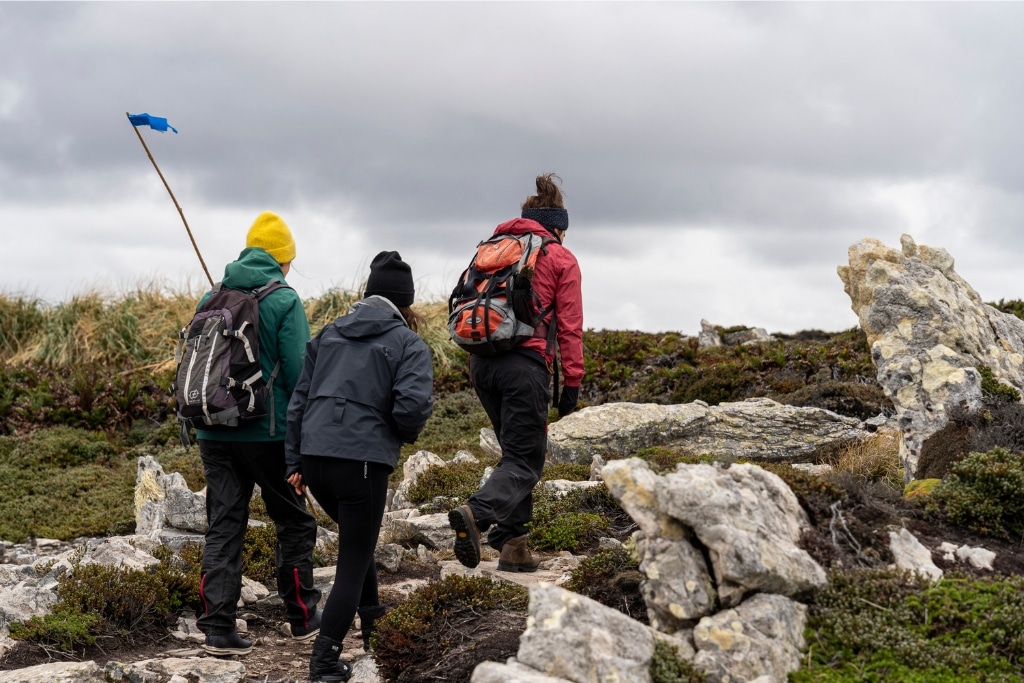
Meeting that challenge requires work at every scale, with some days focused on intimacy – including hand-planting tussac seedlings to stabilize eroded peatlands, or monitoring a single threatened seabird pair clinging to survival. Other days, the work means going big, like coordinating population surveys across multiple islands, tackling predator eradication campaigns, or pushing for marine protections in waters that are pulsing with outrageous life. Unlike conservation groups focused on a single park or coastline, Falklands Conservation shoulders responsibility for an entire nation’s natural heritage, over 12,000 square kilometers of land and 450,000 square kilometers of sea. While their projects are about saving species in isolation, when stitched together, they are restoring entire ecosystems.
Ross James, the NGO’s Biosecurity and Invasives Manager, has spent more than a decade in the Falklands – long enough to witness both the resilience of these wild systems and their vulnerabilities. A huge part of his role is to protect this unique environment from the damages caused by human development. James and his team balance the dual mandate of biosecurity, or stopping new invasive species and diseases from arriving, as well as restoration, which focuses on finding ways to mitigate the damage that has already been done.
“On islands, native species evolved without land predators. They simply don’t have defenses against rats or cats. If we want these ecosystems to survive, we have to step in,” James explained. The group’s collective vision is to actively recover landscapes, allowing birds and plants that have vanished from certain islands to return.

And one island in particular has become the case study for that ambition: New Island. It sits on the far western edge of the archipelago; an outlier among outliers. Its geography is dramatic, known for its sheer cliffs where black-browed albatross soar in endless circles, soft white-sand bays where fur seals haul out, and dense tussac fringes that formerly dominated the coastline. This was also once the site of the archipelago’s only land-based whaling station. Before that, sealers and penguin oil hunters came here to strip its shores. Later came the sheep and rabbits, followed by the cats and mice, and with them came the slow erosion of what made this archipelago spectacular in the first place.
New Island finally reached a turning point 40 years ago, when conservation-minded landowners removed livestock and began monitoring the island’s wildlife. It became a sanctuary of sorts, a living experiment in what recovery might look like throughout the Falklands. Today, you can find thousands of Rockhopper and Gentoo penguins crowding the beaches, elephant seals groaning on the sand, and an incredible amount of bird species using the cliffs as nests.

Bringing Back Lost Species
But beneath that abundance, James said something is missing, something that his team is fighting to bring back. Some of the islands’ most delicate endemics, like the Cobb’s wren or the Falklands camel cricket, simply cannot coexist with invasive rodents. The white-chinned petrels once held a modest colony of 30 to 50 breeding pairs here, but in just two decades, that colony has collapsed. Surveys are finding only five or six pairs returning, and none have managed to raise a chick to fledging. Conservationists have gone so far as to rebuild their old burrows by hand, in a drastic attempt to give them a fighting chance.
That is why New Island has become Falkland Conservation’s focal point. It is large enough and diverse enough to matter ecologically, yet contained enough to serve as a model for how restoration at scale could work across the rest of the islands. The vision centers around the full removal of four invasive mammals—rats, mice, cats, and rabbits—which would give the native ecosystem a chance to rebuild.
Doing so would reestablish the balance between plants, soils, and seabirds that makes these islands function. “It is about restoring the processes, not just the species. When the burrowing birds come back, they move nutrients from the ocean into the soil. That fertilizes the tussac. The tussac then holds the peat, and that peat locks in carbon. Everything is connected,” said James.

Paving the Way
Islands have been restored like this in the thousands around the world, with New Zealand leading the way. Perhaps the most famous example is Zealandia, an urban sanctuary in Wellington that was once written off as too far gone to recover. By constructing a predator-proof fence and removing invasive mammals, the project transformed degraded bush into a thriving refuge where native kiwi, kākā parrots, and tuatara lizards now live within city limits. Its success proved that if you give ecosystems even a small chance to breathe free of predators, recovery can happen astonishingly fast.
On New Zealand’s Stewart Island, at Mamaku Point, conservationists built another predator fence enclosing 240 hectares, creating one of the southernmost predator-free sanctuaries in the world. There, seabirds have begun recolonizing burrows, and native vegetation is returning. These projects show the spectrum of what is possible — from full-scale eradication across wild landscapes to tightly controlled fenced reserves — and Falklands Conservation is adapting those lessons to New Island.

Here, the plan involves a combination of aerial bait drops to target rodents, selective trapping and hunting for cats, and focused control of rabbit populations. Another tactic includes working with trained sniffer dogs, often brought in from New Zealand. They are able to detect even a single surviving rodent by scent alone, and their job is to patrol coastlines, tussac stands, and burrow systems alongside their handlers.
The handlers are to read the faintest raise of an ear or shift in posture that might reveal a hidden intruder. A dog can pick up what humans would never see with cameras or traps. Motion-sensor cameras add another layer of certainty, recording long after the team has gone. On an island as vast and rugged as New Island, dogs and cameras together are the final assurance that an eradication is well underway.

A Myriad of Benefits
James acknowledged that there will be impacts in the short term when it comes to predator eradication. No conservation action of this scale comes without them. But the long-term gains, once predators are eliminated, are immense. Native species can rebound at extraordinary speed. Tussac grass, of which less than 2% remains on East and West Falkland, can begin to reclaim the coastline.
On offshore islands where tussac still thrives, scientists expect to see more than twice as many coastal birds compared to degraded sites. That is because tussac is a true keystone: 46 of the 62 bird species in the Falklands nest, feed, or burrow within it. When tussac is lost, peat erodes into black earth, then to hard clay and barren rock, which is the ecological equivalent of watching a rainforest collapse into desert. Restoration here will stabilize the peat, lock away carbon, and create the shelter that burrowing seabirds and endemic land birds desperately need.

And then comes the most exciting part: reintroductions. Once the island is free of predators, species absent for decades, like the Cobb’s wren and camel cricket that’s found nowhere else, can return. The reintroduction of native plants can further accelerate the process, knitting together a landscape that once again is capable of sustaining the web of life it was built for.
Less than 0.15% of the Falklands’ pristine habitat still remains, and New Island will never be fully pristine again. But it can recover. It can show that restoration is possible. And if Falkland Conservation can do it here, it is just more proof this type of work can rollout worldwide.
Featured image: Ross Moore.
—
This story is part of an editorial collaboration between Earth.Org and Edges of Earth Expedition, a team dedicated to uncovering powerful stories from the frontlines of the climate crisis. Leading the charge is Andi Cross –an expeditionist, impact strategist, writer, and SSI divemaster –who has spent over two years traveling the world, immersing herself in the realities of environmental change.
This story is funded by readers like you
Our non-profit newsroom provides climate coverage free of charge and advertising. Your one-off or monthly donations play a crucial role in supporting our operations, expanding our reach, and maintaining our editorial independence.
About EO | Mission Statement | Impact & Reach | Write for us