


This weekly round-up brings you key climate news from the past seven days, including Europe’s record heatwave and an update on the US National Science Foundation’s dismantling of a key ocean observation system in the Atlantic and Pacific oceans.
—
1. Ongoing European Heatwave, Most Severe Ever Recorded, ‘Virtually Impossible’ 50 Years Ago: Study
A record-shattering, ongoing heatwave affecting much of Europe would have been virtually impossible just decades ago, proof that human-caused climate change is “unequivocally” to blame, a new analysis has concluded.
Much of northern, western and central Europe is sweltering under a heatwave this week that is shattering temperature records. Red alerts are in place in the UK, Germany, Austria, Switzerland, Italy, Spain and France. The heatwave is the most severe ever recorded in the region, according to the World Weather Attribution research group, which is behing the attribution study.
Attribution studies quantify the effect of human-caused warming on extreme weather events like heatwaves and hurricanes. Scientists analyze observation-based weather and forecast data, comparing how these types of events have changed from past cooler climates to today’s climate, which is approximately 1.4C warmer compared to pre-industrial times.
For this study, researchers compared the ongoing heatwave to 1976 and 2003, which were 1.1C and 0.6C cooler, respectively. In 1976, when some of the previous European records were set, such a heatwave would have been “virtually impossible,” they concluded. Compared to 2003, when the first European heatwave of this century took place, chances of such a heatwave occurring at this time of year were “tens to hundreds times” lower.
Full story here.
2. France Shatters Temperature Records as Extreme Heat Grips Europe
France saw its hottest day ever recorded on Wednesday as the national average temperature, which averages day and night temperatures, reached 30C. It broke the record set only a day earlier.
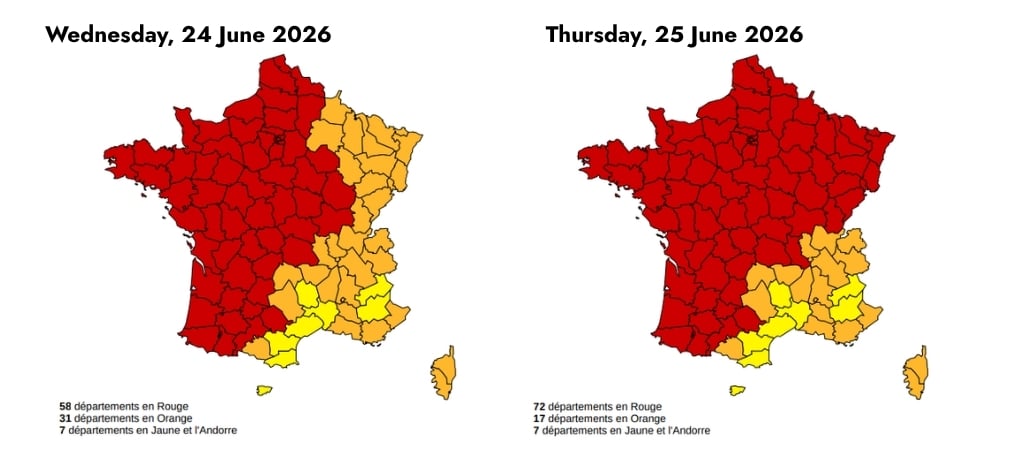
Temperatures climbed as high as 42C in Nantes, a major metropolitan city in western France, as millions of people across the country continue to grapple with one of the most intense and long-lasting heatwaves the country has ever seen. The unprecedented temperatures prompted a record 58 of 96 mainland departments to be placed under red heatwave alerts – the highest warning level – on Wednesday. Conditions are expected to worsen further on Thursday, when a historic 72 departments will be under red alert.
During an emergency crisis meeting with other government officials on Tuesday, Prime Minister Sébastien Lecornu said that since June 18, at least 40 people have drowned while swimming in unsupervised areas such as lakes or canals, noting that “most of the victims are young people.” He called the drownings “a tragic scourge.”
Full story here.
3. Paris Court Rules TotalEnergies Must Disclose Climate Risks Linked to Emissions of Its Products
A French court on Thursday found fossil fuel giant TotalEnergies liable for failing to fulfill its climate vigilance obligations.
The case was brought by a coalition of French local authorities, alongside five local civil society organizations, who challenged TotalEnergies’ continued expansion of oil and gas production – the primary fossil fuels driving climate change alongside coal – despite extensive and indisputable scientific evidence of their impact on global climate.
The claimants argued that TotalEnergies’ strategy is incompatible with its legal duty of vigilance under a 2017 national law, which requires large French companies to identify risks and prevent human rights and environmental abuses resulting from their activities and those of their subsidiaries.

In its Thursday judgement, the Paris Court of Justice recognized that the company has leverage over the emissions generated from the combustion of its oil and gas products – in other words, the emissions generated by consumers. These emissions, better known as Scope 3, account account for 91% of TotalEnergies’ carbon footprint. The company has repeatedly argued that it bears no legal responsibility for Scope 3 emissions, claiming they are entirely attributable to the choices of its customers.
Full story here.
4. Senate Blocks Trump Administration’s Plan to Dismantle Key Ocean Observation Network
The Trump administration has abandoned plans to dimantle a decade-old, deep-ocean observation network that scientists have used to track changes in the ocean and monitor marine heatwaves and coastal flooding.
Dozens of Democratic Senators and one Republican sent letters to the National Science Foundation (NSF) last Monday, urging it to “reverse course” on its dismantling of a decade-old, deep-ocean observation network that scientists have used to track changes in the ocean and monitor marine heatwaves and coastal flooding. On Wednesday, the Senate passed a measure that would block the government from dismantling the system.
The Saving the OOI Act, a two-page bill introduced by the Oregon Democrat Jeff Merkley and Alaska Republican Lisa Murkowski, says no federal funds shall be used to “decommission or descope” the Ocean Observatories Initiative (OOI) system until the NSF conducts a thorough review and assessment of the network with robust stakeholder engagement.
Full story here.
5. None of 17 UN SDGs on Track to Be Achieved By 2030, Report Finds
More than a decade after world nations agreed on a set of goals to guide global sustainable development, progress remains “significantly off track,” according to a new analysis.
Compiled by the Sustainable Development Solutions Network (SDSN) and now in its eleventh edition, the report found that none of the Sustainable Development Goals (SDGs) is on track to be achieved by 2030, with only 16% of targets on course and 16% worsening.
Globally, SDG 11 (Sustainable Cities and Communities), SDG 14 (Life Below Water), SDG 15 (Life on Land) and SDG 16 (Peace, Justice and Strong Institutions) are particularly off track, with major challenges and stagnation in progress since 2015.
Adopted by all UN member states in 2015, the SDGs comprise 17 goals and 169 targets providing a footprint for a global partnership between developed and developing countries to achieve economic prosperity, environmental protections and to safeguard the well-being of people around the world.
Full story here.