

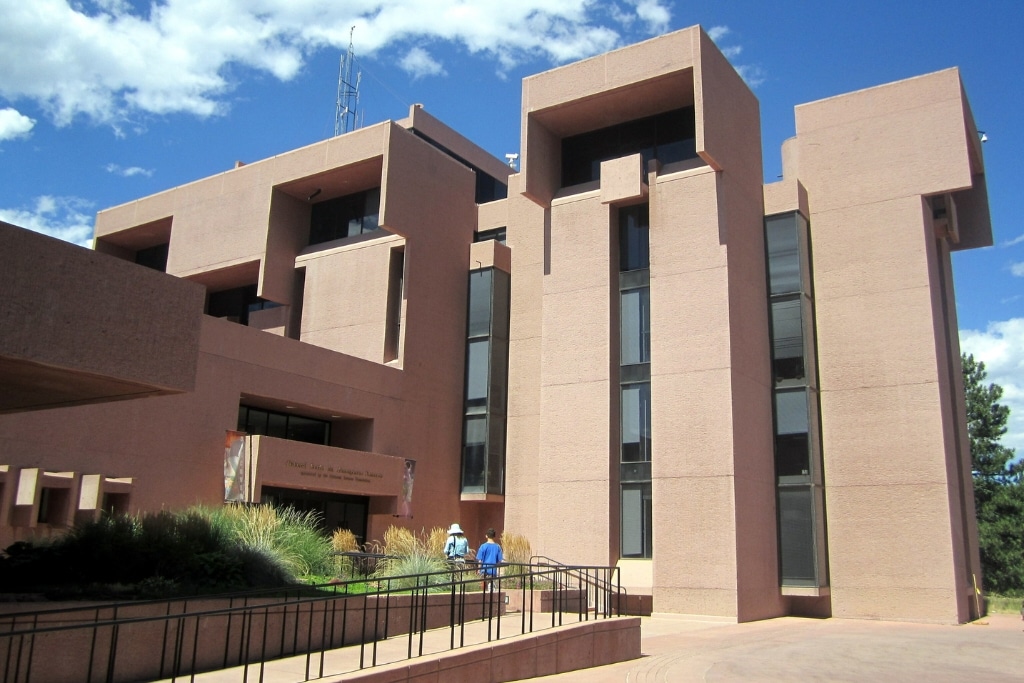
The suit alleges that the Trump administration’s decision to break up a climate research center in Boulder, Colorado, was part of a “widespread and coordinated campaign of punishment and coercion” against the state’s governor, Jared Polis.
—
The Trump administration broke up a key climate research center in Boulder, Colorado as retribution against the state’s governor, a new lawsuit filed on Monday alleges.
The lawsuit, filed by the University Corporation for Atmospheric Research (UCAR), challenges the Trump administration’s decision to shut the National Center for Atmospheric Research (NCAR), which is renowned for advances in the study of weather patterns, including tropical cyclones. UCAR, a non-profit research group made up of colleges and universities that operates the center, alleges that the administration is waging a “widespread and coordinated campaign of punishment and coercion” against Colorado, which started last August over tensions between President Donald Trump and Jared Polis, the state’s Democratic governor.
The administration froze hundreds of millions of dollars in federal funding for the state and vetoed a much needed water pipeline as part of the retaliation campaign. This, the lawsuit alleges, stemmed from the imprisonment of Tina Peters, a former county clerk convicted for breaching voting systems, whom Trump claims is a political prisoner. More recently, Trump has also moved the headquarters of the US Space Command from Colorado Springs to Alabama, falsely claiming that Colorado’s mail-in voting system makes for a “dishonest election”, and has threatened to withhold food stamp benefits from Colorado residents over the state’s refusal to provide personal information about benefit recipients
UCAR is asking the US District Court for the District of Colorado to strike down these actions as illegal and issue an immediate injunction against their implementation to prevent further harm to the center.
The Trump administration announced plans to shut the Colorado-headquartered lab last December, calling it “one of the largest sources of climate alarmism in the country” and a stronghold for left-wing climate activism.
Founded in 1960 and funded by the National Science Foundation, an independent federal agency, the NCAR’s laboratories provide critical data on air quality and tools to improve aircraft safety and wildfire mitigation as well as forecasts of droughts, extreme precipitation events and tropical cyclones. Around 830 people are employed there.

Governor Polis previously said closing the center would put “public safety at risk.”
“NCAR delivers data around severe weather events like fires and floods that help our country save lives and property, and prevent devastation for families. If these cuts move forward we will lose our competitive advantage against foreign powers and adversaries in the pursuit of scientific discovery,” Polis wrote on social media. Tim Raupach, Senior Lecturer at UNSW Sydney, called it a “tragedy” and said “a lot of people are safer” because of it.
Featured image: Wally Gobetz/Flickr.
This story is funded by readers like you
Our non-profit newsroom provides climate coverage free of charge and advertising. Your one-off or monthly donations play a crucial role in supporting our operations, expanding our reach, and maintaining our editorial independence.
About EO | Mission Statement | Impact & Reach | Write for us