


The National Science Foundation announced last month that the recovery of over 900 in-water instruments in the Atlantic and Pacific oceans has already begun. Scientists used them to monitor and understand marine heatwaves and coastal flooding, assess ocean acidification, measure carbon sequestration and study deep-ocean ecosystems.
—
Dozens of Democratic Senators and one Republican sent letters to the National Science Foundation (NSF) on Monday, urging it to “reverse course” on its dismantling of a decade-old, deep-ocean observation network that scientists have used to track changes in the ocean and monitor marine heatwaves and coastal flooding.
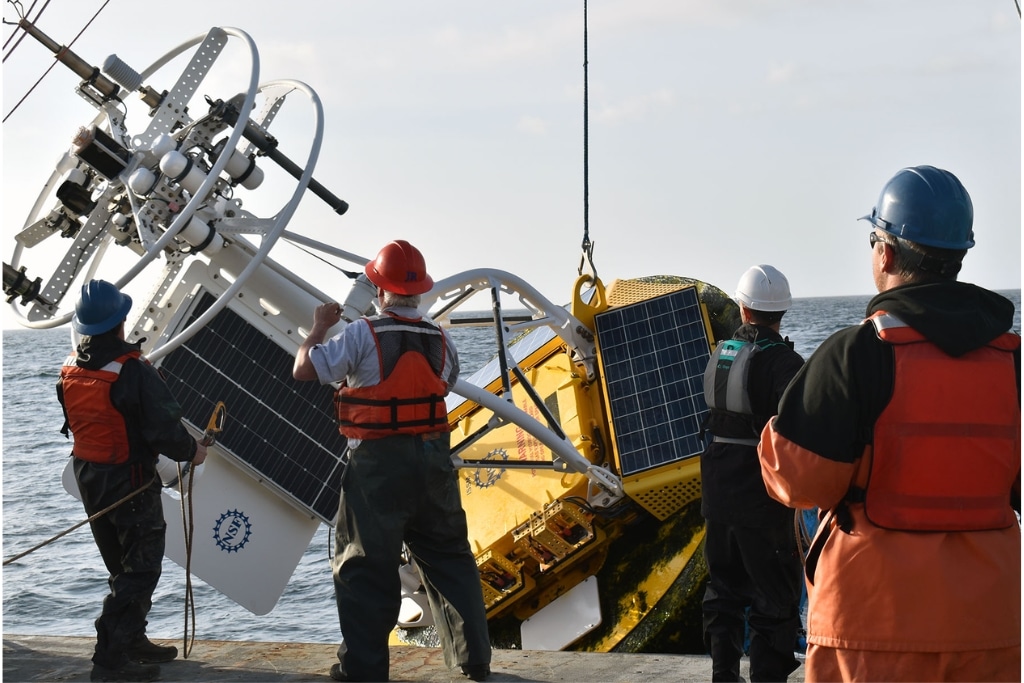
On May 21, the Ocean Observatories Initiative (OOI) announced that the recovery of over 900 in-water instruments at four of five operating arrays – the Irminger Sea, Station Papa, Endurance and Pioneer Arrays – has already begun and will take approximately 15 months.

Funded by the NSF, the network was designed to collect physical, chemical, geological, and biological ocean data for up to 30 years. Scientists used the data collected by more than 900 instruments at five arrays in the Pacific and Atlantic Oceans to monitor and understand marine heatwaves and coastal flooding, assess ocean acidification, measure carbon sequestration and study deep-ocean ecosystems.
The data also helped monitor changes in the Atlantic Meridional Overturning Circulation, better known as AMOC, a key component in global climate regulation. Scientists have repeatedly warned that the AMOC is nearing a tipping point as the planet heats up. Without this constant flow of current circulation, regional temperatures would become more extreme – intense heat near the equator and freezing in the poles – making less land on Earth habitable.
In a strongly-worded letter addressed to NSF’s Acting Director Brian Stone, Democrats from the House Science, Space and Technology Committee and the House Natural Resources Committee, led by Reps. Zoe Lofgren and Jared Huffman of California, criticized the agency for bowing to the Trump administration and “[tearing] itself apart at his whim.”
“This is a startling use of resources in a resource-strapped time for the agency,” the senators wrote, referring to the recent budget cuts to the agency. The Trump administration’s proposed 2026 budget includes a 55% reduction to the NSF budget, from $9 billion to $4 billion, as well as the cancelation of $1.5 billion in active research grants.
“We demand that you cease this expensive, destructive, and – crucially – illegal action at once,” they wrote, arguing that no formal notification of the deconstruction had been transmitted to the House and Senate Appropriations Committees, despite the law clearly requiring the NSF to do so when projects valued at $2.5 million or more are transferred, decommissioned, or terminated. “I need not remind you that report language is not optional. You must cease this illegal decommissioning of the OOI immediately,” the letter read.
Senators went on to describe the move as “pathetic” and one that will make the US more dependent on China. “As the United States retreats from continuous ocean monitoring to provide fodder for internecine political squabbles, China advances. If this Administration has its way, then the United States – as well as international partners who relied on OOI data – will be dependent on China for ocean data,” they said.
Also on Monday, 10 Democratic senators and one Republican sent a separate letter to Stone, urging him to “reverse course” in order to “prioritize public safety.”
“This summer, the world is bracing for a severe El Niño event, a weather pattern known to disrupt regional climates, exacerbate drought and heavy rainfall, and increase heatwaves both on land and in the ocean,” they wrote. “The loss of this deep-water observation system would threaten our ability to prepare for and monitor future El Niño events, leaving public safety officials, natural disaster responders, coastal communities, and industries without the vital information they need to safely participate in a wide range of maritime activities.”
In announcing the move last month, the network encouraged scientists, researchers and educators to continue using its datasets in proposals, publications, and presentations. “Continued engagement demonstrates the scientific impact and wide-ranging applications enabled by the OOI and its data, underscoring its importance as a resource for the oceanographic community,” it said.
In a statement issued a day later, Jim Edson, the initiative’s Principal Investigator, thanked those involved in making the project possible. “Over more than a decade, OOI has delivered the world’s most advanced continuously operating ocean observing systems, supporting science, engineering, education, and workforce development across the ocean sciences community. We are profoundly grateful for the extraordinary efforts of the scientists, engineers, operators, educators, students, and partners who made this facility possible and who continue to advance its legacy through the use of its data,” Edson said.
Featured image: Ocean Observatories Initiative.

This story is funded by readers like you
Our non-profit newsroom provides climate coverage free of charge and advertising. Your one-off or monthly donations play a crucial role in supporting our operations, expanding our reach, and maintaining our editorial independence.
About EO | Mission Statement | Impact & Reach | Write for us