


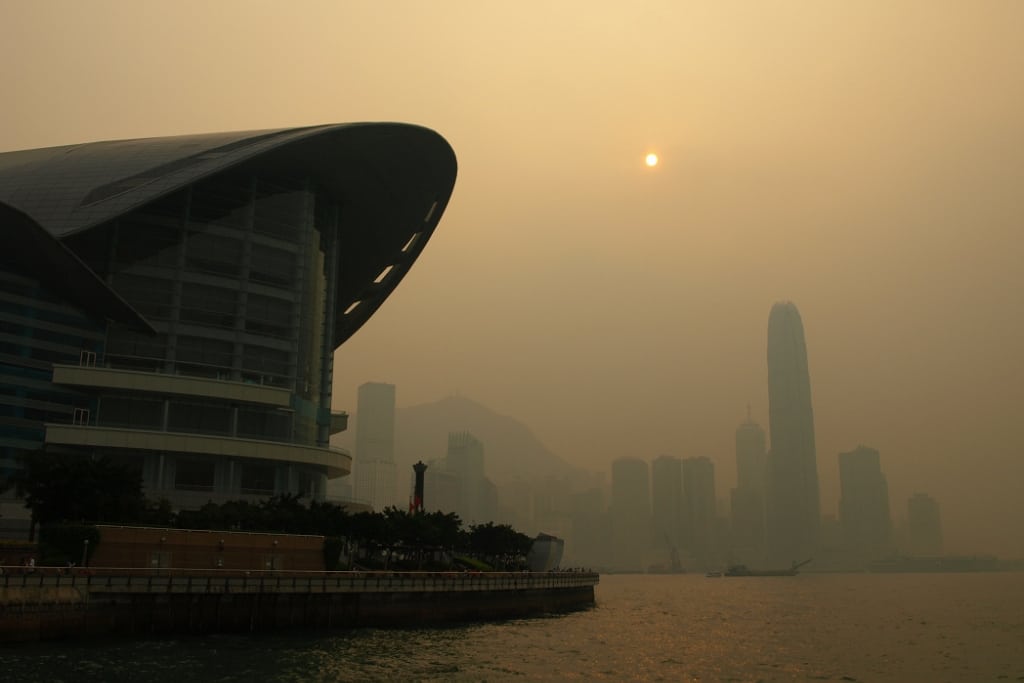
Tackling ozone pollution in Hong Kong requires strengthening controls on volatile organic compounds (VOCs) and regional collaboration.
—
There are two types of ozone (O3) in the atmosphere: stratospheric ozone and tropospheric ozone. While stratospheric ozone exists naturally in the upper atmosphere and protects Earth’s life from the sun’s harmful ultraviolet radiation, tropospheric ozone is a secondary pollutant formed by photochemical reactions between nitrogen oxides (NOx) and volatile organic compounds (VOCs) in the presence of sunlight at ground level.
This ground-level ozone pollution has become a rising concern in Hong Kong. Currently, tropospheric ozone is one of the seven major air pollutants regulated under the Air Pollution Control Ordinance and the Air Quality Objectives, which establish legally binding concentration limits and the number of allowed exceedances.
According to the 2023 Hong Kong Emission Inventory Report, the emission sources of ozone precursors are diversified. The majority of NOx emissions came from combustion processes, such as navigation, electricity generation, and road transport. In contrast, most VOC emissions stemmed from non-combustion sources, including paints, consumer products, adhesives, and sealants.
Why Should We Care?
The tropospheric ozone, a powerful oxidant, can cause adverse effects on human health. Acute exposure may trigger respiratory symptoms such as coughing, throat irritation, and chest pain, while long-term exposure can lead to increased mortality risk from health issues like cardiovascular and ischemic heart diseases.
Ozone can also damage vegetation. When it enters plants, it can reduce photosynthesis rates and slow plant growth. As a result, plants become more vulnerable to diseases, pests, and extreme weather, increasing the risk of death.
More on the topic: How Ozone Pollution Is Destroying Plants
In addition to being an air pollutant, tropospheric ozone is a greenhouse gas that traps heat in the atmosphere, contributing to global warming. A long-term shift in temperature and weather patterns results in climate change.
Trends and Patterns
General Trends
Ozone concentrations in Hong Kong have shown an increasing trend since the early 1990s. In 2024, the concentration slightly dropped to 54.6 micrograms per cubic meter (µg/m3) after reaching a historical high of 61 µg/m3 in 2023. However, concentrations remain dangerously high.
Under Hong Kong’s Air Quality Objectives, the daily maximum eight-hour average concentration must not exceed 160 µg/m3 more than nine times per year. In the past five years, all three roadside monitoring stations have complied with this standard. However, multiple general monitoring stations fail to achieve this each year, according to air quality reports.
| Number of general monitoring stations failing to achieve the standard (out of 15) | Number of roadside monitoring stations failing to achieve the standard (out of 3) | |
| 2020 | 5 | 0 |
| 2021 | 5 | 0 |
| 2022 | 12 | 0 |
| 2023 | 3 | 0 |
| 2024 | 8 | 0 |
Diurnal Patterns
Each day, ozone concentration rises in the morning, peaks in the afternoon, and declines in the evening, showing a diurnal pattern.
Around 6 a.m., transportation and industrial activities start to increase, leading to a sharp rise in NOx emissions, especially during the morning rush. At the same time, the sun begins to rise, providing the ultraviolet radiation needed for driving the photochemical reactions. As a result, the ozone concentration starts increasing in the morning.
The concentrations peak around 2 pm and 3 pm, driven by rapid photochemical reactions under abundant sunlight and elevated levels of NOx and VOCs.
In the evening, the sun begins to set, shutting down photochemical reactions. Therefore, the ozone level decreases rapidly, despite increased NOx emissions during the evening rush.
Seasonal Patterns
Ozone levels in Hong Kong also show a seasonal pattern, with the highest concentrations in autumn and the lowest in summer.
Summer weather conditions do not favor ozone formation. Indeed, frequent rainfall helps wash it out, and the south-westerly monsoon brings cleaner oceanic air to Hong Kong. Therefore, the highest concentration occurs in autumn, when solar radiation is still strong, rainfall is less frequent, and the wind direction changes.
Control Policies
The government has been promoting green transport and clean energy to reduce NOx emissions. Interventions included phasing out aged commercial diesel vehicles, promoting electric and hydrogen-powered vehicles, tightening emission caps for power plants, and targeting the replacement of existing coal-fired generating units with natural gas-fired units and renewable energy sources in the 2030s, according to Hong Kong’s Climate Action Plan 2050 and the Clean Air Plan.
The government has also been regulating VOC-containing products under the Air Pollution Control (Volatile Organic Compounds) Regulation since 2007. The regulation sets limits on the VOC content of 172 types of products, including architectural paints, vehicle refinishing paints, and printing inks. No person is allowed to import or manufacture the regulated product in Hong Kong if it exceeds the legal limit.

Hong Kong is also working with the neighboring Guangdong government in mainland China to improve regional air quality. In 2014, the Guangdong-Hong Kong-Macao PRD Regional Air Quality Monitoring Network was established to provide real-time air quality data to governments for identifying pollution problems in the Pearl River Delta (PRD) and formulating appropriate control strategies.
A Complex Problem
The above government’s control policies effectively reduced both NOx and VOC emissions. Unfortunately, the same trend is not observed in ozone levels.
“Ozone is a complicated air pollution issue as well as a regional issue,” an Environmental Protection Department spokesman said in 2020.
Non-Linear Dependency
The relationships between ozone and its precursors (NOx and VOCs) are nonlinear.
Research has shown that Hong Kong has consistently been a primarily VOC-limited region for the past two decades. This means that reducing VOC emissions lowers ozone concentrations, whereas reducing NOx emissions increases them. Therefore, researchers recommended that Hong Kong should implement stricter VOC control strategies to counteract the effects of NOx reduction measures in the Greater Bay Area.
“In terms of the VOCs control strategies, synchronous reduction of carbonyl compounds and reactive aromatics will be the most effective way to mitigate O3 pollution in Hong Kong,” the research proposed.
Regional Transport
Among the 15 general monitoring stations, Tap Mun station has consistently recorded the most severe pollution. In 2024, the station had an annual average concentration of 76.8 µg/m3 and failed to meet the Air Quality Objective by 34 times.
“Tap Mun station, which is away from urban emission sources, had the highest ozone concentration among the stations, reflecting that ozone pollution was mainly a regional problem,” according to local green group Clean Air Network.
Research has shown that a significant fraction of ozone in Hong Kong is attributable to regional transport. Researchers evaluated the contributions of locally produced and regionally transported ozone from 2011 to 2022. During this period, the average daily maximum 8-hour ozone concentration in Hong Kong was 69.1 ppb, of which 71% was from regional transport, and 29% was from local production.
What’s more, the same research also found an unusual nighttime ozone rise in Hong Kong. Researchers analyzed nighttime ozone concentrations from 2011 to 2022 and found that concentrations in new towns and urban areas increased from 1 am to 4 am in the absence of photochemical reactions. After conducting air rose analyses, they found that the phenomenon is caused by the regional transport of ozone-rich air masses by easterly and northeasterly winds.
“Further pollution control collaborations between Hong Kong and the adjacent PRD region are necessary to address the O3 pollution in the Greater Bay Area,” the researchers suggested.
Featured image: Wikimedia Commons.
This story is funded by readers like you
Our non-profit newsroom provides climate coverage free of charge and advertising. Your one-off or monthly donations play a crucial role in supporting our operations, expanding our reach, and maintaining our editorial independence.
About EO | Mission Statement | Impact & Reach | Write for us