

Conventional food security metrics focus on market availability and import stability, often masking the structural inequalities and loss of local autonomy currently destabilizing the Middle East and North Africa (MENA) region. Shifting the focus to food sovereignty would allow policymakers to address the systemic marginalization of smallholder farmers and reclaim control over land, water, and seeds from corporate and authoritarian interests.
—
Food sovereignty – the right of communities to control their own agricultural, food, and land policies – has emerged as a critical framework in the Middle East and North Africa (MENA) region. Unlike food security, which focuses primarily on whether people have enough food, sovereignty emphasizes who controls food systems, how food is produced, and whether local communities can maintain traditional practices and ecologically adapted crops.
Food sovereignty situates food as a global human right that ensures localized control over access to food as an issue linking economic, social, cultural, political, and environmental rights. Food security reinforces crisis narratives and foregrounds shortage of agriculture production as the main triggers of food insecurity, compounded by population growth and climate risks. This frame corresponds to a corporate and neoliberal food regime, where food insecurity can be addressed through market-driven and technological development to increase food production.
While food security metrics such as the Global Food Security Index emphasize access, affordability, and availability of food, they rely heavily on stable imports and functioning global markets. As a result, these indices provide limited insight into the structural and systemic drivers of food insecurity as they fail to capture how conflicts, displacement or climate related disruptions affect access to food. Further, they obscure how food systems are shaped by external factors such as trade tariffs, agricultural specialization, and power imbalances, particularly in contexts of protracted conflict and authoritarian governance.
Depoliticizing Hunger: Food Governance in the MENA Region
Framing hunger primarily as a problem of supply and market access depoliticizes food insecurity and sidelines questions of sovereignty, local production, and collective rights over “democratized” food systems. Policies that emphasize import dependence or global market integration can fulfill food security goals in the short term but undermine agriculture biodiversity, long-term resilience, and economic autonomy. This is where food sovereignty offers a critical alternative lens, foregrounding rights-based approaches, resilience, and justice in the organization of food regimes rather than treating food merely as a tradable commodity.
This article explores case studies of the limitations of food security frameworks in the MENA region, which remains one of the world’s most import-dependent regions for staple foods and is home to over 12% of the undernourished global population, despite being home to just about 6% of the world’s population.
Lebanon: Seed Laws, Intellectual Property, and Farmers’ Rights
In Lebanon, legal and governance frameworks surrounding land, seeds, and agricultural labor systematically disadvantage small-scale farmers while privileging large landowners and commercial agribusiness, undermining the foundations of food sovereignty despite persistent food insecurity.
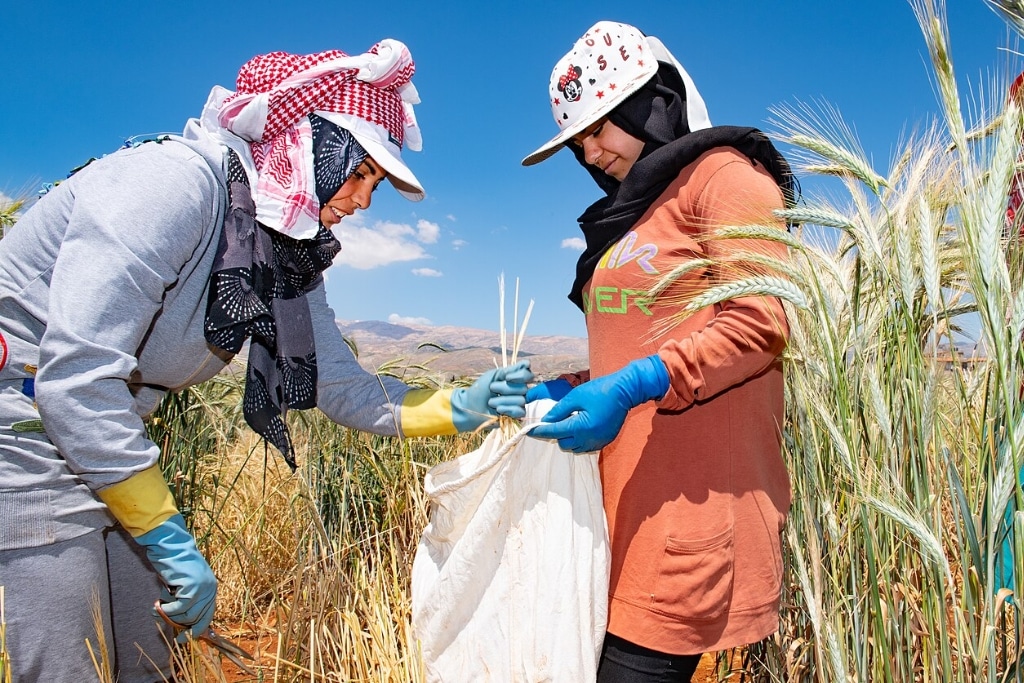
Lebanon’s land regulation and ownership patterns reflect deep inequality: the top 10% of landowners control around two-thirds of agricultural land, while small farms remain fragmented and under-capitalized, and many agricultural workers – including seasonal and Syrian laborers – are landless. Inheritance laws contribute to ongoing fragmentation of land, which limits economies of scale and reinforces elite control.
At the same time, regulatory frameworks governing seed production and trade rely on industrial standards that are ill-suited to local and traditional seed varieties, marginalizing farmer-managed seed systems and reinforcing dependence on commercial seed suppliers. A proposed Lebanese law to regulate the trade of seeds and seedlings has drawn criticism precisely because its compliance criteria (such as Distinctness, Uniformity, and Stability – or DUS standards) are tailored to industrial and hybrid seeds, not to the diverse local varieties that small farmers have traditionally used. The National Human Rights Commission in Lebanon warns that the draft law privileges commercial breeders through registration and certification requirements while stripping farmers of the right to produce food using local resources, directly undermining Lebanon’s obligations to food security rooted in agricultural biodiversity rather than import dependence.
The proposed law aligns with the International Union for the Protection of New Varieties of Plants (UPOV), a framework that grants commercial breeders exclusive rights over new plant varieties.
While the language of “protection” and “union” may seem neutral, it effectively allows corporations to claim ownership over plant varieties that have existed for centuries, undermining farmers’ traditional rights. Together, these legal and institutional arrangements concentrate control over land, inputs, and markets in the hands of powerful economic actors, while small farmers remain vulnerable and politically marginalized. Yet such structural inequalities are largely invisible in food security assessments that prioritize market access, food availability, and price stability rather than rights to land, seeds, labor protections, and democratic participation in food governance.
Egypt: Land Reclamation, Water Politics, and Smallholder Farmers
Egypt’s recent agricultural development trajectory has prioritized capital-intensive land expansion and large-scale production systems, with ongoing plans to cultivate up to 4.5 million feddans by 2027 across desert and new delta areas. Media reports indicate that up to 800,000 feddans (1 feddan = 1.038 acres) had already been reclaimed by 2024.
Although these initiatives aim to boost output and support national food security, they often shift land and resources toward large-scale, commercially viable crops, reinforcing patterns of land concentration and inequality. In practice, vast areas of reclaimed land have been allocated to large agribusiness enterprises and investment-led agricultural projects, including domestic and regional companies operating in sugar, fodder, grain, and export-oriented production. Such projects typically require substantial upfront capital, access to deep groundwater, mechanized irrigation systems, and large-scale infrastructure. Such conditions are more easily met by large operators than by smallholders, whose participation is constrained by limited financial capacity and restricted access to irrigation and mechanization.
Alongside these large-scale development trajectories, farmers in older agricultural areas of the Nile Valley and Delta experience rising land rents, market liberalization, and reductions in subsidies. For example, state-owned and waqf (endowment) land is increasingly rented at market rates that have become economically burdensome. In this regard, waqf land rents reportedly rose from around 400 Egyptian pounds (EGP) per feddan in 2014 to about 13,000 EGP per feddan in 2024. The Endowments Authority has proposed a further increase to 45,000 per feddan for the 2025/26 agricultural season. Such increases far outpace smallholder crop returns and challenge the viability of food crop cultivation.
In addition to land allocation dynamics and land pricing policies, smallholder farmers in Egypt face growing constraints due to water scarcity and limited irrigation infrastructure. These pressures are likely to increase as large desert reclamation projects, such as Egypt’s New Delta initiative, rely on engineered water infrastructure. This includes canal systems that divert Nile water to the Western Desert and drainage treatment plants that reroute reuse water to irrigate millions of feddan of land.
By channeling substantial water resources toward these large-scale projects, smallholder farmers who depend on traditional fresh and drainage water sources may face reduced availability, reinforcing structural inequities in water access. Although these initiatives contribute to national food production targets, such structural disparities in land and water access are not fully captured in conventional food security assessments. In the long term, such dynamics may constrain local autonomy, crop diversity, and the long-term resilience of rural food systems.
Morocco: Export-oriented policies, water scarcity and the limits of Agriculture Modernization
In Morocco, national agricultural strategies such as the Green Morocco Plan (2008–2020) and its successor Generation Green (2020–2030) have driven agricultural modernization, expanded irrigation infrastructure, and increased export-oriented production of high-value crops, particularly fruits and vegetables for European markets. While these achievements are often presented as indicators of improved food security and economic growth, a growing body of research and civil society observants indicate that such initiatives exemplify a form of technopolitics.
Under this paradigm, the state seeks to make agriculture, land, and farmers more “legible” and controllable through technical and economic measures. Here, agriculture modernization is evaluated through measurable outputs – such as yields, profits, and project completion – over the multifunctional, socio-ecological roles of smallholder farmers. A central criticism is the unequal distribution of public investment and policy benefits as large landowners and better resources agro-export enterprises are positioned to access state subsidies, drip-irrigation programs, export certification schemes and aggregation platforms, while individual smallholder farmers face financial and administrative barriers to participation.
Studies indicate that over the past decade, following the rollout of the Green Morocco Plan, less than 20% of cultivable land consumes nearly 90% of Morocco’s water, mostly for high-value crops – well above the global average of 70%. At the same time, more than 80% of small farming plots have limited access to water, infrastructure irrigation and technical resources.
Crucially, these asymmetries in policy support and market integration are mirrored in deeply unequal patterns of water access, revealing how agrarian modernization is sustained through the concentration of irrigation infrastructure and water use in the hands of agriculture elites and export-oriented farming companies. A survey conducted by the Moroccan Center for Citizenship found that 93.9% of respondents perceive large-scale farmers as the main beneficiaries of the Green Morocco Plan, while 83% reported limited improvements in food security, and over 94% associated rising food prices with export-oriented agricultural policies.
These dynamics are further illustrated by crop reconversion programs under the Green Morocco Plan, which promoted the shift from cereal farming toward high-value arboriculture, particularly olive cultivation. Although formally introduced as participatory initiatives aimed at integrating smallholders into international value chains, implementation has largely followed a top-down, technocratic logic. Small-scale farmers are often positioned as passive recipients of technical packages and not economic actors in their own right. Meanwhile, project success is assessed through standardized indicators such as hectares replanted, trees distributed, or investment mobilized, rather than through impacts on household food security, crop diversity, or livelihood resilience. Many smallholders therefore continued cereal cultivation alongside new tree crops, reflecting agriculture’s multifunctional role in food security, income, and risk management, and exposing the limits of modernization strategies centered on commercial efficiency and export growth.
Reclaiming Food Sovereignty in the MENA Region
The experiences of Lebanon, Egypt, and Morocco illustrate that food security metrics alone often obscure the structural inequities embedded within MENA’s food systems. While policies centered on imports, export-oriented modernization, and large-scale land reclamation may enhance short-term food availability, they frequently concentrate access to land, water, and seeds in the hands of a few, marginalizing smallholders and eroding local autonomy.
Food sovereignty reframes this challenge by placing communities at the center of decision-making and linking food systems to rights, resilience, and justice rather than reducing food to a question of market availability. From this perspective, policymakers in the MENA region must ask a fundamentally different set of questions than those posed under the conventional food security paradigm: Are people fed?“, “Who decides how and where food is produced?” and “Does the food system respect local cultures, ecological knowledge, and collective rights?”
As climate change accelerates, water scarcity deepens, and global food markets remain volatile, the stakes for MENA are higher than ever.
Future food policies must prioritize the empowerment of smallholders, the protection of farmer-managed seed systems, and equitable access to land and water resources, while integrating social, ecological, and cultural considerations into agricultural planning. Legal frameworks should balance intellectual property regimes with farmers’ rights, and agricultural modernization strategies should evaluate success not only through yields or export revenues, but through improvements in household food security, crop diversity, and rural livelihoods.
Under these conditions, agriculture can become a pathway to autonomy instead of a mechanism of dependency, which otherwise traps farmers and food-importing countries in cycles of export specialization, debt, and vulnerability to global market volatility. Ultimately, the future of food in the region depends not only on what is grown, but on who holds the power to decide how it is grown – and whether local voices shape the food system as much as global markets do.
This story is funded by readers like you
Our non-profit newsroom provides climate coverage free of charge and advertising. Your one-off or monthly donations play a crucial role in supporting our operations, expanding our reach, and maintaining our editorial independence.
About EO | Mission Statement | Impact & Reach | Write for us