

Researchers looked at data from 2017, the most recent year for which a dataset of emissions is available. Between then and 2023, US oil and gas production has increased by 40% and consumption by 8%.
—
Tens of thousands of premature deaths in the US are linked to air pollution from the oil and gas industries, according to a new study that looked at the entire lifecycle of the two fuels.
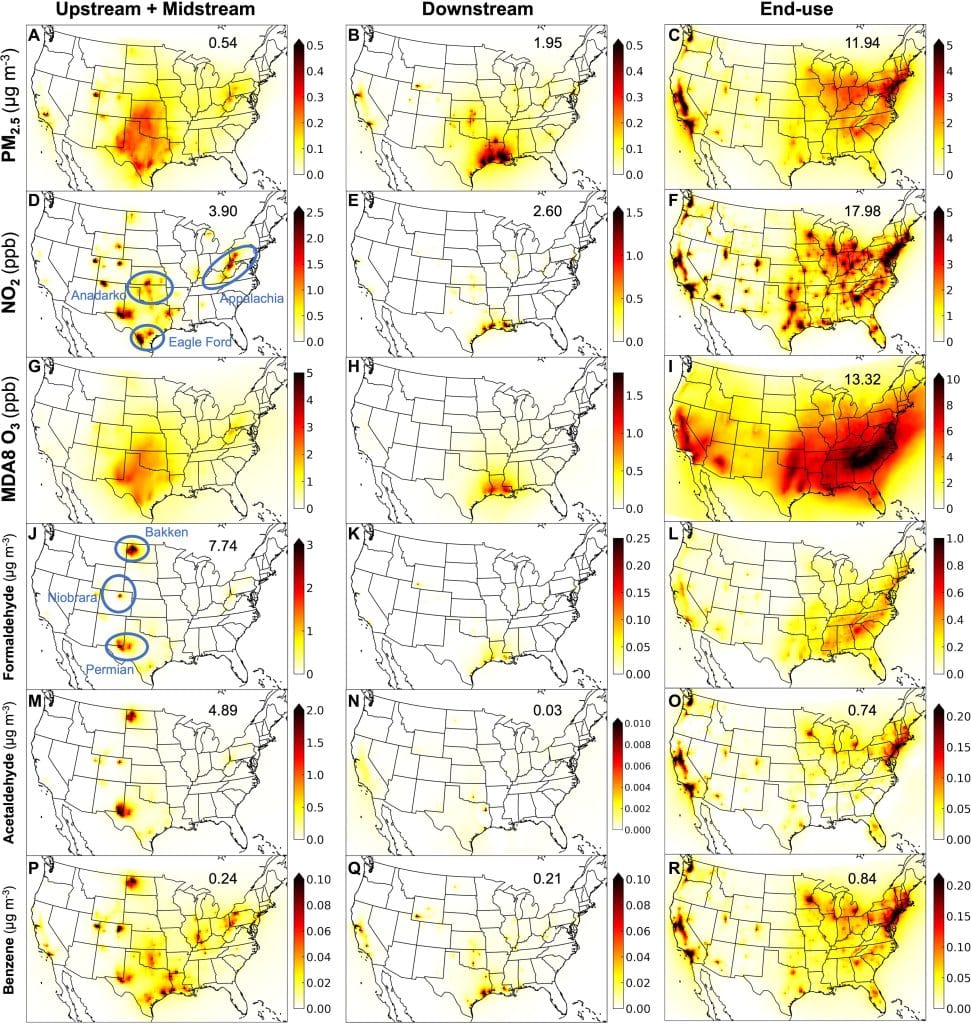
Published Friday in Science Advances, the paper found that fine particles (PM2.5), nitrogen dioxide, ozone and other hazardous air pollutants are attributable to 91,000 premature deaths, 10,350 preterm births and 216,000 childhood-onset asthma and 1,610 cancer cases every year in the country. The US is the world’s largest producer of both oil and natural gas. Together with coal, the three fossil fuels are the single-largest source of global greenhouse gas emissions, the primary drivers of global warming.
The study is the first to look at the health hazards arising from pollution generated across all stages of the oil and gas lifecycle, from exploration and extraction; storage and transmission; alterations processes like oil refining and gas processing, to end-use activities, including storage, transportation and ultimate consumption.
Researchers looked at data from 2017, the most recent year for which a dataset of emissions is available. Between then and 2023, US oil and gas production has increased by 40% and consumption by 8%, according to the Guardian.
Communities of Color Bear the Brunt
California, Texas, New York, Pennsylvania and New Jersey recorded the highest health burden from air pollution from oil and gas. But the impacts were not felt equally across these states.
Asian, Black, Hispanic, and Native American communities experience the worst exposures and burdens for all lifecycle stages and pollutants. The latter two groups are hotspots for pollution from exploration, extraction, transportation and storage. Meanwhile, Asian and Black population – particularly in infamous hotspots like Louisiana’s “Cancer Alley” and eastern Texas – bear the brunt of emissions from alteration processes, manufacturing, distribution and consumption.
The findings reinforce previous studies that pointed at the disproportionate impact of pollutants on minorities and disadvantaged communities. In 2019, for example, scientists estimated that Hispanics and African-Americans in the US breathe in 63% and 56% more health-harming pollution than they respectively produce. On the other hand, Caucasian communities are exposed to 17% less air pollution than they make.
Global Crisis
Globally, air pollution ranks as the second leading risk factor for death, after high blood pressure and before tobacco.
Last year, only seven countries in the world – Australia, Estonia, New Zealand, Iceland, Grenada, Puerto Rico, and French Polynesia – had air quality levels at or below the healthy annual average recommended by the World Health Organization (WHO). The UN agency estimates that at least nine out of 10 people worldwide live in places with low air quality.
Globally, PM2.5 is associated with approximately 7 million deaths around the world every year and causes the average person to lose approximately 2.3 years of life expectancy – or a combined 17.8 billion years.
PM2.5, the most commonly used unit in air quality measurements, refers to an atmospheric particulate matter that has a diameter of less than 2.5 micrometers, or about 3% the diameter of a human hair, and is said to pose the greatest risk to human health. Studies have linked it to premature mortality, heart or lung diseases, acute and chronic bronchitis, asthma attacks, and other respiratory symptoms.
| Pollutant | 2021 AQGs |
| Fine particulate matter, µg/m3 | Annual: 5 24-hour: 15 |
| Ozone, µg/m3 | 8-hour: 100 |
| Nitrogen dioxide, µg/m3 | Annual: 25 24-hour: 40 |
WHO issued new, more stringent guidelines on air pollution in September 2021, following new research showing PM2.5 to be more harmful than previously thought. It set the 24-hour PM2.5 safe limit at 15 μg/m3 and the annual threshold at 5 μg/m3.
Featured image: Wikimedia Commons.
You might also like: How Air Pollution Affects Stress, Anxiety and Depression in Vulnerable Populations
This story is funded by readers like you
Our non-profit newsroom provides climate coverage free of charge and advertising. Your one-off or monthly donations play a crucial role in supporting our operations, expanding our reach, and maintaining our editorial independence.
About EO | Mission Statement | Impact & Reach | Write for us