

Ocean accounts help integrate fragmented data about the ocean’s environment, economy and society to inform policy and support sustainable oceans. Earth.Org explores recent developments in this space.
—
2025 is pivotal for ocean action, marked by international milestones and increased focus on a sustainable blue economy.
The UN Ocean Conference, which concluded last month with the Nice Ocean Action Plan, aims to accelerate action to conserve and sustainably use the oceans, seas, and marine resources in support of SDG 14 – Life Below Water. It underscored the urgent need for robust data and integrated knowledge to achieve ocean-related goals.
In this context, ocean accounts emerge as a critical enabler, providing the comprehensive framework necessary to measure progress, assess marine health, and inform sustainable policy.
What Are Ocean Accounts?
Ocean accounts are comprehensive frameworks that organize data on ocean environment assets (like mangroves), economic activities (like fisheries sales), and social conditions (including coastal employment).
The accounts have been inspired by existing international frameworks for national accounting, such as the System of National Accounts (SNA) and the System of Environmental-Economic Accounting (SEEA). These frameworks are used by countries to track economic activity and environmental assets, but until recently, there was no standardized way to apply them specifically to the ocean.

Integrating ocean accounts into a country’s existing national accounts is essential to move beyond traditional metrics of measuring economic progress such as the Gross Domestic Product – or GDP. Traditional economic metrics do not provide a comprehensive view of environmental health and the impact on local communities, especially in relation to the ocean economy.
By combining data from various sources, ocean accounts will allow governments to develop and implement more effective policies for marine spatial planning, ecosystem management, and resource allocation.
The Framework
The ocean accounts framework organizes and integrates information for the following components:
- Ocean assets (natural capital): Information about the physical state, condition, and value of marine and coastal resources such as fish, coral reefs, mangroves, minerals, and water.
- Flows to the economy (ocean services): Record of what the ocean provides to people and the economy, like fish, energy, recreation, and other goods and services. This includes how much is taken from the ocean and its value.
- Flows to the environment (impacts/residuals): What is released into the ocean from human activities, such as pollution, waste, and emissions as well as the impacts of these on ocean health.
- Ocean economy: The economic activities linked to the ocean, such as fisheries, tourism, shipping, and related jobs and income.
- Ecosystem accounts: The extent, health, and services of different ocean ecosystems, such as coral reefs, mangroves, seagrass, including their biodiversity and the benefits they provide to people.
- Social and governance factors: Data on people who benefit from or depend on the ocean, as well as information about how the ocean is managed, governed, and protected.
These components are designed to be compatible with international standards, allowing countries to compare and combine data to support better decision-making for sustainable ocean use.
Implementation
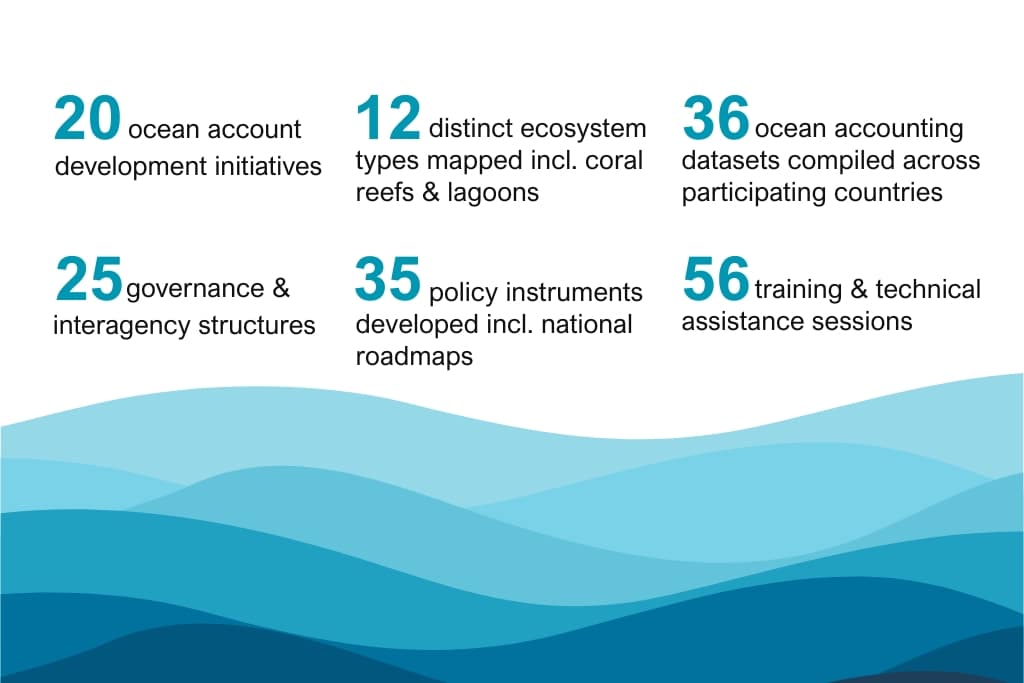
The Global Ocean Accounts Partnership (GOAP), launched in 2019 by the United Nations Economic and Social Commission for Asia and the Pacific (UNESCAP) and partners, is a collaborative initiative to coordinate international efforts, develop guidance, and support countries in implementing ocean accounts. The Technical Guidance on Ocean Accounting for Sustainable Development developed under GOAP’s leadership sets the foundation and provides a structured approach for countries and organizations to produce consistent, comparable, and integrated data on the ocean.
Approximately 50 countries worldwide are undertaking some form of ocean accounting, according to GOAP’s progress report for 2025. Countries that have published or are actively developing ocean accounts span continents and include a mix of developed and developing nations with varying levels of ocean accounting maturity.
Nations like Australia, Canada and Norway have advanced ocean accounting and ongoing blue economy initiatives, while many countries in Asia-Pacific, Africa, and Latin America, such as Indonesia, Maldives, Costa Rica and Kenya, are actively piloting. India and other nations are also part of a growing group transitioning from ocean accounting concepts to formal frameworks and implementation, supported by GOAP and international collaboration.
The Way Forward
While technical guidance exists, evaluating the physical or economic value of often intangible cultural ecosystem services is a complex task.
Diverse groups, cultures, and societies often attribute varying levels of significance and value to ocean systems and the ecosystem services they provide. This can lead to either overvaluation or undervaluation of these resources. However, when consistent valuation criteria are applied, assessing and comparing the importance of these services becomes meaningful.
Many countries, especially developing and low-resource nations, face challenges in technical capacity, institutional readiness, and funding to develop and maintain ocean accounts. This includes shortages of skilled personnel, data infrastructure, and financial support. Variability in data quality and accessibility also complicates compilation.
Expanding collaboration among governments, international organizations, academia, and the private sector helps mobilize resources, align efforts, and promote ocean accounting as a global priority. Linking ocean accounts to national priorities such as marine spatial planning, blue economy strategies, climate commitments, and SDG reporting enhances relevance and political buy-in.
The global dialogue around sustainable blue economies reflects increasing recognition of ocean accounts as essential tools for sustainable ocean governance worldwide. With collaboration and coordinated efforts, policymakers, scientists and stakeholders can ensure that the ocean continues to sustain livelihoods and biodiversity for generations to come.
This story is funded by readers like you
Our non-profit newsroom provides climate coverage free of charge and advertising. Your one-off or monthly donations play a crucial role in supporting our operations, expanding our reach, and maintaining our editorial independence.
About EO | Mission Statement | Impact & Reach | Write for us