


Last month was the third-warmest September on record globally, with temperatures only 0.07C cooler than the second-warmest September on record, in 2024. “Much above-average” sea surface temperatures were also recorded in many parts of the world.
—
Global temperatures last month remained high across much of the world, proof of the “continuing influence of greenhouse gas accumulation in the atmosphere,” according to a monthly bulletin by the Copernicus Climate Change Service (C3S).
The global average surface air temperature for September was 16.11C, the third-highest on record for the month. Only September 2023 and 2024 were warmer – 0.27C and 0.07C warmer, respectively.
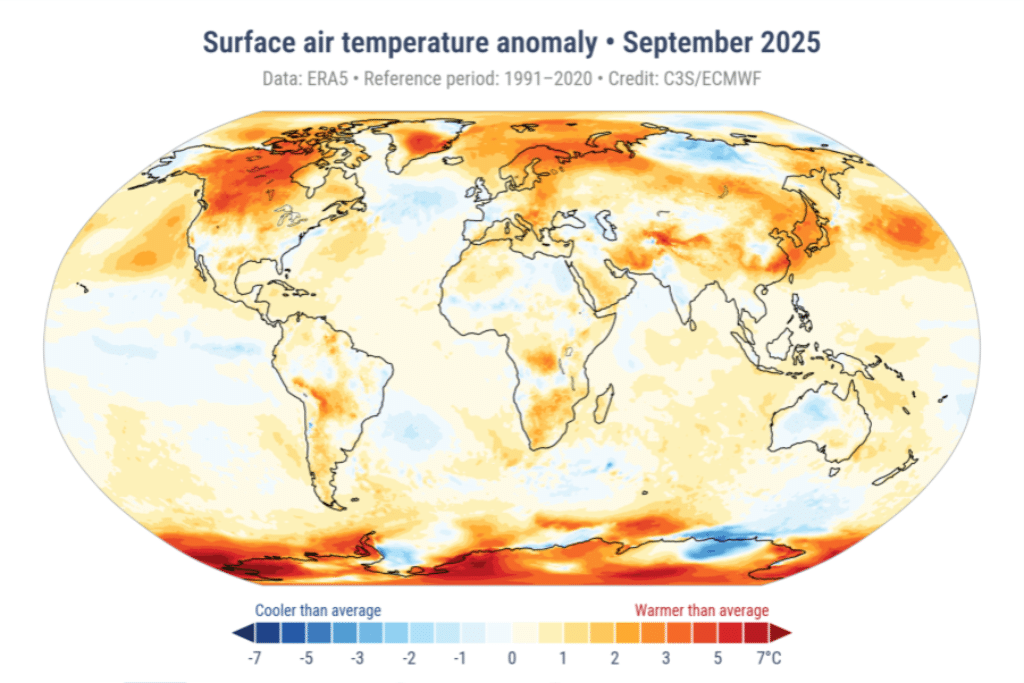
The average temperature in the past 12 months was 1.51C above the pre-industrial average.
If long-term global warming exceeds 1.5C, a limit that is considered breached when consistently surpassed over decades, experts warn that critical tipping points will be breached. This could lead to devastating and potentially irreversible consequences for several vital Earth systems that sustain a hospitable planet, such as rising sea levels, more intense heatwaves, stronger storms, and disruptions to ecosystems and biodiversity.
So far, the world has warmed by 1.3C compared to pre-industrial times – with more than two-thirds (~1C) of this warming occurring since 1975.
Rising temperatures, a consequence of increasing levels of greenhouse gases in the atmosphere, primarily from fossil fuel burning, have devastating impacts on the planet. These include more frequent and severe weather events such as heatwaves and tropical cyclones, melting ice caps, rising sea levels, and disruptions to ecosystems and biodiversity.
‘Much-Above Average’ Sea Temperatures
Sea temperatures globally were also “much-above average,” according to C3S, an European Union-funded service implemented by the European Centre for Medium-Range Weather Forecasts (ECMWF).
Globally, the sea surface temperature was the third-highest on record for the month, 0.20C below the 2023 record. Areas in the North Pacific and the Mediterranean as well as in a large region from the Norwegian Sea to the Kara Sea saw much-above average to record-high sea surface temperatures.
A persistent and intense heatwave known as the “blob” has been affecting the North Pacific Ocean since August, stretching about 5,000 miles from the water around Japan to the US West Coast. The intense heat is affecting the weather on land and could have ripple effects on marine life, experts say.
Japan experienced unusually high temperatures this summer, which turned out to be the country’s hottest on record. Scientists have linked the unusual heat to the marine heatwave.

Oceans are the world’s largest carbon sink – absorbing more than 90% of excess heat created through human-made greenhouse gasses and around 25% of carbon dioxide (CO2) emissions, resulting in ocean warming.
A 2019 report by the Intergovernmental Panel on Climate Change (IPCC) revealed that ocean warming events such as marine heatwaves are likely to increase as the climate crisis deteriorates, putting a greater strain on marine ecosystems such as corals, leading to ocean acidification and sea level rise, and altering ocean currents, resulting in massive die-offs of marine species, and dead zones due to oxygen depletion.
The world’s corals are currently undergoing a mass coral bleaching event in response to warmer oceans. The event is the largest ever recorded, affecting dozens of countries worldwide.
“The global temperature in September 2025 was the third warmest on record, nearly as high as in September 2024, less than a tenth of a degree cooler,” said Samantha Burgess, C3S Deputy Director.
“A year on, the global temperature context remains much the same, with persistently high land and sea surface temperatures reflecting the continuing influence of greenhouse gas accumulation in the atmosphere,” she added.
Featured image: C3S / ECMWF.
This story is funded by readers like you
Our non-profit newsroom provides climate coverage free of charge and advertising. Your one-off or monthly donations play a crucial role in supporting our operations, expanding our reach, and maintaining our editorial independence.
About EO | Mission Statement | Impact & Reach | Write for us