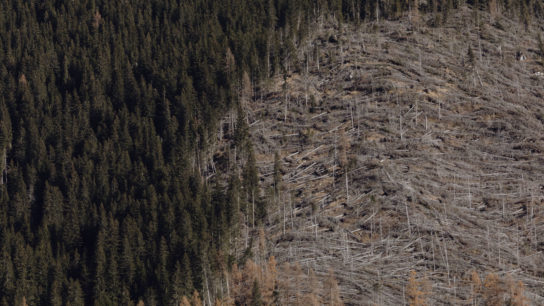

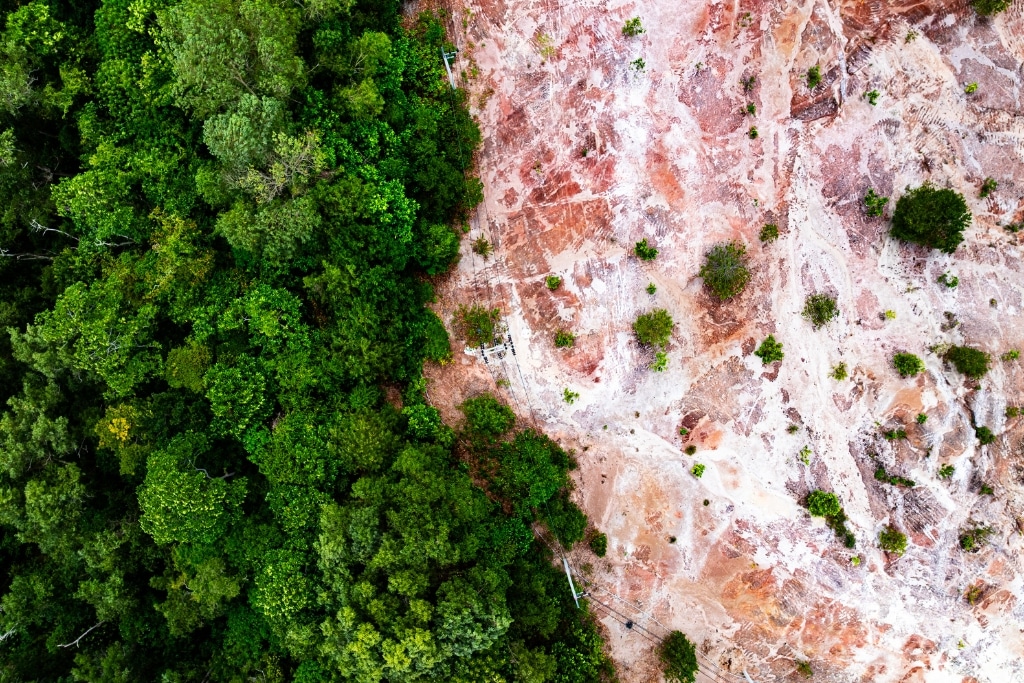
In 2023, the latest year for which data are available, more than $7.3 trillion was invested in “nature-negative finance flows” – in other words, projects that directly damage nature.
—
Investments in projects deemed harmful for nature far outpaced the money invested in nature-based solutions, according to a new analysis.
The report, released today by the UN Environment Programme, looks at global financial data on the imbalance, and explores ways to address the gap in nature based financing. In 2023, the latest year for which data are available, more than $7.3 trillion was invested in “nature-negative finance flows” – in other words, projects that directly damage nature.
By contrast, nature-based financing is on the rise but still amounted only to $220 billion. Nature-based solutions encompass biodiversity and landscape protection, but can also include broader areas such as food systems, utilities, construction, infrastructure, extractives, chemicals, and other “real economy” sectors.
The report is the latest in a series of six annual reports on the topic. It calls for a major shift in global financing of nature-based solutions, and a phase out of harmful investments to deliver high returns, reduce risk exposure, and enhance resilience.
The gap between the two opposing forces is not only one of impact: the source of the funding is also starkly separated between public and private funders. Most of the $7.3 trillion spent per year in nature-negative money comes from the private sector, while 90% of investment to protect and restore nature is coming from public funds.
The report also offers a roadmap to address this imbalance. Ivo Mulder, Head of Climate Finance Unit at UNEP and one of the report’s authors, told Earth.Org: “This report is meant to give an image of the more nature-positive society that we should collectively work towards. How can it be applied in my city, my neighborhood, my environment?”
Investment in projects that directly harm nature is highly concentrated in a few sectors, with $4.9 trillion of the total going to utilities, industrials, energy, and basic materials. Meanwhile, many governments also directly subsidize the destruction of nature. In 2023, $2.4 trillion was spent on harmful subsidies to areas such as fossil fuels, agriculture, and water use. Much of this comes from petrostates, which subsidize exploration, while there was an uptake in fossil fuel subsidies in the European Union and the US following Russia’s invasion of Ukraine to protect consumers from elevated electricity prices.
Investments in Nature-Based Solutions on the Rise But Insufficient
The overall direction of investment in nature-based solutions appears to be upwards, at least through the end of 2023: globally, international public finance was 22% higher than in 2022, and 55% higher than in 2015. Meanwhile, the private sector has yet to invest at scale in these solutions, despite the growing awareness of dependencies, risks, and opportunities related to nature. Private investment in this area in 2023 amounted to only $23.4 billion, even though, in order to meet targets set out under the Rio Conventions, these investments need to grow 2.5 times, to $571 billion per year, by 2030.
To make this a reality, experts say a significant change is needed both in attitude and finance infrastructure. “It’s important to look for portfolio approaches instead of one-off pilots, so investors can spread ecological and performance risk,” Jean-Marc Champagne, Managing Director at Seneca Impact Advisors, an advisory firm in nature-based solutions, told Earth.Org.
“We also need clear NbS investment and readiness frameworks, and they need to be aligned with IUCN standards so investors know what proper NbS looks like,” he added. This could come in the form of standardized templates, taxonomies, or simple pathways that make projects easier to compare and fund.
According to Champagne, more seed funding is necessary to get projects investment-ready, instead of “dying in the feasibility gap,” as well as blended finance and catalytic capital to de-risk early stages. Project risk can be reduced by providing support and funding to prove the long-term viability of the project. Additionally, high-integrity monitoring and impact metrics are needed so that investors can trust the results.
“We’re not saying, ‘Here are the numbers, good luck with it,’ but, ‘If you were to change, how would you go about it?’ You don’t have to accept the status quo,” said Mulder.
To this end, the UNEP report introduces a framework designed to help policymakers and businesses sequence reforms and scale up nature-based solutions. The framework charts a path for phasing out harmful subsidies and destructive investment in entrenched systems of production, while simultaneously raising nature-based solutions and nature-positive investments. It also offers roadmaps to meet the challenge of a trillion-dollar nature transition economy. The report highlights examples of how this is already being applied by governments and business leaders around the world.
“A relatively low-hanging fruit is re-greening urban areas to improve human well-being,” said Mulder. “There would be a lot of citizen support for this. Another could be shifting agricultural practices in line with improving soil health and reducing deforestation. This is already in line with a lot of voluntary commitments, but not yet implemented to the extent it could be. And in agriculture we are on a trajectory of downward yields due to climate change, which already is seen in higher prices consumers.”
Other solutions include embedding nature in road and energy infrastructure and producing emissions negative building materials using carbon dioxide.
Disclosure: The author of this article is on the advisory board of Seneca.
This story is funded by readers like you
Our non-profit newsroom provides climate coverage free of charge and advertising. Your one-off or monthly donations play a crucial role in supporting our operations, expanding our reach, and maintaining our editorial independence.
About EO | Mission Statement | Impact & Reach | Write for us