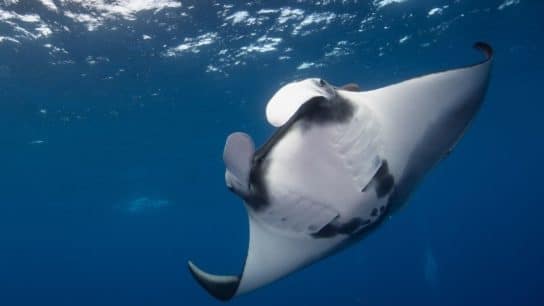



Two of the three regions of the Great Barrier Reef saw the largest drop in coral cover in a single year since monitoring began 39 years ago, a consequence of last year’s record-breaking marine heatwave.
—
A new assessment of Australia’s Great Barrier Reef confirmed unprecedented coral cover loss across two of the reef’s three regions as a result of last year’s record-breaking marine heatwave.
In its most recent survey of the reef – the world’s largest living ecosystem – the Australian Institute of Marine Science (AIMS) found that hard coral cover has dropped across all three regions of the reef following last year’s unprecedented marine heatwave. This marked the fifth mass coral bleaching event to affect the iconic reef since 2016.
Researchers collected the data during manta surveys on 124 reefs between August 2024 and May 2025. They found that in the northern and southern reef regions, the declines were the largest ever recorded in a single year since monitoring began in 1986. The average coral cover dropped from 29.8% in 2024 to 30% this year in the north and from 38.9% to 26.9% in the south.
In the central region, cover declined from 33.2% to 28.6%, though here researchers also found the greatest number of reefs with stable or increasing coral cover.
Despite the concerning losses, considerable coral cover remains in all three regions, AIMS said, with only two of the 124 reefs surveyed having hard coral cover of less than 10%. Most reefs (77) had coral cover between 10-30%, 33 reefs had cover between 30-50%, 10 reefs had coral cover between 50% and 75%, and the remaining two reefs had cover higher than 75%.
Coral bleaching occurs as a heat stress response from rising ocean temperatures, which drives algae away from coral reefs, causing reefs to lose their vibrant colours. While a bleaching event does not necessarily kill corals, more frequent and intense heat stresses make them more vulnerable to diseases, slowing down their recovery and limiting their ability to spawn. If recovery takes too long, corals will ultimately die.
“These results provide strong evidence that ocean warming, caused by climate change, continues to drive substantial and rapid impacts to Reef coral communities,” said AIMS CEO Selina Stead.
“The future of the world’s coral reefs relies on strong greenhouse gas emissions reduction, management of local and regional pressures, and development of approaches to help reefs adapt to and recover from the impacts of climate change and other pressures,” she added.
Coral reefs are extremely important ecosystems that exist in more than 100 countries and territories and support at least 25% of marine species; they are integral to sustaining Earth’s vast and interconnected web of marine biodiversity and provide ecosystem services valued up to $9.9 trillion annually. They are sometimes referred to as “rainforests of the sea” for their ability to act as carbon sinks by absorbing the excess carbon dioxide in the water.
You might also like: Southern Great Barrier Reef Affected By ‘Catastrophic’ Bleaching: Study
Global Issue
As global sea temperatures rise, reefs are disappearing at an alarming pace.
Some 83.7% of the world’s coral reef area across at least 83 countries and territories have been impacted by bleaching-level heat stress since January 2023, according to the US National Oceanic and Atmospheric Administration. It is the fourth global mass coral bleaching event ever recorded and the second to occur in the last 10 years.
In 2024, ocean heat content reached the highest level in the World Meteorological Organization’s (WMO) 65-year observational record. Sea surface temperatures reached record levels from January to June, and were the second-warmest on record in the second half od the year, behind only 2023.

Each of the past eight years has set a new record for ocean heat content, according to the WMO. The rate of ocean warming over the past two decades (2005-2024) is more than twice that in the period 1960-2005.
“As the world’s oceans continue to warm, coral bleaching is becoming more frequent and severe,” NOAA’s Coral Reef Watch coordinator Derek Manzello said last year. “When these events are sufficiently severe or prolonged, they can cause coral mortality, which hurts the people who depend on the coral reefs for their livelihoods.”
According to the most recent report by the Global Coral Reef Monitoring Network (GCRMN), the world has lost approximately 14% of corals since 2009.
Featured image: Tourism and Events Queensland.
This story is funded by readers like you
Our non-profit newsroom provides climate coverage free of charge and advertising. Your one-off or monthly donations play a crucial role in supporting our operations, expanding our reach, and maintaining our editorial independence.
About EO | Mission Statement | Impact & Reach | Write for us