
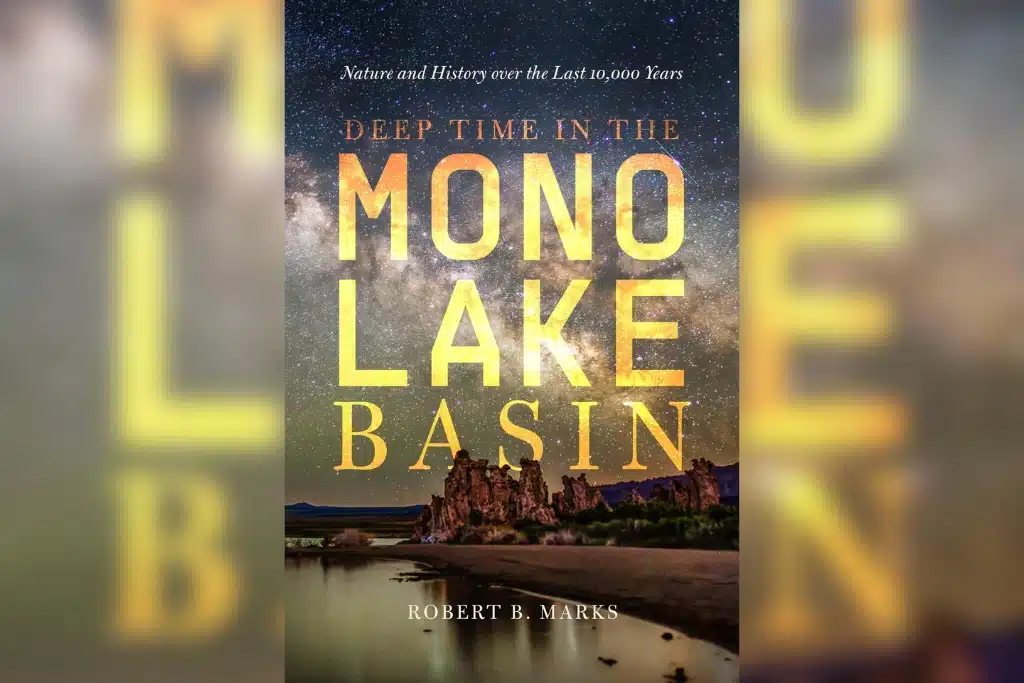
After four decades of sweeping overviews of societal impact on our planet, a California-based historian has produced a sensitive, thoughtful portrait of the unique ecosystem in his backyard, and the dramatic changes it has undergone in the past ten millennia.
—
While inland lakes such as the Great Salt Lake are familiar to many, there are several less-famous saline lakes in the so-called Great Basin, a geologically-defined area located west of the Rockies. Their stories can fascinate when told by a historian with an appreciation for both biological and geological nuance as well as human tragedy and hope.
Marks lives near Mono Lake, which sits in northeastern California just inside the Nevada border. In this saline lake and its surroundings, an unusual ecosystem has sustained humans for thousands of years.
Throughout the first section of this book, Marks offers a comprehensive overview of the region’s inhabitants, from its algae, alkali flies, sagebrush, and pronghorns to its most recent Indigenous residents, the Kootzaduka’a people. This section will appeal to readers with an interest in how people interact with biological systems. It also sets out heartbreaking (and often infuriating) details of how the Kootzaduka’a and other people in the area were dispossessed of their land and their lives. This explanation demonstrates in microcosm the larger context of how the land of the American West was ravaged by the Euro-American quest to exploit the area for agriculture or for gold. A unique and extraordinary part of the book is a chapter of in-depth testimony from a number of Kootzaduka’a who applied for federal land allotments in the early 20th century, related in their own voices.
In the second section, an ugly new element emerges: the theft of the region’s water to serve the needs of the city of Los Angeles and its hydroelectric industry. This action was spearheaded by a man named J.S. Cain, who is described dispassionately but whose devastating impact is felt even today. The book becomes a legal and corporate drama at this point, explaining and exposing a series of fraudulent corporate shenanigans that ultimately scarred the region, lowering the water level of the Mono Lake to below its pre-industrial state.
The third and final section of the book, however, is hopeful. Starting from the 1990s, defenders of the Mono Lake Basin began to win back its rights – in some cases with trout fishers as their fiercest backers. Ironically, because of the legal consolidation of the Los Angeles Department of Water and Power, it was easier for environmental activists to use the legal system to bring about binding regulatory decisions.
One of the book’s greatest achievements is that it leverages a vast variety of untapped primary and secondary sources. These range from physical evidence analyzed by archeologists to contemporary written accounts that the author discovered languishing in local archives.
The book’s images include numerous detailed maps of the region, some prepared by the author himself, as well as photographs of the landscape and its inhabitants. Additional pictures of the natural environment and the lake itself would have been welcome; the reader is left wondering what exactly an alkali fly looks like (let alone how a dish of their larvae might taste).
Likewise, while the personal accounts are excellent, some of the legal and business drama lacks juicy details – for example, we know what J.S. Cain did but not who he was as a person.
The book’s scope is geographically narrow, but its lessons are universal. By examining the story of a single saline lake basin and its people, the reader learns how to understand our own role on the planet.
Deep Time in the Mono Lake Basin: Nature and History over the Last 10,000 Years
Robert B. Marks
2026, University of California Press, 384pp
—
Check out more Earth.Org book reviews here.
This story is funded by readers like you
Our non-profit newsroom provides climate coverage free of charge and advertising. Your one-off or monthly donations play a crucial role in supporting our operations, expanding our reach, and maintaining our editorial independence.
About EO | Mission Statement | Impact & Reach | Write for us
Earth.Org
Free, non-profit and independent environmental journalism.