As recently as the beginning of this decade, it might just have been possible to lead a company or a business unit with only a cursory knowledge of sustainability – perhaps by ignoring the relentless evidence for anthropogenic climate change and the impact of biodiversity loss, or by surface level compliance with increasingly sophisticated regulatory frameworks. Such an approach is now quaint if not outright irresponsible. But even for business leaders who have already embraced a sustainability mindset, global boundary conditions are now changing at such an accelerating rate that a steady, professional guide has become a necessity. Whether you fall into the first or second category, Leading the Sustainable Organization: The Quest for Ethical Brands and a Culture of Sustainable Innovation is for you.
—
Peter McAteer has been helping companies transform in the face of changing external conditions ever since the tech boom of the 1990s. This skill took a turn towards sustainability when he joined the United Nations Development Programme, and he later began spreading the word as the Managing Director of Harvard Business School Publishing. This, his latest book, is a practical, up-to-date, no-nonsense user manual for emerging leaders who are striving to operate their businesses in a world where climate change and biodiversity wield the greatest impact on the future of business.
The book introduces two core concepts early on: the role of boundary conditions and the importance of a specific, articulated statement of purpose – a North Star, as McAteer calls it. These topics, along with a strong underpinning of ethical behavior, return throughout the book. The chapters run through the fundamentals of leading sustainably, establishing a practical knowledge base, and the how-to’s of navigating the transition, through to innovation, collaboration, and telling the company’s story.
The section on transitions is the best in the book, not only outlining a clear methodology to develop a more sustainable business, but helping to analyze potential pitfalls. While the lengthy list of failures has the potential to be demoralizing, it is better viewed as a reality check on the enthusiasm of the previous chapters. Indeed, a few of the author’s pronouncements about opportunities for differentiation can come off as naive optimism. For example, McAteer’s early assertion that the artificial intelligence boom “will require not only sources of alternative energy, but products designed to be much more efficient, with a substantially reduced waste stream, capable of being recycled, remanufactured, or reused” could have come from an analysis funded by Big Tech.
The second half of the book is more nuanced, and takes a hard look at slippery, vital topics like collaboration, storytelling, avoiding derailment, and future-proofing.
These areas are unevenly fleshed out. While there are many excellent examples of sustainability promises gone awry, it is difficult to find the type of clear instruction that characterizes the earlier chapters. Meanwhile, one tantalizing section touches on the fascinating topic of using social rituals to reinforce sustainability, but leaves the reader hanging when it comes to what this might look like in practice. Likewise, the chapter about storytelling quickly drills down into reporting while ignoring most other communication channels.
Overall, this is a solid, mainstream textbook-style guide for people in conventional business environments. Each chapter begins with a quote from a prominent personage such as Richard Branson or John F. Kennedy, ends with a helpful checklist and point scoring system, and includes several diagrams from the “words in ovals connected by line arrows” school of design. The author presents a satisfactory mix of examples from legacy businesses and smaller start-ups, and includes a rich variety of clear, actionable to-do lists.
This extreme focus on practicality throws into sharp relief the very last appendix of the book. It comes after a surprisingly in-depth glossary of sustainability buzz-words – not just greenhushing but greenbleaching – and a list of useful databases, many of which have survived the recent Trumpian cull.
This final appendix, entitled “Eight Reflection Exercises to Refine Your Thinking”, does exactly what it promises. It is a rare business textbook that can make readers re-examine their own conclusions, but this one succeeds. Each of the cases uncovers the complexity and difficulty that faces a businessperson committed to ethical leadership, and offers knotty challenges to unsnarl. It is here that the intellectual depth and experience of the author is truly revealed. It also helps call forth the multiple examples from earlier in the book, from Asia, Europe, and North America in their various contexts.
It is here as well that the reader might wish that there had been somewhat greater variety in the preceding chapters: perhaps a philosophical musing, an interview transcript, or a photo to better illustrate one of the line-and-text diagrams. Nevertheless, this book has undoubted clarity and heft, and would be an excellent addition to the shelf of any modern business leader seeking to understand modern sustainability.
Our non-profit newsroom provides climate coverage free of charge and advertising. Your one-off or monthly donations play a crucial role in supporting our operations, expanding our reach, and maintaining our editorial independence.
The International Court of Justice’s advisory opinion on climate change, issued July 23, offers a chance to create a unified understanding of states’ climate obligations, transcending specific treaties and regional arrangements and cutting across the entire spectrum of international law. It provides authoritative guidance on how international law applies more broadly to the climate crises.
—
This article is part 3 of a three-part series looking at landmark, climate-related advisory opinions issued by international courts. Read part 1 (ITLOS) and part 2 (IACtHR).
Initiated by the Pacific Island nation of Vanuatu, the United Nations General Assembly (UNGA) Resolution A/77/L.58 – jointly sponsored by 132 developed and developing countries – formally requested an advisory opinion from the International Court of Justice (ICJ) concerning states’ legal duties on climate change.
It was the culmination of a six-year campaign initiated by the Pacific Island Students Fighting Climate Change (PISFCC), who, when faced with the existential threat of sea level rise, sought legal clarity on climate obligations through the world’s highest court.
The UNGA resolution specifically posed the following questions:
(a) What are the obligations of States under international law to ensure the protection of the climate system and other parts of the environment from anthropogenic emissions of greenhouse gases for States and for present and future generations?
(b) What are the legal consequences under these obligations for States where they, by their acts and omissions, have caused significant harm to the climate system and other parts of the environment, with respect to:
(i) States, including, in particular, small island developing States, which due to their geographical circumstances and level of development, are injured or specially affected by or are particularly vulnerable to the adverse effects of climate change?
(ii) Peoples and individuals of the present and future generations affected by the adverse effects of climate change?
The advisory opinion was hailed as a historic turning point in climate justice and accountability, with the ICJ unanimously affirming the entirety of Vanuatu’s submissions. Below are some key highlights.
Climate as an existential threat of anthropogenic nature
The court underscores that the consequences of climate change are “severe and far-reaching,” affecting both natural ecosystems and human populations. Climate change, it asserts, is an “urgent and existential threat” to humanity.
Moreover, the court confirms that greenhouse gas emissions are “unequivocally caused by human activities,” and observes that all parties to the proceedings accept the Intergovernmental Panel on Climate Change (IPCC) as the most authoritative source of scientific knowledge on the “causes, nature and consequences” of climate change.
The Paris Agreement goal of 1.5C
The ICJ confirms that limiting global warming to 1.5C is the primary temperature goal collectively embraced by Paris Agreement parties. This elevates 1.5C from an aspirational goal to a definitive legal benchmark governing the ambition, scope, and due-diligence duties of every state under both the Paris accord and general international law.
On the interpretative principle of lex specialis
During the ICJ proceedings, a coalition of predominantly high-emitting, industrialized states advanced the theory of climate-treaty exceptionalism – namely that the UNFCCC, Kyoto Protocol, and Paris Agreement constitute a self-contained lex specialis framework superseding the broader body of international law.
The ICJ opinion rejects this narrow framing, affirming that climate treaties neither displace nor exhaust states’ wider obligations under general international law and other treaty laws.
Directly relevant applicable law
The ICJ considers the entire corpus of international law to form part of the most directly relevant applicable law.
This includes but is not limited to: the Charter of the United Nations; the three climate change treaties (UNFCCC, Kyoto Protocol, Paris Agreement); the UN Convention on the Law of the Sea (UNCLOS); international human rights law; customary international law relating to climate change, as well as other environmental treaties, including the Ozone Layer Convention, the Montreal Protocol, the Biodiversity Convention, and the Desertification Convention. This also includes the principles of sustainable development, common but differentiated responsibilities and respective capabilities, equity, intergenerational equity and the precautionary approach as guiding principles, that are also part of the applicable law.
On climate treaties
The ICJ unanimously held that the UNFCCC, the Kyoto Protocol and the Paris Agreement are complementary and mutually reinforcing. The judges found no conflict among them, making it unnecessary to invoke the later-in-time lex posterior rule under the Vienna Convention, an idea advanced by a coalition of predominantly high-emitting, industrialized states.
It also determined that states’ discretion in formulating their Nationally Determined Contributions (NDCs) is not unlimited. In setting NDCs, parties must exercise due diligence so that, collectively, their commitments can limit warming to 1.5C above pre-industrial levels and stabilize greenhouse-gas concentrations at a level that prevents dangerous human-induced interference with the climate system.
Customary law
The “duty to prevent significant harm to the environment”embodies an obligation to act with due diligence. This duty, construed expansively in the ICJ advisory opinion on the Legality of the Threat or Use of Nuclear Weaponsas one that applies to “global environmental concerns,” is therefore extended to include “the climate system and other parts of the environment.”
Due diligence requires assessments, in concreto, of what measures are reasonable in the specific circumstances of a state, while also adhering to general conduct standards proportionate to the character of the risk, as is especially clear given the indisputable threats posed by climate change.
The “duty to cooperate”, which lies at the core of the UN Charter, is central to climate change treaties and other environmental treaties. It is intrinsically linked to the duty to prevent significant harm to the environment.
Human right to a clean, healthy and sustainable environment
The ICJ recognizes the interdependence between human rights and the protection of the environment. It affirms that every person has a human right to a “clean, healthy and sustainable” environment, which is a prerequisite for enjoying foundational rights – such as life, health, food, water and housing. States cannot meet their existing human-rights obligations unless they also protect the environment. The court treats the right as firmly grounded in international, regional and national law, pointing to its widespread recognition by United Nations resolutions, human-rights treaties and more than 100 constitutions.
Judge Iwasawa Yuji, President of the International Court of Justice. Photo: UN Photo/ICJ-CIJ/Frank van Beek. Courtesy of the ICJ.
Breach of legal responsibility
In its opinion, the ICJ held that states failing to honor their climate obligations commit “an internationally wrongful act.” Judge Yuji Iwasawa, the court’s President, underscored that omitting necessary measures to safeguard the climate system amounts to a breach of international law, with corresponding legal consequences.
The court reinforces the principle that any conduct – whether action or omission – by a state organ is attributable to the state itself. It goes on to specify that a state’s failure to regulate greenhouse gas emissions – including through fossil-fuel production, consumption, licensing, or subsidies – constitutes such an internationally wrongful act.
Furthermore, the offending state must continue to fulfil the breached obligation and, where applicable, cease the harmful conduct, offer guarantees of non-repetition, and provide full reparation – including restitution, compensation and satisfaction – to injured states, provided a sufficiently direct causal link to the harm can be established under the rules of state responsibility.
The court further determined that any breach of obligations related to loss and damage from climate change must be assessed under the established customary international law rules on state responsibility.
Climate finance
The ICJ confirmed that under the Paris Agreement parties incur binding obligations to provide financial assistance, technology transfer and capacity-building to vulnerable states.
Protection of statehood for Small Island States
The ICJ underscored that rising sea levels threaten the physical territory – and, by extension, the very existence – of Small Island States. Nonetheless, it stresses that even if an entire landmass were lost and its people displaced, the state should still be presumed to continue as a legal entity; once statehood is achieved, losing a component such as territory does not automatically strip a state of its sovereign status.
People watch the live stream of the ICJ advisory opinion delivery outside of the Peace Palace in The Hague on July 23, 2025. Photo: Holland Park Media.
Implications
Although advisory opinions are not formally legally binding, they still possess considerable legal and moral weight and play a crucial role in shaping and clarifying international law by outlining states’ legal responsibilities.
While lacking direct enforceability under Article 59 of the Court’s Statute, they are among the most persuasive sources of international legal interpretation. Historically, they have often altered state behavior, driven legislative change, and guided national courts because their reasoning clarifies existing international law and helps crystallize emerging customs.
In this climate advisory opinion, the ICJ confirms that states do have legal duties – including a due-diligence obligation to regulate private actors – to prevent, mitigate, and remedy climate harm. Those duties flow from treaty obligations (e.g., UNFCCC, Paris Agreement) and customary international law, including a right to a clean, healthy, and sustainable environment.
As well-respected Christiana Figueres – former executive secretary of the UNFCCC and a key architect of the Paris Agreement – observes “This is without a doubt, the most far-reaching, comprehensive and the most consequential legal Opinion we have ever had.”
As put by Jennifer Robinson, Barrister for Vanuatu and the Marshall Islands, the opinion marks a pivotal shift for climate negotiators and litigators, poised to serve as a powerful tool in strategic legal proceedings before domestic and regional courts worldwide.
Very importantly, this advisory opinion has advanced the cause of climate justice.
To conclude with the words of the ICJ judges: “Above all, a lasting and satisfactory solution requires human will and wisdom – at the individual, social and political levels – to change our habits, comforts and current way of life in order to secure a future for ourselves and those who are yet to come.”
Featured image: UN Photo/ICJ-CIJ/Frank van Beek. Courtesy of the ICJ.
This story is funded by readers like you
Our non-profit newsroom provides climate coverage free of charge and advertising. Your one-off or monthly donations play a crucial role in supporting our operations, expanding our reach, and maintaining our editorial independence.
When we picture the tools we deploy to fight climate change, we often think of renewable energy and electric vehicles. Rarely do we think about simulations.
—
Computational Fluid Dynamics (CFD) is a branch of science that uses the physics of fluids (like water, air, fuel, flames etc.), mathematics and computer science to create accurate real-life simulations.
CFD aids researchers in simulating everything from droplets to complex ocean currents and atmospheric turbulence. It is a powerful tool that plays a vital role in understanding and predicting the behavior of complex natural systems and extreme weather events.
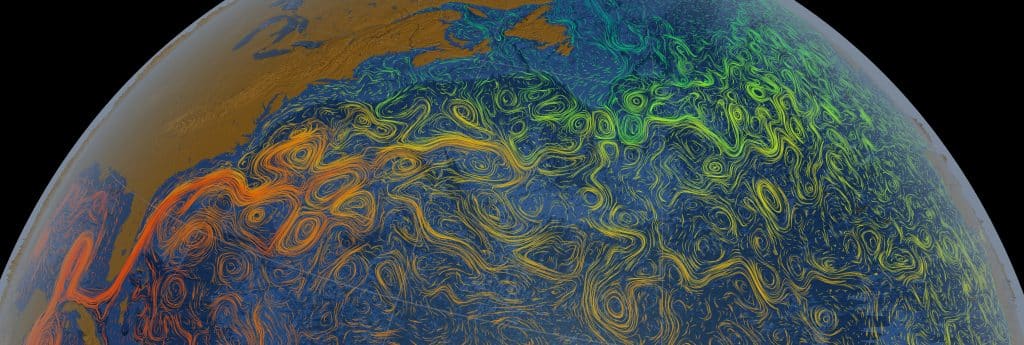
Map of Ocean currents with sea surface temperature data. Image: NASA/Goddard Space Flight Center Scientific Visualization Studio.
The Earth’s climate represents a massive complex fluid dynamics problem. For example, as shown in Figure 1, air flow over Canary Island generates a swirling vortex called the von Kármán vortex street, a phenomenon also seen in classic fluid dynamics scenarios such as flow past a cylinder.
Every climate event, from air and ocean currents to rainfall, hurricanes, tornadoes, and heatwaves, involves the movement of fluid (air, water, droplets, humidity). By using the equations governed by fluid flow, CFD can simulate these natural phenomena accurately with the help of high performance computers and mathematics. For instance, the MIT General Circulation Model (Figure 2) is used to study ocean currents and heat transport, helping us understand long-term ocean trends.
Other models and simulations from these models help researchers understand how heat and moisture are transported in the atmosphere, predict how oceans circulate heat across the planet, simulate the formation and path of hurricanes or cyclones as well as model the impact of melting ice sheets and rising sea levels.
Clean Energy Modelling
Implementing renewable energy infrastructure like wind farms, tidal power stations, or other clean sources like nuclear requires costly and energy-intensive physical testing. This, in turn, can generate carbon emissions and material waste, partly offsetting the environmental benefits associated with these technologies.
Simulations offer a sustainable alternative and help engineers design, optimize, and implement clean energy technologies with far less environmental impact. For instance, as shown in Figure 3, CFD simulations can be used to optimize turbine blade shapes or determine the most efficient layout of turbines across wind farms to reduce wake loss and maximize energy output. Similar approaches are used to model cooling systems in solar farms or simulate flow dynamics in tidal and nuclear energy systems.
These digital experiments are not only faster and more cost-effective but also significantly reduce carbon footprint and material waste.
Earth’s water resources have constantly been polluted by industrial waste, sewage discharge, littering, and agricultural runoff. Accidental or not, oil spills pose a great threat to the environment and marine eco-systems, as seen in disasters like the 2010 Deepwater Horizon spill – the largest marine oil spill in history.
CFD is used to study how oil spreads in the ocean. These simulations help predict how oil moves through water, how it breaks apart, and how it interacts with wind, waves, and currents.
Schematics of subsea oil spill. Image: Barker et al./MPDI (2020).
For example, the ADIOS model developed by the National Oceanic and Atmospheric Administration (NOAA) uses such simulations to estimate how oil might behave under different conditions. Various other computational tools have also been used to simulate how oil rises from deep-sea blowouts and travels through the ocean. These tools help emergency teams respond faster by showing where the oil will go and how to contain it without needing to run expensive or polluting physical tests.
This technology allows us not only to better prepare for oil spill emergencies but also to improve laws and safety regulations.
What the Future Holds
The examples discussed above are just the tip of the iceberg. There are many more ways computer simulations, including CFD, are helping us tackle climate change. Of course, building these high-fidelity simulations comes with its own challenges.
Running simulations requires computing power, which consumes energy and contributes to carbon emissions. However, the environmental cost of simulations is only a small fraction compared to that of full-scale physical experiments
The world of computational science is evolving rapidly. New algorithms and numerical techniques are constantly improving simulation efficiency, reducing both time and energy requirements. Moreover, more data centers are transitioning to renewable energy and are being cooled effectively. From liquid cooling systems to hybrid designs, these advancements significantly lower the carbon footprint of large-scale simulations.
As the climate crisis deepens, the need to act swiftly and smartly grows. CFD doesn’t just help us predict the future, it allows us to design better solutions, reduce waste, and avoid environmental damage before it begins. It lets us simulate the world we want to build and the ones we hope to avoid.
Featured image: Allison Nussbaum/NASA Earth Observatory.
This story is funded by readers like you
Our non-profit newsroom provides climate coverage free of charge and advertising. Your one-off or monthly donations play a crucial role in supporting our operations, expanding our reach, and maintaining our editorial independence.
Writing about the climate and other environmental topics has evolved over the past several decades, expanding from its niche origins in obscure scientific journals to mainstream popular science books and even climate fiction. However, a book of poetry that focuses on climate change is still a novelty. This excellent volumeis a welcome addition to the genre.
—
“Speech Dries Here on the Tongue” packs an emotional punch. But although it tackles grim topics – indeed, the phrase “mental health” is often used as a euphemism for “poor mental health” – the poems are not all gloomy. In their excellent preface, the editors explain that “[p]oetry can serve as a space to envision alternate futures.” The 21 poets, writing from an eclectic range of viewpoints, can be despairing and angry as they “grapple with the overwhelming realities of ecological destruction,” but they are just as often meditative or reverent.
“Even as speech may dry on the tongue, it gives us a thirst for change,” the editors point out.
The title of the book comes from its opening work, “Movement XV” by Khashayar Mohammadi, playing on the meaning of the “DAFFODILS style guide” while grappling with an uncertain future. This is one of the works that examines environmental writing itself.
Other pieces deal explicitly with mental health issues, such as “bipolar” and “Anxiety” by gregor Y kennedy [sic], or with the human relationship to nature. Many focus on specific environmental topics such as water (like “Be Water” by Grace), soil, or wildfires (as in the poems “Fire and Flood” by Jennifer Wren and “Three Senryu” by Fiona Tinwei Lam). Pieces like “If I had a son I would call him Ben” by Tara McGowan-Ross also tackles our relationship with animals. Of course, poets can never stray from writing about love, and pieces such as “When Finding a Lover in the Anthropocene” by Maryam Gowrallis bring new life to the perennial topic.
Several poems are featured for each of the poets, giving them a chance to showcase their individual range. In some cases, the poems form a suite; in others, it is a surprise to note that the pieces are by the same poet. The poets are not bound by traditional forms; there are neither sonnets nor any other kind of rhyming poetry in this book. In fact, several of the concrete poems, such as Gary Barwin and Elee Kraljii Gardiner’s “Riven Museum”, blur the boundaries between visual arts and the written word.
Gary Barwin and Elee Kraljii Gardiner’s “Riven Museum”. Image: screenshot.
For the most part, this choice is a success, although some of the prose poems might work better as flash fiction and a small number are needlessly obscure even in the context of modern poetry. Additionally, the breezy style of the introduction by Karen Houle, while entertaining, is somewhat jarring for this book. However, the beauty of a poetry collection like this is that the reader can browse, meditate in depth, or return many times to those pieces that evoked emotion.
The best way to enjoy the book may be to use it as inspiration. When Brandon Wint, in the poem “Whatever Splits a Raindrop into Fourteen Splattered Gemstones”, writes:
I want the stillness of forests, suppleness of moss a sparrow nosing shrubs
It is just possible to imagine that this desire may be fulfilled. Indeed, one of the poets in the collection, Fiona Tinwei Lam, exhorts the reader to persist in the face of despair:
Until the end, we will keep pretending we’re not marching for nothing.
Our non-profit newsroom provides climate coverage free of charge and advertising. Your one-off or monthly donations play a crucial role in supporting our operations, expanding our reach, and maintaining our editorial independence.
In a conversation with Earth.Org, Vishwanath Srikantaiah, a water conservation expert and urban planner, discussed the many initiatives that have been implemented to improve water security in Bangalore, India’s third most populouscity. Interestingly, many of these initiatives can be mapped – intentionally or not – to circular economy principles.
Water is vital to all forms of life. About 96.5% of the Earth’s water is in our oceans and is therefore too salty to drink. Freshwater makes up less than three percent of the Earth’s total water, with most of it locked away in glaciers, ice caps or very deep underground. Less than 1% of all water is accessible as freshwater.
India is a water-stressed country, having 18% of the world’s population but only 4% of the world’s freshwater. Water stress is felt acutely in some of its large densely populated cities.
Earth.Org interviewed Srikantaiah Vishwanath, a water conservation expert, well-known for his pioneering efforts to find solutions to the freshwater crisis. He teaches, writes and engages with water and sustainable water practices, which help cities become self-sufficient in water needs. Vishwanath’s model is being replicated in multiple cities across India.
In this interview, Vishwanath discusses solutions for water security, with Bengaluru, India as a case-study.
EO:Bengaluru is India’s third-largest city, with a population of over 14 million. The city has faced repeated water crises, exacerbated by irregular monsoons and weather patterns. The demand for water is expected to increase as the city continues to grow. How will the city manage to provide water for all its people in the future?
Vishwanath: Bengaluru’s main source of water is the river Kaveri located more than 100 kms away. Additionally, the city receives the equivalent of 3,000 million liters per day in terms of rainfall, which along with water from river Kaveri is adequate for the city’s growth. The challenge is to harvest this 3,000 million liters and bring it into play for supplementing the water requirements of the city.
In Bengaluru, it is mandatory for every residential unit to have its own rainwater harvesting system. So the city strives to engage every house as part of the solution through rainwater harvesting. At the next level, the city is looking at reviving lakes. The rainwater that runs off from roads, parks, and open spaces is directed towards the city’s lakes, allowing water levels to increase, thereby recharging underground aquifers. It is also planned for parks and open spaces to have their own rainwater harvesting systems through swales and recharge wells.
So through prudent management of rainwater and engaging every citizen as part of the solution, the city strives to balance its water requirement, helping the city become self-sufficient in terms of demand and supply. This is the way that every city in India has to go and every city in the world has to go.
EO: But most large cities in India are like concrete jungles with minimal open areas where water can naturally see through. In this scenario, what can cities do to ensure that rainwater doesn’t just run off, but actually recharges groundwater?
Vishwanath : We have to treat rainwater as a productive resource. We have to understand that we are concreting the surface. Therefore we have to create percolation spaces, cracks or sponge cities as they are called in China to make sure that this water recharges the groundwater.
EO: Is the recharging of groundwater dependent only on rainfall? For context, recently, Bengaluru had no rain for six months at a stretch. How can groundwater levels be maintained?
Vishwanath: We must understand the storage capacity of the underground aquifers to hold water. We have found that in many places in Bengaluru, the storage capacity is 20 times the surface water storage. So if you top up the aquifer during the rainy season, you can draw on it like a bank during dry spells. There is enough and more capacity in the aquifer to hold water. How do we top it up?
There are two ways to do it. One is through rainwater harvesting and recharging. The other is to use treated water to recharge the aquifers. We need to be smart about understanding aquifers and making sure that it becomes part of your solution.
EO: Could you elaborate further on reusing wastewater?
Vishwanath: Treated wastewater is a huge opportunity for any city. About 80% of the water that we consume in our homes can potentially come back into the system as used water. The water we use in our dishwashers, washing machines and showers is referred to as ‘grey’ water. It can be treated at source in apartments and at sewage treatment plants. We need to invest in sewage networks so that every drop of grey water is collected and treated. This treated water is then available for reuse.
So where will the reuse be?
It can directly be used in our homes for non-drinking purposes. It can be used in industries which require ever-increasing quantities of water. Rivers, lakes, streams and wetlands can be supplied with treated wastewater. Finally, agriculture reuse. The hinterland of Bengaluru is drought prone and climate change prone. But our farmers are very proactive. The treated wastewater reaches them through lakes that exist in their surroundings. This helps farmers become water secure and in turn, helps Bengaluru city become food secure.
Bengaluru is running the second largest project of its kind, in the world, next only to Mexico City, to treat roughly around 2,000 million litres per day of wastewater and supply to farmers to fill 500 lakes and make sure that 64,000 farmers receive the treated wastewater. About 1.1 million hectares of land is brought under cultivation, so that the farmers are climate secure, water secure and the city is food secure. Thus wastewater is recycled and put to productive use.
EO: What does efficient urban water infrastructure look like?
Vishwanath: I’d like to draw on the experience of Singapore which talks about four taps and in the case of Bengaluru, there are six taps.
The first is the pipe water from the river Kaveri which is about 100 kilometers away. Second is rain water which falls on our city. The third is surface water sources like lakes. The fourth is aquifers which hold water. The fifth is treated wastewater. The sixth is actually a tap control. It’s called demand management. This requires pricing water appropriately to ensure that people use water conservatively. This requires mandating water efficient fixtures on taps, flushes and showers. For example, Bengaluru has mandated the installation of flow restrictors or aerators for taps in all homes and commercial establishments. It also requires reducing leakage in water pipes.
By wisely using these six taps, we can strive to understand the demand on water and make sure that it’s balanced by the supply. Demand management is at the heart of how cities will manage water in the future.
EO: How can each one of us play a role in sustainable water management?
Vishwanath: For each one of us, the six taps are open for engagement. We can engage with rainwater through rainwater harvesting. We can engage with surface water by being part of communities who clean up lakes, streams and rivers. We can make sure that community and infrastructure is in play for harvesting the water. We can make sure that the piped water from our taps is not wasted. The wastewater that goes out from our house can be of better quality. We can use eco-friendly detergents. We can use good behavior in not pushing oil, paints and other chemicals into sinks and toilets. We can plant trees which helps cool the city, reducing the demand for air conditioners, which is an indirect control on water. And finally, engaging with the state institutions to understand and improve their accountability and responsibility will be something that citizens need to do.
EO: How do we involve children in water management to make them more aware and more responsible?
Vishwanath: Children are the future adults. Biome [the trust set-up by Vishwanath] works with public schools to engage children in water conservation activities. Children learn to appreciate rainfall patterns, learn to test for chemicals in the water using water quality testing kits, and learn about rainwater harvesting.
Once children are sensitized to rain and to water quality and to the basics needed in the community, they are one of the best ambassadors in persuading their parents to shut off the tap to make sure the water is used efficiently and not wasted. Working with children is essential because water literacy is what society needs urgently.
EO: What are some common ideas to improve water security that apply to all cities?
Vishwanath: The common ideas across cities is to protect your flood plains, protect your lakes, wetlands and rivers from illegal construction, pollution and debris. Make sure that local aquifers are treated respectfully. Make sure that pollution is reduced, if not eliminated, so that fresh water is not contaminated. Price water appropriately to reduce wastage. Implement rainwater harvesting. Treat water as a human right and make sure that everybody has access to water.
—
Interview with Vishwanath Srikantaiah on sustainable water management in India.
Featured image: Wikimedia Commons.
This story is funded by readers like you
Our non-profit newsroom provides climate coverage free of charge and advertising. Your one-off or monthly donations play a crucial role in supporting our operations, expanding our reach, and maintaining our editorial independence.
A human and political story and an environmental history, this surprisingly compact volume offers a readable overview of the most important environmental transformation in history: that of mainland China over the past thirty years. Presented in six chronological sections that each drill down into an area such as water pollution or hydroelectric dams, it manages to provide a nuanced, objective portrait of the complexities of environmental advocacy and policy, but with the plot twists of a modern thriller.
—
The author, Ma Tianjie, is a well-known Chinese environmental activist and reporter and former director of the influential China Dialogue in Beijing, an independent non-profit organization dedicated to promoting a common understanding of China’s environmental challenges.
Ma was himself present for many of the pivotal events described in the book; anyone interested in environmental issues in China would be forgiven for coveting his contact list. But he stays in the background, with each section of the book described through the lens of a particular player such as a photographer, an activist, or a politician. These personalities grow in importance over the course of the book as the scope of environmentalism expands from local quibbles to global issues requiring state-level, multinational intervention.
The book opens with the “cat-and-mouse drama” of the Huai River in the first part of the 1990s, and the battle to manage the toxic effluent created by small wheat-straw paper mills and larger enterprises like Lotus MSG. This early conflict between industry, economic development, state policy, and the monitoring role of independent press, sets the tone for the following chapters. Recurring themes include an examination of Liang Congjie’s concept of 緑色公民, or “green citizens”, and balancing the human impact of industrial and economic development.
This early section is the first to introduce vivid stories of human impact, both on the victims of environmental mismanagement as well as those who strove to address it. These include the story of Huo Daishan, a photographer whose career included the documentation of esophageal cancer in the local people in 20 “cancer villages” on the Huai River, and endured abuse such as a beating by anonymous goons in 2000 just after delivering a scathing report on an offending company.
From this launching pad, the book explores the fight over the planned Nu River hydroelectric dam project, told from the point of view of activist Wang Yongchen, founder of the Green Earth Volunteers. It then charts the rise of state environmental policy and the growing strength of the State Environmental Protection Agency (later the Ministry of Ecology and Environment) as its then vice-minister, Pan Yue, pushed through major policy changes in the mid-2000s following the environmental disaster of a chemical incident on the Songhua River.
This is followed by an account of the author’s trip to Guangzhou, written in a more journalistic style, where Ma meets activist Luo Jianming to understand more about the waste management controversies in the mid- to late-2000s. This section is also a fascinating portrait of how the online and offline worlds began to interact during this period, creating a shift in official strategy to formal engagement.
Ghastly air pollution grips Henan Province on Christmas Day, 2013. Photo:
V.T. Polywoda/Flickr.
The book kicks into high gear with a detailed description of the rush to clean up the air for the 2008 Olympic Games, the 2010 “crazy bad” air quality with its off-the-scale atmospheric concentrations of PM2.5, a toxic air pollutant, and the 2013 “Airpocalypse”, when even basketball star Yao Ming commented on the smog.
It is during this period that China’s State government seized control of the issue and the narrative, with direct intervention by Chinese President Xi Jinping. Although by this point, “The battle to steer China’s energy path toward low-carbon sources was already won on the political level,” the book is careful to explain that this shift did not mean that the central government exerted absolute power: instead, turf wars, give-and-take negotiations, corruption, and personal influence all played a role in the “systemic restructuring of the entire economy”. Ma’s wry comment that “China appears to have achieved much environmental progress despite all the weaknesses in its system” rings true.
Former climate envoy Xie Zhenhua speaks at the 2018 Global Climate Action Summit in San Francisco, California. Photo: Wikimedia Commons.
Throughout the book, entities from earlier chapters like Lotus MSG come back to haunt the agents of progress and villains become surprising advocates as the policy stakes continue their relentless rise. The final section, about China’s role in global climate change, the development of emissions trading, and the complex bilateral negotiations by former climate envoy Xie Zhenhua, is particularly fascinating for anyone who has read the same story from the American point of view.
Ma explains in the introduction that his aim is to create “a blend of journalistic non-fiction, a historical account, and a personal reflection on the journey we have collectively undertaken.” He warns against giving too much credit to China’s socio-political roots for modern “eco-Marxism”, emphasizing the “materialistic stance that the human economy is embedded in its biophysical environment.” However, the book often takes a step back to examine the theoretical underpinnings of China’s transformation. This even includes the “两山论”, or “Two Mountains Theory” cited by Xi himself: “Green mountains can bring gold mountains, but you cannot buy back green mountains with gold,” which traces its roots to Friedrich Engels’s Dialectics of Nature. It is clear that the evolution of environmental policy in China has been fortified by a robust intellectual foundation.
It is difficult to find anything to criticize in this book. If anything, it would be instructive to read a more personal story of Ma’s own involvement in environmental advocacy. At the same time, the story is not over. China’s official net zero target is currently 2060 (at the time of writing, China has yet to submit a new Nationally Determined Contribution), but a fractious relationship with the current US administration, continued structural problems, and backpedaling in the face of competing interests mean “[t]he much celebrated developmental environmentalism is more of a work in progress than an end state.” It is clear, after reading this book, that China’s “work in progress” is vital to that of the rest of the planet, and our collective future.
Our non-profit newsroom provides climate coverage free of charge and advertising. Your one-off or monthly donations play a crucial role in supporting our operations, expanding our reach, and maintaining our editorial independence.
Kazakhstan has lost 21% of its per capita water availability since 1999. But what are the main forces behind the country’s rapidly worsening water crisis?
—
Only 42% of Kazakhstan’s water is available for consumption due to outdated infrastructure and poor management. Over 45% of available water is transboundary, meaning it comes from sources such as the Irtysh and Ili rivers from China and the Syr Darya from neighboring Kyrgyzstan and Uzbekistan, making Kazakhstan vulnerable to politics and foreign water mismanagement.
The poor irrigation productivity, at less than US$0.5 US per cubic meter, means that for every cubic meter of water (1000 liters) used for irrigation, the resulting agricultural output generates less than half a dollar in value. Combined with unmaintained infrastructure and low returns from water-intensive crops this also plays a role, translating into huge missed economic opportunities. The inadequate sanitation alone costs the government some US$750 million per year, compared to $500 million in investments needed to close this gap.
The graph shows the renewable internal freshwater resources per capita. We can see a steady decline over the years. Data: World Bank. Graph: Earth.Org.
Glacial Threat
Kazakhstan’s water sources are heavily dependent on glacier-fed rivers from the Tien Shan mountains. Glaciers in this region have already lost about 30% of their mass and may retreat by another half by 2050.
The initial deluge in meltwater is temporary; soon enough, these rivers will dry out in the summer months, when water is most needed for cooling and irrigation, eventually leading to seasonal shortages and ecological collapse.
The graph of annual freshwater withdrawal by sector through years (1994-2021) highlights the prevalent use of water in agriculture. Data: World Bank. Graph: Earth.Org.
Agriculture: Thirsty and Wasteful
In 2021, 63% of annual water withdrawal in Kazakhstan was spent on agriculture, making it the largest sector of water waste, compared to 19% for domestic use. It is reported that only half of the water determined for agricultural use is utilized effectively or reaches the crops.
Additionally, only 16% of all irrigated land uses modern irrigation techniques, such as drip or sprinkler systems. The government introduced a policy on Water Resources Management (2023–2029), which acknowledges these challenges and aims to reduce agricultural water loss through main canals from 20% to 15% by 2029.
The agricultural inefficiencies not only stress the country’s water resources but also put additional pressure on food security and economic stability.
Unequal Access to Water
Despite Kazakhstan’s efforts to improve water infrastructure, differences between urban and rural areas still exist. While urban centers enjoy access to centralized water and sanitation, rural residents face challenges that affect their health and quality of life.
As of 2024, around 99.5% of urban residents had access to clean water, with 97.8% of rural settlements having similar access. Access to piped water shows a more pronounced discrepancy. While 94% of urban households are connected to piped water systems, the number is closer to 60% for rural households – forcing people to rely on other sources of water like public standpipes or wells.
The differences in water access between urban and rural areas are not only an infrastructural issue; they also have serious implications for public health, economic development, and social equity. Addressing these challenges requires investments in rural water infrastructure, community engagement, and policy reforms targeted at ensuring equal access to water sources across Kazakhstan.
Geopolitics
Kazakhstan’s water resources, as was mentioned earlier, are dependent on transboundary rivers – particularly the Ili and Irtysh rivers, which originate in China and are vital for Kazakhstan’s agriculture, industry, and ecosystem in general.
Negotiations between Kazakhstan and China to reach an agreement on water equitability have been ongoing. But despite some progress, such as the joint construction of hydraulic facilities on shared rivers like the Khorgo, a broad agreement on water allocation remains ambiguous.
The situation is complicated by Kazakhstan’s dependence on other transboundary rivers such as the Syr Darya, which flows through Kyrgyzstan and Uzbekistan before reaching Kazakhstan. Effective use of these water resources requires regional cooperation, which is challenging due to differing national interests and priorities.
Kazakhstan has taken steps to reduce tensions with its neighbours. For example, Kazakhstan and Uzbekistan installed transboundary water meters to monitor water consumption and share data, improving cooperation and transparency.
However, the challenge remains because of the lack of binding international agreements and the ever-increasing demand for water in the region, depicting risks to Kazakhstan’s water security. Addressing the geopolitical challenges is essential for sustainable water management and preventing conflicts over this vital resource.
Prediction of renewable freshwater resources per capita, including uncertainty interval, projects the continued decline in water availability by 2030. Data: World Bank. Graph: Earth.Org.
What the Future Holds
The predictive model Earth.Org has built depicts an uneasy reality. Renewable internal freshwater resources have been in decline since the 1990s, and forecasts show this trend will continue, potentially dropping to 2,750 cubic meters by 2031.
The widening uncertainty interval emphasizes the importance of action – policy changes, investments in water-saving technologies, and improved regional cooperation.
Water scarcity has further effects on public health, economic resilience, and national security. The best time to act is now.
Our non-profit newsroom provides climate coverage free of charge and advertising. Your one-off or monthly donations play a crucial role in supporting our operations, expanding our reach, and maintaining our editorial independence.
Energy demand is growing in India, but current renewable additions are not enough to meet this rising demand, let alone replace existing coal.
—
In Gujarat’s white desert, the Khavda renewable power plant is set to become the world’s largest clean energy installation, generating a staggering 30 GW of solar and wind power by 2030. Yet, across the country, a 3 GW coal-fired plant in Chandrapur, Maharashtra, continues to spew smoke, one among hundreds that still power over 60% of India’s grid.
This juxtaposition captures the central tension in India’s energy transition: How can a developing nation reconcile its growing hunger for energy with its increasingly ambitious climate goals?
Development vs. Decarbonization
Unlike developed economies, India is still growing. Its people still consume far less energy than the global average. Electricity provision – a given in the developed world – is still a development imperative here.
Over the past two decades, India has made remarkable progress in electrification. Thanks to targeted government programs, electricity access rose from just 60% in 2000 to near-universal coverage today, and electricity shortfalls have fallen below 1%. However, this electrification has been driven primarily by coal.
Coal capacity surged in the previous decades, and continues to rise, albeit more slowly. Today, the electricity sector accounts for over half of India’s emissions. While its per capita emissions remain low, India is now the world’s third-largest emitter of greenhouse gases.
Graph: Geetanshu Gupta.
Even so, India has emerged as a climate leader. Its 2015 Nationally Determined Contribution (NDC) pledged that 40% of its electricity capacity would come from non-fossil sources by 2030. In 2022, it raised that target to 50% and set a net-zero goal for 2070. Since 2015, India’s renewable capacity has grown nearly 20% annually, crossing 200 GW in 2024.
Graph: Geetanshu Gupta.
Still, as the world’s “well below 2C” window closes fast, attention is turning to India. While global emissions are expected to peak soon, India’s are still climbing. The country is projected to drive over a quarter of global energy demand growth through 2040. As the world is trying to phase out coal, why isn’t India able to move away from it?
Renewables Are Cheaper, But that Is Not Enough
Over the past decade, the costs of solar and wind have plummeted. On a levelized cost of energy (LCOE) basis – the average unit cost of electricity over a plant’s lifespan – renewables are now cheaper than coal. Even by variable cost comparisons, solar now beats coal. Then why are new coal plants still being built and planned?
The answer lies in what cost metrics do not capture.
Graph: Geetanshu Gupta.
A Kilowatt Isn’t Always a Kilowatt
Solar and wind – classified as variable renewable energy (VRE) – generate power only when the sun shines or the wind blows. A solar plant generates only 15-25% of its maximum output over a year – known as the Capacity Utilization Factor (CUF) – while wind averages 25-35%. A coal plant, in contrast, can run 24/7, with CUFs as between 70-90%. This means that much more VRE capacity must be built to meet the same demand, requiring greater upfront investments, especially challenging in a country where capital is expensive.
But the challenge isn’t just how much power is generated. It’s also about when and where.
Integration Challenges: Time and Space
A key challenge is timing. India’s power demand peaks twice daily: once at noon and again after sunset. Solar power helps with the former, but not the latter. And with solar making up the bulk of new renewable additions in India, there is little clean energy available after sunset, just when people return home and air conditioner use spikes.
This temporal mismatch between demand and supply could be solved through battery storage. Solar output during the day could be stored and used for nighttime demand. But utility-scale battery storage remains far from commercially viable. Another option is to use flexible fuels like natural gas: its generation can be ramped up or down quickly to complement renewable generation. Countries in the Global North rely on it to complement VRE. India, however, lacks the infrastructure for gas at scale. Instead, it relies on coal.
Coal is less nimble, and costly to turn on and off. As a result, coal plants are often kept running all day, even when renewable generation is high. This lowers their CUFs, and drives up their per-unit costs, since fixed costs are spread over fewer units of output. Paradoxically, it was the overcapacity of coal built in the previous decade that provided much needed flexibility to integrate VRE at scale. But it also drove coal CUFs to record lows.
Geography is another challenge.
While coal thermal plants can be built close to demand centres, India’s solar and wind resources lie far away. The Khavda facility, for instance, lies far from Gujarat’s industrial and urban hubs. Connecting these new energy sources requires massive new transmission infrastructure.
Moreover, India’s renewable potential and current installed capacity are geographically concentrated in six southern and western states. Meanwhile, coal-rich states in central and eastern India account for much less. And although India has a nationally integrated grid, actual dispatch and balancing are often done at the state level. So excess solar in Rajasthan cannot easily serve daytime peaks in neighboring states.
While transmission infrastructure is being expanded, it is struggling to keep pace with renewable deployment. This mismatch has led to curtailment – clean power that goes unused because the grid cannot absorb it – which has increased in multiple states in recent years.
These integration challenges – temporal, geographic and institutional – add hidden costs. They lower CUFs and increase curtailment, neither of which are captured in LCOE calculations. They also limit the share of VRE that can be integrated to the grid, regardless of how cheap it becomes. The remaining demand must be met by other sources, which in India’s case, is predominantly coal.
When Might Coal Peak?
Rahul Tongia, Senior Fellow at think tank Centre for Social and Economic Progress (CSEP), offers a useful framework: the Ladder of Competitiveness.
Stage 1: VRE is costlier than new coal → Coal dominates new capacity.
Stage 2: VRE becomes cheaper than new coal → Renewables meet some new demand, but coal persists. India is here today.
Stage 3: VRE + storage becomes cheaper than new coal → Renewables meet nearly all new demand, coal additions stop.
Stage 4: VRE + storage is cheaper than existing coal → Renewables start to meet demand earlier met by coal. Coal starts to decline.
A number of studies project India’s annual electricity demand growth at 6-6.4% until 2030. According to CSEP, meeting this demand without accounting for storage would require adding 46 GW of solar and wind each year, consistent with India’s 500 GW target. But factoring in storage pushes the number higher.
CEEW finds that once transmission constraints are included, the 500 GW target may fall short, but diversifying VRE capacity across states could help reduce the shortfall. Ember and TERI find battery costs keep falling by roughly 7%, India may remain in Stage 2 at least until 2032, when storage at scale becomes viable. Until then, VRE could meet over 75% of solar-hour demand, but only a third in non-solar hours, the rest met by coal.
Yet, actual deployment is lagging. Annual additions may be lower–20-30 GW for solar and 4-8 GW for wind. If that gap persists, coal dependency may grow further.
The Way Forward
Until storage scales, increasing the flexibility of India’s power system is key. Demand responsemeasures such as Time-of-day (ToD) pricing could incentivize customers to shift demand to times when the supply is more plentiful, reducing the need for battery storage.
Grid operators need better real-time monitoring and control systems to manage intermittency, such as a sudden cloud cover over solar fields. Coal plant flexibility increases, such as ramping down during solar peaks and ramping up during time hours, could enhance supply flexibility, but doing so could be costly, making operators reluctant. Finally, transmission reforms, such as improving inter-state coordination could drastically reduce curtailment, cut emissions and minimise unnecessary coal additions.
Final Thoughts
We began with a striking image: the gleaming Khavda solar park and the aging Chandrapur coal plant. But perhaps framing India’s energy story as a battle is misleading.
India’s energy demand is still growing. Current renewable additions aren’t enough to meet this rising demand, let alone replace existing coal. So for now, it is coexistence – with coal filling gaps that renewables can’t yet close.
The stakes are global. How India balances its growth and decarbonization over the next decade will play a major role in determining whether the world can limit warming below 2C. But for now, the world may have to accept the fact that coal isn’t going anywhere anytime soon.
This story is funded by readers like you
Our non-profit newsroom provides climate coverage free of charge and advertising. Your one-off or monthly donations play a crucial role in supporting our operations, expanding our reach, and maintaining our editorial independence.
The impact of extreme heat on women isn’t merely about discomfort – it is physiological, economic, and deeply personal.
—
Scorching sun, no shade, and temperatures soaring to 32C – the relentless heat takes its toll on Auntie Fausty, a hardworking woman in her mid-50s, who ekes out a living selling bags in Accra, Ghana’s capital city, at the brimming Makola Market. As she sits in a worn plastic chair, her eyes scan the crowded market, searching for customers.
But the heat is suffocating, draining the life from her very pores. Auntie Fausty wipes the sweat from her brow with a tattered rug, her face a map of deep lines and creases. And yet, despite the oppressive heat, she remains steadfast, her beautifully arranged bags a testament to her unyielding spirit.
“After the harmattan season in January, the heat becomes intense, lasting till the rains arrive in May or June,” she shares, her voice laced with resilience and resolve. She describes her typical day: “I face harsh conditions from morning till 3 pm, sweating profusely and drinking plenty of water to cope, all while worrying about making ends meet.”
54-year-old Auntie Fausty. Photo: Ernest Ankomah.
Women Bear the Heat
Just a short walk away at Tema Station market, Ama Serwaa meticulously arranges her collection of local spices beneath the fragile sanctuary of a faded umbrella. Like Auntie Fausty, she battles not only the economic pressures of urban survival but also the physical assault of rising temperatures.
“The afternoon sun feels like punishment,” Ama confides, her voice dropping to a whisper as though the heat might overhear and grow stronger. “The headaches come like clockwork – throbbing, blinding pain that only painkillers can touch. Sometimes, all I can do is close my eyes and rest, even as customers walk by.”
As both women speak, others move through the market carrying heavy loads balanced precariously on their heads. The scene presents a stark visual metaphor – Ghana’s women literally bearing the weight of economic necessity while simultaneously enduring the crushing burden of climate change’s thermal consequences.
Their reality stands in sharp contrast to those who spend days in air-conditioned offices. For these market women, there is no escape button, no thermostat to adjust when the heat becomes unbearable. Their workplace is exposed to the elements, their bodies the frontline in a climate battle they never asked to fight.
The Female Body Under Fire
The impact of extreme heat on women isn’t merely about discomfort – it is physiological, economic, and deeply personal. According to Kathy Baughman McLeod, Chief Executive Officer of Climate Resilience for All, biology itself places women at greater risk.
“Ecologically, women’s bodies respond differently to heat stress,” McLeod explained. “It’s not just perception – their cardiovascular systems, skin structure, and hormonal fluctuations create unique vulnerabilities that science is only beginning to properly document.”
The consequences extend far beyond temporary discomfort. McLeod’s voice grew solemn as she shared observations from partner communities in South Asia: “We’ve documented daily skin rashes, chronic dizziness, debilitating headaches – and most devastating of all, miscarriages directly attributable to extreme heat exposure. Last May alone, six women from our community partners died from heat-related causes while working outdoors.”
Caryn Agyeman Prempeh, Health Director at La Dade Kotopon Municipal Assembly, added medical context to these lived experiences. “Heat stress triggers cortisol release in women’s bodies, creating hormonal imbalances that manifest as visible skin conditions like acne and eczema, but also as invisible threats to reproductive health.”
“When a woman experiences prolonged heat exposure day after day, her entire endocrine system can be affected. The body perpetually believes it’s under attack.”
Women walk along a street market in Accra, Ghana. Photo: Ernest Ankomah.
Fertility Amidst Flames
The consequences of heat on fertility are particularly devastating for women, as rising temperatures disrupt the intricate physiological processes that regulate reproduction.
Research reveals that rising temperatures interfere with the hypothalamus – the brain’s regulator of reproductive function. In heat stress on reproductive function and fertility in mammals, studies show that under heat stress, the hypothalamus falters, disrupting the release of gonadotropin-releasing hormone. This results in erratic hormonal signals throughout the body. Luteinizing hormone and follicle-stimulating hormone, both crucial for egg maturation, fail to function properly, leaving ovarian follicles stranded and unable to develop. The system that should enable life is left out of sync, and ovulation is brought to a halt.
For pregnant women, the dangers are even more dire. Elevated body temperatures do not just affect the mother – they place the unborn child in jeopardy. Heat stress transforms the womb, once a sanctuary, into a hostile environment. Miscarriages, stillbirths, and severe birth defects are far more likely when heat overwhelms the body’s natural processes. The future, once filled with the potential of new life, is suddenly erased, as heat robs it before it even has a chance to form.
In Zimbabwe’s Kusile rural district, where climate change and inadequate healthcare intersect, pregnant women face an existential threat. This nightmare is a devastating reality for far too many. Meck Sibanda, Executive Director of the Christian Youth Volunteers Association Trust, bears witness to this crisis: “Rural women embark on perilous journeys to access basic healthcare, including maternity care. This isn’t just an inconvenience; it’s a matter of life and death.”
Men are not exempt from the impact of heat, though their struggle is less visible. Heat was found to affect men’s testes, the organs responsible for sperm production. Excessive heat can impair the function of the cells within the testes, leading to reduced sperm production and compromised sperm quality. Sperm counts may drop, and DNA integrity can be affected. However, these changes are often reversible once temperatures return to normal.
Both men and women face the wrath of heat, but women bear the heaviest burden. The damage to female fertility can be irreversible, robbing them of the chance to conceive. While male fertility may recover, women’s reproductive systems are often left permanently altered. In the fight against a warming world, heat is not just a physical stress – it is a thief of life, stealing futures and leaving bodies in its wake.
Travel northward to Bolgatanga in Ghana’s Upper East Region, and the temperature climbs even higher. Here, where the mercury regularly touches 40C, another deadly consequence of extreme heat emerges from the parched landscape.
Cerebrospinal meningitis (CSM) cases surge during peak heat periods, turning temperature into a matter of life and death. The northern regions have recorded thousands of cases over recent years, with fatality rates that send shudders through local health systems.
Here too, women bear additional burdens. As primary caregivers, they typically carry on with their domestic responsibilities even when sick. They walk farther for increasingly scarce water. They maintain households while their own health deteriorates under the double assault of heat and duty.
“We are the nurses when clinics are too far away,” said Adisa Adams, a mother of three from a village outside Bolgatanga. “We are the ones who must remain strong when others fall ill. But who cares for us when the heat makes us weak?”
Science Behind the Sweat
Ghana’s rising temperatures are no accident or natural fluctuation. A 2014 paper documented how greenhouse gas emissions from fuel consumption, deforestation, and agricultural practices have accelerated since 1990, pushing Ghana toward a climate tipping point despite its relatively small global emissions footprint.
By 2020, all of Ghana’s ecological zones had surpassed 2C warming – a threshold once considered a distant concern. Projections for 2050 and 2080 suggest continued temperature increases that threaten to remake the country’s environmental and social landscape.
The consequences ripple through every sector. Agriculture yields decline as crops wither under intensifying heat. Hydropower generation falters as rainfall patterns shift. Public health crises multiply with increased incidence of malaria and cholera. And at every point of impact, women – especially those with limited economic resources – absorb the harshest effects. A study published in April delivered even more sobering news: heatwaves across Ghana are becoming more frequent, longer in duration, and more intense in their peak temperatures. The northern regions, particularly the Sudan Savannah zone, experience the most severe conditions, yet they receive the least attention in climate adaptation planning.
Ghana’s temperature has already passed the 2C warming mark, and is forecast to increase further in the decades to come. Photo: Afia Agyapomaa Ofosu, AWiM.
The Gendered Cost of Climate
Extreme heat does not affect all Ghanaians equally. Women – especially those who work outdoors, care for families, or live in poverty – are disproportionately exposed and less protected. Their labor is invisible, their suffering normalized.
“We must view heat stress as a gendered health crisis,” said Prempeh. “The public sees women in markets but rarely thinks about what that exposure does to their organs, their fertility, or their future.”
Beyond markets, women working as farmers, cleaners, food vendors, and teachers are increasingly reporting chronic fatigue, heatstroke, and productivity loss. Yet policies remain gender-neutral – blind to the fact that equal isn’t always equitable.
Despite these challenges, women across Ghana demonstrate remarkable adaptability. The World Health Organization recommends simple preventive measures: staying hydrated, avoiding strenuous activity during peak heat hours, wearing appropriate clothing, and seeking shade whenever possible.
Pushing For Change in a Burning Landscape
Christopher Gordon, former director of the Institute for Environment and Sanitation Studies at the University of Ghana, identified the vicious cycle trapping Ghana in escalating heat.
“We’re cutting down forests while cocoa yields decline,” he said. “Farmers, desperate for income, sell land to illegal gold miners. The result? More deforestation, polluted water bodies, and temperatures that climb even higher.”
His analysis revealed the interconnectedness of environmental degradation and climate consequences. Deforestation reduces natural cooling, accelerates soil erosion, and diminishes water retention – all factors that intensify heat impacts, particularly in rural communities where women are central to agricultural production.
For the first time, Ghana has appointed a dedicated Minister of State for Climate Change and Sustainability – Baba Issifu Seidu. This institutional recognition of climate challenges offers new hope for policy interventions that might specifically address heat’s gendered impacts. Minister Seidu’s engagement with University of Ghana academics signals a promising shift toward evidence-based climate policy. For this approach to succeed, it must recognize and address the specific vulnerabilities of women while amplifying their essential role in climate adaptation and mitigation strategies.
Cooling Communities Through Collaboration
Innovation emerges from necessity. Across Ghana, women are not merely victims of climate change but pioneers of climate solutions.
The national tree-planting initiative represents one scalable approach to heat mitigation. Millions of trees planted annually provide essential shade, cool surrounding air through evapotranspiration, and help reduce urban heat island effects that make cities particularly dangerous during extreme heat events.
More targeted interventions also show particular promise. The Heat Adaptation Benefits for Vulnerable Groups in Africa (HABVIA) project has implemented a roof-painting initiative in communities including Ga-Mashie in Accra and Nkwantakese in Kumasi. The program applies specialized reflective paint to approximately 30 homes in each location, significantly reducing interior temperatures.
“Before the white roof, my children couldn’t sleep at night because of the heat,” explained Maamle Sackey, a participant in Ga-Mashie. “Now our home stays cooler, and we rest better. My headaches have lessened too.”
Doreen Larkailey Lartey, a researcher with the University of Ghana Centre for Climate Change and Sustainability Studies, believes in women’s capacity to cool their environments through small-scale interventions.
“Urban women have extraordinary power to transform microclimates,” Lartey said. “Home gardens, reduced energy consumption, and water conservation—these seemingly small actions multiply when communities embrace them collectively.”
Her vision is both practical and inspirational: thousands of small gardens transforming Ghana’s urban heat profile while improving food security and enhancing biodiversity. “Women already hold ecological knowledge,” she insisted. “They simply need resources and recognition to deploy it effectively.”
As rising temperatures scorch the West African nation of Ghana, the heat is on to act. Women, often the most vulnerable to the climate crisis, bear the brunt of droughts, floods, and storms. To shield them and future generations from the worst impacts of climate change, Ghana must adopt policies that prioritize their needs and perspectives. Integrating climate change mitigation, public health protection, and social equity will forge a resilient, equitable, and thriving future. The time for collective action is now – Ghana’s women, and its very future, depend on it.
Featured image: Ernest Ankomah.
This story is funded by readers like you
Our non-profit newsroom provides climate coverage free of charge and advertising. Your one-off or monthly donations play a crucial role in supporting our operations, expanding our reach, and maintaining our editorial independence.
“Most of the current solutions stay as superficial fixes that do not challenge the root causes of our problems. What we keep returning to in our work is the need for truly global cooperation, because the problems we face are deeply interconnected, and so are the solutions,” Irmak Karakislak, senior expert at the United Nations University Institute for Environment and Human Security, told Earth.Org.
__
In April, the United Nations University Institute for Environment and Human Security (UNU-EHS) launched the 2025 Interconnected Disaster Risks report, which examines why necessary actions are not taken to address climate change despite decades of warnings by scientists – as well as what is preventing these actions. While previous editions of the report analysed how the disasters are interconnected, and what risk tipping points the world will reach if humanity continues to weaken the systems humans depend on, this year’s edition asked a crucial question: “how do we change course?”
In an exclusive interview with Earth.Org,Irmak Karakislak, senior expert at the UNU-EHS and lead author of the Interconnected Disaster Risks report, explains that the world can build on the change that is already happening.
An Interview With Irmak Karakislak
EO: “If we know what we need to do, then why are we not doing it?” This is a crucial question the report addressed. What are your thoughts on this attitude of humans, especially considering climate change is intensifying?
Karakislak: Most people agree that we should protect our ecosystems, stop pollution, reduce waste, and so many people around the world are trying to make changes for these goals. We recycle, plant trees or support climate-friendly causes — and these efforts matter. However, our report highlights a key challenge: we often stop at surface-level or superficial fixes and fail to confront the deeper systems and mindsets that created the crisis in the first place.
For example, our rivers are polluted with plastic waste, which leads to floods, ecosystem damage and health risks. In response, we often focus on recycling, which helps, but doesn’t solve the root problem of why we have so much plastic waste to begin with. The real issue is the “take-make-waste” model of production and consumption, where we extract resources, use them and then throw them away. The assumption that resources are endless, that newer is always better or that waste is someone else’s problem is causing this issue. Our report shows that we need to go deeper to rethink the very ideas of waste, consumption and value.
Dr. Irmak Karakislak. Photo: UNU-EHS/Gonzales.
EO: Why is it difficult – and appears almost impossible – for humans to really take required steps to stop emissions and halt climate change?
Karakislak: One of the biggest reasons is that we are not tackling the deeper, systemic forces driving the climate crisis. Our societies are built on long-standing assumptions about how the world should work and they often go unquestioned. These include ideas like infinite growth, the separation between humans and nature, or the belief that economic value matters more than our well-being or sustainability. In our report, we introduce the Theory of Deep Change, a framework that helps us to explore these hidden layers – the mindsets, beliefs, and structures shaping our everyday decisions. The good news is that these deeper ideas are not set in stone. They are socially constructed, built over time by people, meaning that they can change.
It seems difficult, but such deeply ingrained beliefs can shift. Think about smoking, for example. It was once considered completely normal behaviour, you could smoke in restaurants, offices, even airplanes. Over time, as we recognized the health risks and began to change public perceptions, laws and norms followed. The same kind of shift is possible in how we relate to the environment and climate. It requires a transformation in how we think, what we value and how we imagine the future. But even when we know what needs to change, actually making those changes can be daunting. This is often referred to as the Delta of Doom – a space where solutions are known, but implementation becomes stalled due to conflicts of interest, fear and systemic resistance. Navigating this space requires strong collective will and governance to overcome the inertia and push through toward meaningful, lasting change.
EO: Are governments and other institutions doing enough to address climate change?
Karakislak: There are many ongoing efforts being made by governments and institutions to address the climate crisis, but the reality is that they are often fragmented, short-term or insufficient in scale. Most of the current solutions stay as superficial fixes that do not challenge the root causes of our problems. What we keep returning to in our work is the need for truly global cooperation, because the problems we face are deeply interconnected, and so are the solutions.
A powerful example of what is possible is the Montreal Protocol, a landmark agreement where countries came together to phase out ozone-depleting substances. It has been highly successful: the ozone layer is expected to fully recover by 2066. This is proof that collective, multilateral action can work. We need more of these ambitious, cooperative efforts to address today’s challenges.
EO: The report outlines five key changes to achieve a desirable future. How can key stakeholders such as the governments and advocacy groups effectively implement these changes?
Karakislak: Our report introduces the idea of deep change, which occurs at two levels called inner and outer levers. Inner levers relate to shifting mindsets, values and assumptions with the aim to redefine what is possible. Outer levers are about structural change like new policies, governance models or investments. These two levers must work together to ensure deep, long-lasting change.
One of the five key changes we explore is the shift from short-term thinking towards long-term thinking, so we can leave a liveable and thriving world for future generations. This begins with an inner shift like caring about the well-being of those who come after us. But it must also be supported by outer lever mechanisms, such as committees for the future. These are often parliamentary or governmental bodies that formally advise on long-term impacts. These committees already exist in countries like Chile, Finland, Wales, the Philippines and even within the European Commission. They are practical ways to integrate future-thinking into decision-making.
EO: Despite decades of warnings from scientists, not much has been done to reverse climate change. How do you think the five key changes outlined in the report will translate into desired results?
Karakislak: While we know so much about the climate crisis and yet still struggle to act decisively is the central question driving our report. Part of what we found is that change is already happening in many places, and these examples can inspire and guide broader transformation. One of the five key changes we outline is about realigning our relationship with nature. When we treat nature as separate from us, as something to control or extract from, we create cascading risks.
But ecosystems can recover when we change our approach and give them the chance. In the US, the Kissimmee River in Florida was once altered for navigation, causing widespread ecological damage. When the river’s natural flow was restored, biodiversity and water quality began to rebound, proving that healing is possible when we work with nature rather than against it.
Kamikatsu, a small town in Katsuura District, Tokushima Prefecture, Japan, recycles over 80% of its waste by sorting it into 45 categories. Photo: Wikimedia Commons.
Another example is from Kamikatsu, Japan, a small town that recycles over 80% of its waste by sorting it into 45 categories. The community took on this ambitious approach entirely by itself and became a global model for zero-waste living along the way. These kinds of community-driven efforts show that, with the right values, tools and support, we can get desired results.
EO: What challenges do you think may arise in the application of the Theory of Deep Change?
Karakislak: Like any framework, the Theory of Deep Change comes with limitations. One of the biggest challenges is that change is highly context-dependent. What sparks transformation in one place might not work well in another. So, applying the theory requires local sensitivity, inclusive dialogue and collaboration among changemakers across regions.
Another challenge is that current systems, as flawed as they are, benefit certain groups. There can be resistance to change, but the cost of not changing is far greater. We are experiencing risks that threaten to trigger cascading disasters, from the climate crisis to food and water insecurity. The deeper shifts we propose in this report are urgently necessary. Change is not without difficulty, but it holds the opportunity to build systems that are fairer, more sustainable and resilient.
EO: What last thoughts would you like to share with our readers?
Karakislak: With so many crises happening at once, it is easy and normal to feel hopeless and overwhelmed at times. But our report offers a different perspective: it shows that change is already happening, and we can build on it. Across the globe, people are rethinking systems, restoring ecosystems and experimenting with bold, new ideas.
The journey towards a better future that we can build together starts with all of us. Even seemingly small actions matter, because collectively, they create a big impact. Readers should feel inspired to see themselves as part of this transformation, to reimagine what is possible and to work towards achieving it.
Featured image: Michael Adams via Flickr.
💡How can I contribute to a more sustainable planet?
🗳️ Vote for climate action: Exercise your democratic rights by supporting candidates and policies that prioritize climate change mitigation and environmental protection. Stay informed with Earth.Org’s election coverage.
👣 Reduce your carbon footprint: Make conscious choices to reduce your carbon footprint. Opt for renewable energy sources, conserve energy at home, use public transportation or carpool, and embrace sustainable practices like recycling and composting.
💰 Support environmental organizations: Join forces with organizations like Earth.Org and its NGO partners, dedicated to educating the public on environmental issues and solutions, supporting conservation efforts, holding those responsible accountable, and advocating for effective environmental solutions. Your support can amplify their efforts and drive positive change.
🌱 Embrace sustainable habits: Make sustainable choices in your everyday life. Reduce single-use plastics, choose eco-friendly products, prioritize a plant-based diet and reduce meat consumption, and opt for sustainable fashion and transportation. Small changes can have a big impact.
💬 Be vocal, engage and educate others:Spread awareness about the climate crisis and the importance of environmental stewardship. Engage in conversations, share information, and inspire others to take action. Together, we can create a global movement for a sustainable future.
🪧 Stand with climate activists: Show your support for activists on the frontlines of climate action. Attend peaceful protests, rallies, and marches, or join online campaigns to raise awareness and demand policy changes. By amplifying their voices, you contribute to building a stronger movement for climate justice and a sustainable future.
For more actionable steps, visit our ‘What Can I do?‘ page.
This story is funded by readers like you
Our non-profit newsroom provides climate coverage free of charge and advertising. Your one-off or monthly donations play a crucial role in supporting our operations, expanding our reach, and maintaining our editorial independence.
💡How can I contribute to a more sustainable planet?
🗳️ Vote for climate action: Exercise your democratic rights by supporting candidates and policies that prioritize climate change mitigation and environmental protection. Stay informed with Earth.Org’s election coverage.
👣 Reduce your carbon footprint: Make conscious choices to reduce your carbon footprint. Opt for renewable energy sources, conserve energy at home, use public transportation or carpool, and embrace sustainable practices like recycling and composting.
💰 Support environmental organizations: Join forces with organizations like Earth.Org and its NGO partners, dedicated to educating the public on environmental issues and solutions, supporting conservation efforts, holding those responsible accountable, and advocating for effective environmental solutions. Your support can amplify their efforts and drive positive change.
🌱 Embrace sustainable habits: Make sustainable choices in your everyday life. Reduce single-use plastics, choose eco-friendly products, prioritize a plant-based diet and reduce meat consumption, and opt for sustainable fashion and transportation. Small changes can have a big impact.
💬 Be vocal, engage and educate others:Spread awareness about the climate crisis and the importance of environmental stewardship. Engage in conversations, share information, and inspire others to take action. Together, we can create a global movement for a sustainable future.
🪧 Stand with climate activists: Show your support for activists on the frontlines of climate action. Attend peaceful protests, rallies, and marches, or join online campaigns to raise awareness and demand policy changes. By amplifying their voices, you contribute to building a stronger movement for climate justice and a sustainable future.
For more actionable steps, visit our ‘What Can I do?‘ page.
This story is funded by readers like you
Our non-profit newsroom provides climate coverage free of charge and advertising. Your one-off or monthly donations play a crucial role in supporting our operations, expanding our reach, and maintaining our editorial independence.
Boost this article
By donating us $100, $50 or subscribe to Boosting $10/month – we can get this article and others in front of tens of thousands of specially targeted readers. This targeted Boosting – helps us to reach wider audiences – aiming to convince the unconvinced, to inform the uninformed, to enlighten the dogmatic.