


Unveiled at the Stockholm Food Forum, the second EAT-Lancet Report is the product of extensive research by international experts in nutrition, climate, economics, health, social sciences and agriculture from more than 35 countries across six continents. Its conclusions and recommendations have massive implications for the way we farm, buy, and eat food. For the first time, the report also addresses food justice.
—
Humankind’s food systems are central to global efforts to manage climate change, a landmark new report by the EAT-Lancet Commission concluded.
Even if a global energy transition away from fossil fuels occurred, food systems could cause the world to breach the Paris Agreement’s global warming limit of 1.5C, the research group said.
Unlike the previous report, issued in 2019, the new study quantified global food systems’ share of all nine planetary boundaries. It found that food is the single largest cause of planetary boundary transgressions, contributing to five of the six breached boundaries, and has a “notable impact” on the climate change boundary and the ocean acidification boundary.
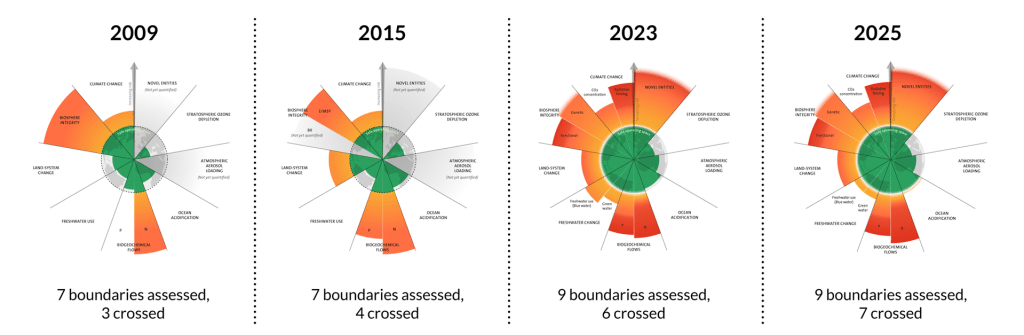
“Unsustainable land conversion, particularly deforestation, remains a major driver of biodiversity loss and climate change,” according to the report. “Food systems account for the near totality of nitrogen and phosphorus boundary transgression … and the massive use of novel entities in food production, processing, and packaging (ranging from plastics to pesticides) remains a major concern.”
Planetary Health Diet
In light of the findings, the report set out a transformation pathway, including a shift to healthy diets, increased agricultural productivity, and reduced food loss and waste. These recommendations center on the concept of a “Planetary Health Diet”, or PHD, and pathways to reach it.
“The report sets out the clearest guidance yet for feeding a growing population without breaching the safe operating space on Earth set by the planetary boundaries,” lead author Johan Rockström, Co-Chair of the EAT-Lancet Commission, said in a statement. “It shows that what we put on our plates can save millions of lives, cut billions of tonnes of emissions, halt the loss of biodiversity, and create a fairer food system.”
Consistent with the previous report and earlier recommendations, the largest portion of the recommended PHD consists of vegetables, fruits, whole grains, tubers and starchy roots. Another central feature of the PHD is the importance of nuts and legumes (including beans, pulses, and soy) as major protein sources.
Weekly consumption is limited to one serving of red meat at most, a maximum of two eggs, two servings of poultry, and two servings of fish. Regarding dairy, one serving (250g) per day is included but is optional and can be reduced to zero.

In the PHD, all of these foods are prepared in a minimally processed form: the report points out that diets high in ultra-processed foods have been associated with 32 adverse health outcomes.
If the world follows these recommendations, a healthy diet is possible for up to 9.6 billion people, with modest impacts on average food costs. However, it would also profoundly change what kind of food we eat, as well as how it is produced and prepared. For example, ruminant meat production would contract by 33% while fruit, vegetable, and nut production would need to increase by 63% compared with 2020.
You might also like: Breaking the Chains: Liberating Ourselves and the Planet from Meat Addiction
Addressing Social Justice for the First Time
For the first time, the EAT-Lancet Report also showed the interaction of food and planetary considerations with an analysis of the social foundations for a just food system. It incorporated new data and perspectives on “distributive, representational, and recognitional justice.”
At the report launch, Shakuntala H. Thilsted, co-chair Justice Group Lead, said, “From the very beginning, it was decided that the new report would include aspects of justice … not just healthy and sustainable food, but also justice in food systems.”
Researchers found that responsibility for planetary boundary transgressions from food systems is not equal: the diets of the richest 30% of the global population contribute to more than 70% of the environmental pressures from food systems. Meanwhile, just 1% of the global population is in a “safe and just space”, as more than half of the world’s population struggles to access healthy diets.
For this reason, the updated PHD allows flexibility and is compatible with many foods, cultures, dietary patterns, traditions, and individual preferences. “The elements of a healthy diet … can be combined in various types of flexitarian, vegetarian, pescatarian, and vegan diets,” the recommendations state. At present, no national diet matches the PHD, but a shift to this pattern could avert approximately 15 million deaths per year.
Additionally, the impact of agriculture production on human health is poorly recognized and unequally distributed. Globally, agriculture accounts for 650,000 deaths, or 20%, of mortality related to poor air quality, largely due to nitrogen pollution from fertilizers. The report recommends a process of “sustainable intensification” to counter these ills.
Ecological intensification, a subset of sustainable intensification, promotes ecological processes such as above-ground and below-ground carbon sequestration, nutrient cycling and storage, pollination, and biological pest regulation. “Zero conversion” of intact forests and grasslands is part of this transformation.

Women’s Role
The interdependent nature of food with various planetary crises is thrown into sharp relief when the role of women in climate change, food production and preparation is considered. “Women are at the heart of food systems,” said Thilsted.
For example, much of the time and labor required for systemic transformation of food preparation will be borne by women. In the case of infant nutrition, women are quite literally food producers. Meanwhile, more than one billion adolescent girls and women suffer from undernutrition, anemia, and other micronutrient deficiencies. This is further exacerbated in situations where marginalized groups face discrimination, or in countries with conflict or war.
“Hunger and starvation have often been used as political weapons of war, and continue to be used as such today,” the report points out.
A Cultural Challenge
Along with its assessment of the current status and its description of an ideal PHD, the 2025 EAT-Lancet report also went a step further than its predecessor. It called for the development of transformative roadmaps to ensure that, by mid-century, “all individuals have access to healthy diets that are equitably produced, processed, and distributed within planetary boundaries.”
With this in mind, the report includes a range of development trajectories with their associated annual and decadal rate of change – covering areas such as irrigation water, phosphorus, land use, production of sugar, red meat, and vegetables – needed to meet the Commission’s suggested targets by 2050.
“The 2025 EAT-Lancet report reflects a growing recognition that transforming food systems isn’t just a scientific challenge, but a cultural one — and that progress depends on the shared insights of farmers, business leaders, policymakers, and citizens alike,” Heidi Yu Spurrell, Founder of consultancy Future Green told Earth.Org in an emailed response.
Despite its dismal findings, the report highlights not only the need for change but also the possibility of a just transition for food systems, arguing: “A just food systems transformation is possible.”
This story is funded by readers like you
Our non-profit newsroom provides climate coverage free of charge and advertising. Your one-off or monthly donations play a crucial role in supporting our operations, expanding our reach, and maintaining our editorial independence.
About EO | Mission Statement | Impact & Reach | Write for us