


Bow Seat is a platform where creativity meets purpose, giving young artists the necessary tools to communicate various environmental issues through art and to turn environmental concerns into tangible action. It has reached over 44,000 students across 142 countries and has awarded nearly US$1 million in scholarships.
—
When Linda Cabot first set sail up the coast of Maine, she did not imagine her weeklong family sailing trip would plant the seeds for a global youth movement. “I just wanted my daughters to experience the ocean, and to connect with it, and to understand the challenges that our oceans were facing,” she said.
Cabot, an artist and lifelong sailor from Boston, had recently read Cod by Mark Kurlansky – a book that examines the history of cod fishing in New England and how it shaped the region’s future. She was shocked to learn that overfishing had drastically diminished cod populations in the Gulf of Maine. What struck her most was how little she knew about the consequences of overfishing and human activity in the waters of the region. She eventually translated her curiosity into an educational film.
She brought a long and experienced photographer, and on her way up to Maine, she interviewed local scientists, authors and fishermen and recorded her daughters’ own reflections on the issue. It was experiential learning in its most authentic form: hands-on, immersive, and deeply personal.
”I wanted to make it fun, but meaningful,” Linda said, as she recollected the trip. “And to show my daughters that caring for the environment can also be an adventure.’’
After the film was released online, she faced the question most artists face: What next?
Creative Action for Conservation
Cabot started small. She first launched an essay contest at a few schools in New England inspired by her film project, inviting young people to share their own observations and ideas about ocean conservation. The response was immediate: 67 entries in its first year. Soon, more teachers incorporated the contest into classrooms, and Cabot realized she had tapped into something bigger.
“As an artist myself, I thought, why not include an art category?” she recalled.
That single addition transformed the program. Participation increased significantly. Students were no longer writing essays as the program expanded to include other artistic forms; soon, they were painting, drawing, photographing, and writing poetry. And just like that, her organization – Bow Seat: Creative Action for Conservation (formerly known as Bow Seat: Ocean Awareness Programs) – had taken off.
Now, nearly 15 years later, Bow Seat has reached over 44,000 students across 142 countries and has awarded nearly US$1 million in scholarships. It is a platform where creativity meets purpose, giving students the necessary tools to communicate various environmental issues through art and to turn environmental concerns into tangible action.
“Creative making gives people a powerful agency,” Cabot said. “When you create something, you’re learning how to communicate your ideas freely. You’re learning to plan, devise and think critically, and you’re having fun doing it.”
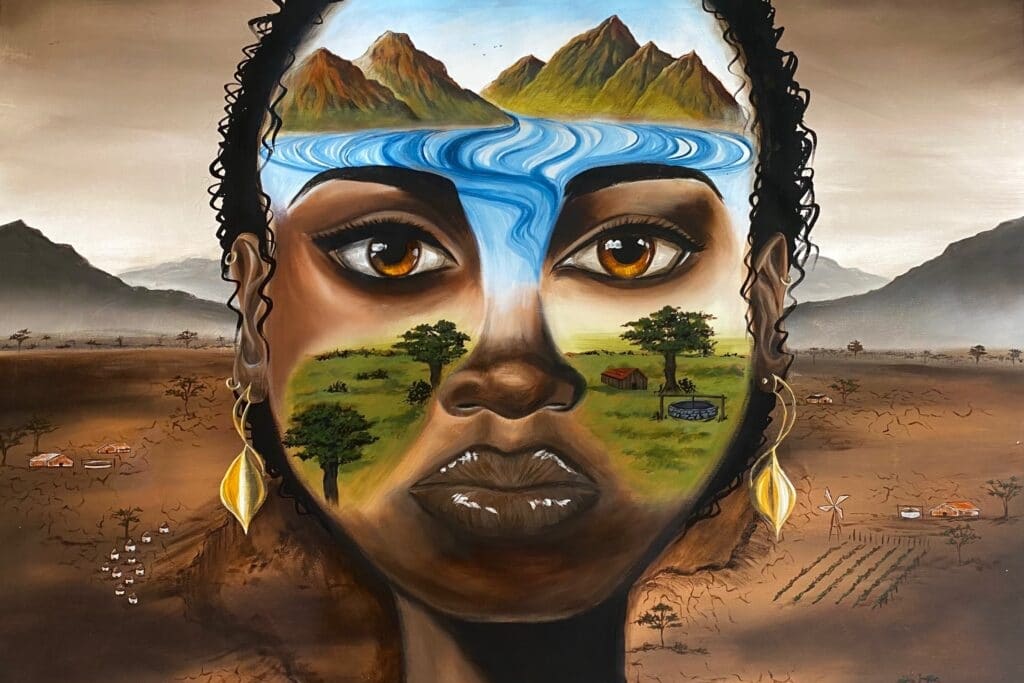
The Physicality of Creativity
What makes Bow Seat’s approach unique is the way it blends intellectual engagement with a hands-on physical experience. Cabot explains that using your hands to paint, sculpt, or film strengthens the connection between thought and action.
“It’s a different type of learning,” she said. “You’re using your brain and your body. You’re experimenting. You’re telling a story through something tangible. It’s incredibly empowering.”
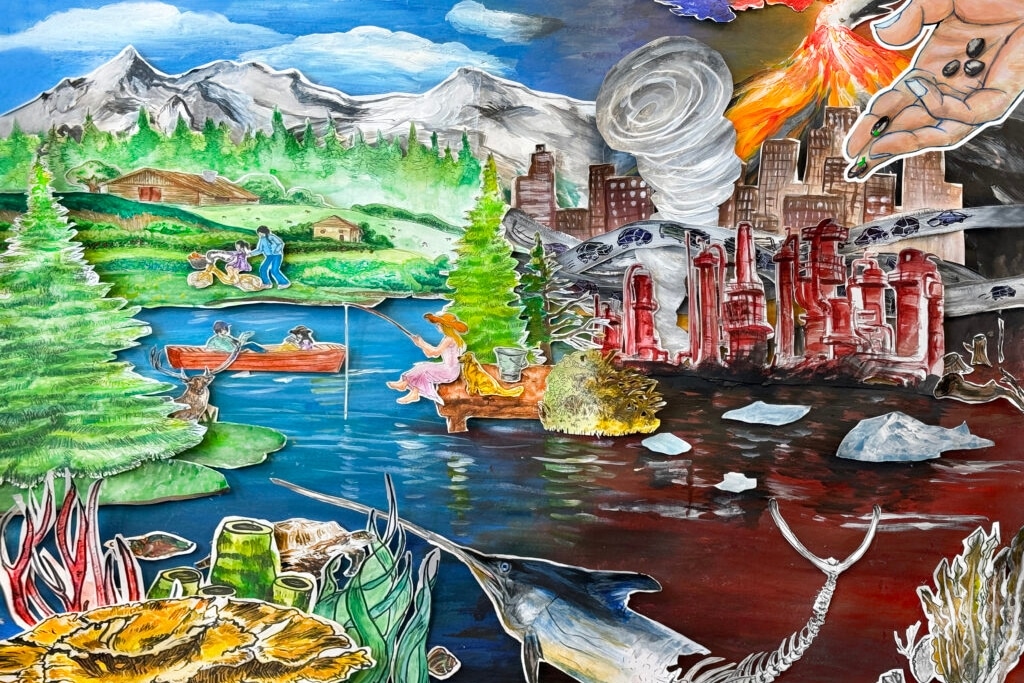
This empowerment is not abstract. It reflects on the creative projects the students create: a watercolor depicting bleached coral reefs, a creative writing piece about local community in a remote corner of the Earth affected by climate change or a natural disaster, a film that illustrates the impacts of the ever changing climate on young people’s mental health, or a poem that mourns the loss of a local wetland.
“These young creatives are not just raising awareness. They’re processing their own feelings about the world, transforming anxiety into hope and action,” Cabot said.
Youth Voices Take Centre Stage
Across the globe, students are taking up this opportunity to talk about conservation. In Singapore, a teen named Ryan drew ghosts of species now extinct from his local forest; in Concord, Massachusetts, Michelle drew a North Atlantic whale in need of protection; and in Milpitas, California, Dyllan crafted poetry inspired by cheeseburgers to raise awareness in his local community about the effects of excessive food consumption and the meat industry’s role on climate change. The list goes on and on. Across continents, students use art to make the abstract real, to translate scientific facts into stories that resonate with the heart as well as with the mind.
“These young people are still hopeful. They care deeply about the world that they are inheriting. They believe things can be better, and they’re willing to act on it,” she explained.
And act they do. Many of these participants in the organization’s programs go on to organize their own local initiatives, create awareness campaigns, and mentor others. , Art becomes the seed for leadership, not just self-expression.
![‘High on Kalopsia’ by Chae Won Yoon, Evan Young Won Ryu, Junhee Won, Ariana Husseini, Do Yune Yi, Louis Chun (London, United Kingdom) [left]; ‘Museum of Ghosts’ by Ryan Chua (Singapore) [right].](https://earth.org/wp-content/uploads/2025/10/5-3.jpg)
Storytelling as Connection
At the heart of Bow Seat’s mission is storytelling. The majority of students root their work in their own personal experiences with the environment, whether that is a local community in China struggling with excessive heat or a student’s childhood memories of the ocean in South Africa.
“These stories tie the global to the personal. They remind students that environmental issues are connected to identity, family, and community.”
Sharing these stories also fosters a sense of belonging. When students see their peers’ projects, they feel recognized. This is what makes Bow Seat an “incredibly uplifting” community of young leaders, in which creativity and environmental concern complement and reinforce one another.
“ “Being part of this wide global network gives kids the confidence to keep going. They feel their actions matter and that they are not alone,” she added.

The Human Touch in the Age of AI
In an era where the rise of artificial intelligence threatens the creative arts, Cabot emphasized the importance of the human hand in the creative process: “There’s something about art that’s personal, authentic, and irreplaceable. Students need to experience creating from scratch, making mistakes, and experimenting. That’s where courage and resilience grow.”
Indeed, Bow Seat encourages its students to embrace and celebrate the experiential process and to bring their own bodies and minds into the work. It is a powerful reminder that human creativity in the face of artificial uncertainty is uniquely powerful.

A Hopeful Future in the Hands of Young Artists
Ultimately, these students do not just produce beautiful work. They aim to cultivate empathy, curiosity, and responsibility for the planet.
“When students lead with awe, they approach problems with hope. They’re inspired to act, to make a difference, to dream bigger,” said Cabot.
From classrooms to community centres, the impact is tangible. All these inspiring projects spark conversations, inform policy and take centre stage in global climate discussions. Each drawing, film or poem becomes part of a larger story: a collective declaration that our shared future is worth protecting.
For Cabot, witnessing this work is a continual source of wonder: “Every time I see a new submission, I feel the same awe I did sailing in Maine. The world feels open, full of possibility, and in good hands.”
Featured image: ‘Climate Justice’ by Hajin Lee (Seoul, Republic of Korea).
This story is funded by readers like you
Our non-profit newsroom provides climate coverage free of charge and advertising. Your one-off or monthly donations play a crucial role in supporting our operations, expanding our reach, and maintaining our editorial independence.
About EO | Mission Statement | Impact & Reach | Write for us