

It is the first climate lawsuit in France seeking to require a multinational oil company to reduce its fossil fuel production, which is worsening climate change.
—
A French court is expected to rule in June on the nation’s first climate lawsuit aimed at holding a multinational oil giant accountable for its contribution to global warming, following a two-day hearing last week.
The case was brought in 2020 by a coalition of French local authorities, alongside five local civil society organizations against France-based multinational TotalEnergies, one of the world’s top six “supermajor” oil companies and one of the 20 largest historical emitters of planet-warming greenhouse gases. It challenges the company’s continued expansion of oil and gas production – the primary fossil fuels driving climate change alongside coal – despite extensive and indisputable scientific evidence of their impact on global climate.
More specifically, the claimants argue that TotalEnergies’ strategy is incompatible with its legal duty of vigilance under a 2017 national law, which requires large French companies to identify risks and prevent human rights and environmental abuses resulting from their activities and those of their subsidiaries. Moreover, Article 1252 of the French Civil Code empowers courts to order “reasonable measures” to prevent or halt imminent ecological damage, acting independently of compensation claims.
The claimants also argue that the multinational’s strategy is in violation of internationally recognized climate obligations, including the 1.5C global warming target established with the Paris Agreement a decade ago.
Despite positioning itself as a “major player in the energy transition”, TotalEnergies has plans to increase its hydrocarbon production by 3% per year until 2030, with at least two-thirds of its investments in fossil fuels. This directly contradicts the scientific consensus that halting new gas and oil field projects is the only way to keep the 1.5C-compatible net-zero emissions scenario alive.
Hearings took place over two days at the Paris Court of Justice last week. Among the prosecution’s witnesses were Valérie Masson-Delmotte and Céline Guivarch, members of the Intergovernmental Panel on Climate Change, the world’s leading and most authoritative scientific body on climate change.
The judges are expected to rule on the matter on June 25. They could compel TotalEnergies to cut its emissions across all its activities as well as to adopt adequate measures such as the termination of new oil and gas projects.
“We are confident in the strength of our legal arguments and the clarity of climate science, and we are hopeful that the judges will compel Total to do its part in the fight against climate change. The company’s climate impunity has gone on for too long,” said Justine Ripoll, Campaign Manager at Notre Affaire à Tous. The NGO brought the case alongside Sherpa, ZEA, Les Eco Maires and France Nature Environnement.
Jérémie Suissa, Executive Director of Notre Affaire à Tous, said TotalEnergies would never voluntarily cut its fossil fuel production after it admitted in court that fossil fuel production must increase despite recognizing that we are in a climate emergency. “Total is therefore telling us that it knows its actions have serious consequences, but that it intends to continue accelerating them,” Suissa said.
Global Momentum
The court case against TotalEnergies comes amid an increase in climate litigation cases seeking to hold states, but increasingly also high-emitting companies, accountable for their contribution to climate change.

It follows landmark rulings by the European Court of Human Rights and the International Court of Justice that have redefined state climate responsibility. Both courts have clarified that states and companies have legal obligations to make adequate contributions to limiting global warming to 1.5C.
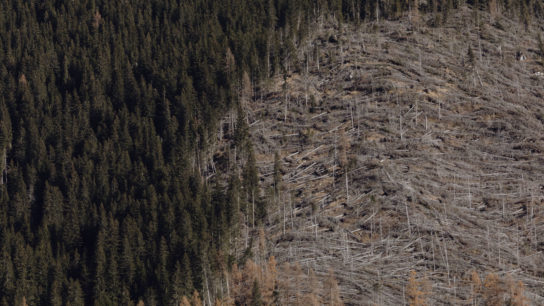
Featured image: Rémy El Sibaïe.
This story is funded by readers like you
Our non-profit newsroom provides climate coverage free of charge and advertising. Your one-off or monthly donations play a crucial role in supporting our operations, expanding our reach, and maintaining our editorial independence.
About EO | Mission Statement | Impact & Reach | Write for us