Researchers looked at data from 2017, the most recent year for which a dataset of emissions is available. Between then and 2023, US oil and gas production has increased by 40% and consumption by 8%.
—
Tens of thousands of premature deaths in the US are linked to air pollution from the oil and gas industries, according to a new study that looked at the entire lifecycle of the two fuels.
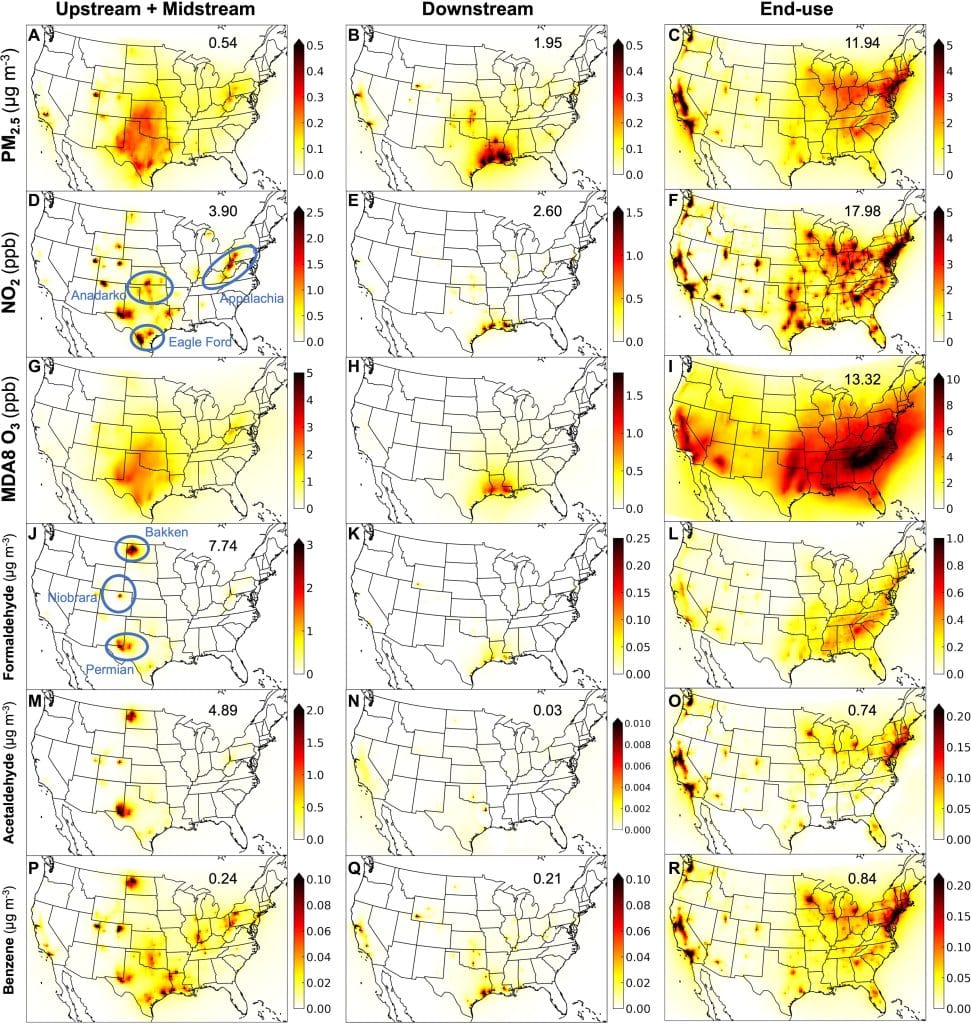
Published Friday in Science Advances, the paper found that fine particles (PM2.5), nitrogen dioxide, ozone and other hazardous air pollutants are attributable to 91,000 premature deaths, 10,350 preterm births and 216,000 childhood-onset asthma and 1,610 cancer cases every year in the country. The US is the world’s largest producer of both oil and natural gas. Together with coal, the three fossil fuels are the single-largest source of global greenhouse gas emissions, the primary drivers of global warming.
The study is the first to look at the health hazards arising from pollution generated across all stages of the oil and gas lifecycle, from exploration and extraction; storage and transmission; alterations processes like oil refining and gas processing, to end-use activities, including storage, transportation and ultimate consumption.
Researchers looked at data from 2017, the most recent year for which a dataset of emissions is available. Between then and 2023, US oil and gas production has increased by 40% and consumption by 8%, according to the Guardian.
Communities of Color Bear the Brunt
California, Texas, New York, Pennsylvania and New Jersey recorded the highest health burden from air pollution from oil and gas. But the impacts were not felt equally across these states.
Asian, Black, Hispanic, and Native American communities experience the worst exposures and burdens for all lifecycle stages and pollutants. The latter two groups are hotspots for pollution from exploration, extraction, transportation and storage. Meanwhile, Asian and Black population – particularly in infamous hotspots like Louisiana’s “Cancer Alley” and eastern Texas – bear the brunt of emissions from alteration processes, manufacturing, distribution and consumption.
Surface concentrations of health-damaging air pollutants for each major O&G lifecycle stage in 2017. Image: Vohra et al (2025).
Globally, air pollution ranks as the second leading risk factor for death, after high blood pressure and before tobacco.
Last year, only seven countries in the world – Australia, Estonia, New Zealand, Iceland, Grenada, Puerto Rico, and French Polynesia – had air quality levels at or below the healthy annual average recommended by the World Health Organization (WHO). The UN agency estimates that at least nine out of 10 people worldwide live in places with low air quality.
Globally, PM2.5 is associated with approximately 7 million deaths around the world every year and causes the average person to lose approximately 2.3 years of life expectancy – or a combined 17.8 billion years.
PM2.5, the most commonly used unit in air quality measurements, refers to an atmospheric particulate matter that has a diameter of less than 2.5 micrometers, or about 3% the diameter of a human hair, and is said to pose the greatest risk to human health. Studies have linked it to premature mortality, heart or lung diseases, acute and chronic bronchitis, asthma attacks, and other respiratory symptoms.
Pollutant
2021 AQGs
Fine particulate matter, µg/m3
Annual: 5 24-hour: 15
Ozone, µg/m3
8-hour: 100
Nitrogen dioxide, µg/m3
Annual: 25 24-hour: 40
Recommended 2021 World Health Organization’s Air quality guidelines (AQG) levels. Table: Earth.Org
WHO issued new, more stringent guidelines on air pollution in September 2021, following new research showing PM2.5 to be more harmful than previously thought. It set the 24-hour PM2.5 safe limit at 15 μg/m3 and the annual threshold at 5 μg/m3.
Our non-profit newsroom provides climate coverage free of charge and advertising. Your one-off or monthly donations play a crucial role in supporting our operations, expanding our reach, and maintaining our editorial independence.
While there was “no evidence” that cuts to weather agencies affected weather warnings ahead of the floods, a well-known US meteorologist said these cuts “will eventually bite us with unneeded loss of life.”
—
At least 78 people have died and dozens remain missing after catastrophic floods wrecked havoc in Texas on Independence Day.
28 of the victims were children, Larry Leitha, sheriff of Kerr County in Texas Hill Country – the epicenter of the flooding – confirmed on Sunday.
The disaster unfolded rapidly on Friday, as torrential rain across central Texas increased the water level of the Guadalupe River by 26 feet (8 meters) within 45 minutes, bursting its banks and destroying everything in its path.
As search-and-rescue operations – some of the largest efforts in recent Texas history – continue, questions have surfaced regarding local authorities’ preparedness and the effectiveness of the warning systems in place.
Some Texas elected officials have blamed the National Weather Service (NWS) for issuing inadequate forecasts and warnings ahead of the storm. But meteorologists and former Weather Service officials have defended the forecasts, saying they were as good and accurate as they could be given the storm’s abrupt escalation, the New York Times reported.
Rapidly intensifying rainfall events like this one are inherently difficult to predict, and forecasters often cannot pinpoint exactly where and when high-intensity and heavily localized rainfall will occur, UCLA climate scientist Daniel Swain explained. Flash floods, as the name suggests, are also very hard to predict due to their rapid and often sudden onset.
Criticism over the Trump administration’s recent cuts to emergency response and weather forecasting agencies have also mounted over the weekend. Experts have repeatedly warned that these cuts have diminished forecasters’ abilities to predict disasters and provide accurate advance warning.
Meteorologist John Morales said on Saturday there was no evidence that cuts to weather agencies affected weather warnings ahead of the floods, though he added that these cuts “will eventually bite us with unneeded loss of life.” On Sunday, however, Morales pointed out at current vacancies at local NWS offices in key roles such as Meteorologist in Charge and Warning Coordination Meteorologist.
Some experts have warned that these staff shortages, which have doubled since Donald Trump took office in January, might have complicated forecasters’ ability to coordinate responses with local emergency management officials, the New York Times reported.
Trump was quick to reject the claims, while the White House said in a statement to media outlets that claims that NWS cuts were related to the tragedy were “shameful and disgusting.”
Climate Link
There is consensus among climate experts that events like this are becoming stronger and more frequent in a rapidly warming world.
A warmer atmosphere, heated by fossil fuel emissions, can hold more moisture, resulting in heavier downpours. For every 1C that Earth’s atmospheric temperature rises, the amount of water vapor in the atmosphere can increase by about 7%.
Current sea surface temperatures in the Gulf of Mexico are made 10x to 30x more likely by climate change. Image: Climate Central.
According to Climate Central, the low-level moisture fueling the weather system over Texas came from a warmer-than-average Gulf of Mexico. Sea temperatures here are currently 1-2F above average for this time of year owing to climate change.
“This kind of record-shattering rain (caused by slow-moving torrential thunderstorms) event is *precisely* that which is increasing the fastest in a warming climate,” said Swain. “So it’s not a question of whether climate change played a role–it’s only a question of how much.”
Temperatures have been abnormally high across the US in recent weeks, while much of Europe endured a deadly heatwave that shattered records in Portugal and Spain.
This story is funded by readers like you
Our non-profit newsroom provides climate coverage free of charge and advertising. Your one-off or monthly donations play a crucial role in supporting our operations, expanding our reach, and maintaining our editorial independence.
Agriculture Secretary Brooke Rollins on Monday announced the administration’s intention to rescind a quarter-century old rule prohibiting road construction, reconstruction, and timber harvest on large areas of the National Forest System.
—
The Trump administration plans to rescind a Clinton-era rule that blocked logging on national forest lands, Agriculture Secretary Brooke Rollins announced Monday.
Speaking at the Western Governors Association annual meeting, Rollins announced a rollback of what she described as the “overly restrictive” Roadless Rule. Introduced by the Clinton administration in 2001, the policy prohibits road construction, reconstruction, and timber harvest on nearly 59 million acres of the National Forest System.
It follows a March executive order and a memo issued by Rollins in April, which laid the groundwork for a major increase in industrial logging across federal forests.
“The roadless rule has protected 58 million acres of our wildest national forest lands from clearcutting for more than a generation,” said Drew Caputo, Vice President of Litigation for Lands, Wildlife and Oceans at Earthjustice.
“The Trump administration now wants to throw these forest protections overboard so the timber industry can make huge money from unrestrained logging. These are lands that belong to all Americans, not the timber industry,” Caputo added, threatening leagl action against the Trump administration if the rollback goes ahead.
“Once again, the Trump administration is ignoring the voices of millions of Americans to pursue a corporate giveaway for his billionaire buddies,” said Alex Craven, Forest Campaign Manager at grassroots environmental organization Sierra Club.
The groups warned that timber and mining activities would pollute air and drinking water and strip away essential habitats for wildlife such as California condors, grizzly bears and wolves of the Yellowstone area, native salmon and trout in the Pacific Northwest, migratory songbirds of the Appalachian hardwoods.
Deforestation is also directly linked to higher emissions. When forests are cleared, the carbon stored in trees is released into the atmosphere as carbon dioxide, the largest contributor to global warming.
US Secretary of Agriculture Brooke Rollins. Photo: Gage Skidmore via Wikimedia Commons.
Rollins justified the move as necessary to allow for better fire management in places such as Utah, Montana, and Alaska’s Tongass National Forest, where large areas of forest are protected under the Roadless Rule. This is despite research finding that most fires originate in close proximity to roads and settlements.
According to the Center for Biological Diversity, a US-based non-profit, decades of logging, fire suppression and livestock grazing have dried out forests across the country, increasing the risk of large, high-intensity fire.
Featured image: Wikimedia Commons.
This story is funded by readers like you
Our non-profit newsroom provides climate coverage free of charge and advertising. Your one-off or monthly donations play a crucial role in supporting our operations, expanding our reach, and maintaining our editorial independence.
“The federal government’s actions are not only unlawful; they’re irrational and wildly partisan,” California’s Democratic Attorney General Rob Bonta said on Thursday.
—
California’s Attorney General Rob Bonta sued the Trump administration over a Congress-backed resolution blocking the state’s mandates to phase out gas-powered cars.
President Donald Trump signed a resolution blocking California’s first-in-the-nation ban on the sale of new gas-powered cars by 2035. Shortly after, Bonta announced the lawsuit at a press conference, describing the move as “reckless, politically motivated, and illegal attacks on California.”
Ten other states that are enforcing California’s emissions rules, including Colorado, Delaware, Massachusetts, New Jersey, New Mexico, and New York, joined the lawsuit.
Previous administrations granted California waivers to set to set its own, more stringent vehicle standards in the 1967 Clean Air Act to curb air pollution in the state, which is home to five of the country’s 10 most polluted cities.
Under California’s 2022 mandate, which builds on builds on decades of tightening emissions standards for cars sold in the state, 35% of new 2026 model cars sold in the state must be zero-emissions, increasing to 68% in 2030 and 100% in 2035.
Trump’s resolution also blocked California’s 2020 Advanced Clean Trucks rule, which established zero-emission vehicle standards for medium and heavy-duty vehicles, and a 2020 state regulation reducing smog-forming nitrogen oxides emitted by trucks and buses. It came after the Republican-led Congress approved the resolution last month.
California Attorney General Rob Bonta. Photo: Wikimedia Commons.
In a statement, Governor Gavin Newson accused Trump of being “wholly-owned subsidiary of big polluters.”
“Trump’s all-out assault on California continues – and this time he’s destroying our clean air and America’s global competitiveness in the process,” the statement read.
California is currently involved in 25 lawsuits challenging Trump administration actions, including blocking billions in federal funding for electric vehicle chargers and halting the approval of wind energy infrastructure.
‘Fundamentally Irreconcilable’
In April, US President Donald Trump instructed the Department of Justice to “stop the enforcement” of what his administration says are “unconstitutional” or “otherwise unenforceable” state climate laws.
The executive order instructs Attorney General Pam Bondi to “prioritize the identification” and “take all appropriate action to stop the enforcement” of state laws “purporting to address ‘climate change’ or involving ‘environmental, social, and governance’ initiatives, ‘environmental justice,’ carbon or ‘greenhouse gas’ emissions, and funds to collect carbon penalties or carbon taxes.”
The order identified California, New York, and Vermont as targets, alongside a wide array of state regulations that the administration aims to invalidate, spanning from cap-and-trade programs to licensing regulations. Trump says these laws are “fundamentally irreconcilable with my Administration’s objective to unleash American energy” and they “should not stand.”
US President Donald Trump signs an executive order on January 20, 2025. Photo: Wikimedia Commons.
One of the rules under attack is California’s climate superfund legislation, which the state adopted in February. Modelled on climate superfund laws passed by New York and Vermont last year, California’s Polluters Pay Climate Superfund Act seeks to hold fossil fuel companies financially responsible for damage caused by the burning of three planet-warming fossil fuels – coal, oil and gas.
It requires companies generating more than 1 billion tons of greenhouse gas emissions between 1990 and 2024 to pay into the newly created state fund, with fees going into a Polluters Pay Climate Fund to finance climate disaster recovery and resiliency projects.
Our non-profit newsroom provides climate coverage free of charge and advertising. Your one-off or monthly donations play a crucial role in supporting our operations, expanding our reach, and maintaining our editorial independence.
Drastically reversing prior marine protections, US President Donald Trump recently signed a proclamation opening the Pacific Remote Islands Marine National Monument (PRIMNM)to commercial fishing. Conservationists are worried this move will erase years of biodiversity progress in the zone, and fear it is a stark example of commercial interests being prioritized over environmental stewardship.
—
Announced last month, the Trump administration’s America First Fishing Policy reverses protections that restricted commercial fishing across nearly 500,000 square miles of Pacific waters. The restrictions were designed to protect the space, home to coral reefs, endangered species like the coconut crab and hawksbill turtle, and migratory fish populations such as the bumphead parrotfish.
According to Trump, commercial fishing, when appropriately managed, does not harm “objects of scientific and historic interest” that the PRIMNM protects. He further argues that because tuna and similar fish are migratory and not permanent residents of the monument’s waters, opening the space to commercial fishing would not necessarily harm them.
The PRIMNM, recently renamed the Pacific Islands Heritage Marine National Monument by the Trump administration, includes US remote Pacific territories such as Baker, Howland, and Jarvis islands; Johnston, Wake, and Palmyra atolls; and Kingman Reef, located roughly 750 miles southwest of the islands of Hawaii.
Scientists and environmentalists, however, remain sceptical.
Marine biologists have warned that the decision will create chaos for ocean ecosystems already burdened with the pressure of warming waters and acidification. The PRIMNM is considered one of the most untouched marine environments in the world, with living coral ecosystems, rare bird species, and crucial migratory corridors.
“This is one of the most pristine tropical marine environments in the world that already faces dire threats from climate change and ocean acidification,” said David Henkin, an attorney in Earthjustice’s Mid-Pacific Office, adding that “we will do everything in our power to protect the Monument.”
US President Donald Trump signs a proclamation to unleash American commercial fishing in the Pacific Ocean—a key component of the America First Fishing Policy, on April 17, 2025, in the Oval Office. Photo: The White House/Flickr.
Fish First
Trump’s proclamation echoes a common industry argument – that the prior ban from his predecessors did little to stop overfishing since tuna and numerous other fish species are migratory. But experts say that is a misunderstanding of what marine protected areas are.
“MPAs act as safe havens for marine life,” notes the National Oceanic and Atmospheric Administration (NOAA). These areas provide crucial spaces to support the life cycles of numerous marine species, creating healthy, resilient ocean ecosystems.
Environmental specialists warn that the rollback opens the door for deregulation in federal waters, part of Trump’s wider effort to derank environmental protections when prioritized with economic growth.
Critics say Trump’s fishing order is only the start to more environmental hardships, especially in terms of marine life and ocean conservation.
“When we protect the oceans, we’re really protecting ourselves,” said Sandy Aylesworth, Director of the Pacific Initiative for the Natural Resources Defense Council, adding that expanding protections is crucial to prepare ocean ecosystems for future stressors like climate change and industrial exploitation.
The order is already facing legal resistance, with Earthjustice and other environmental groups announcing plans to sue the administration.
“We will do everything in our power to protect the Monument,” said David Henkin, an attorney with Earthjustice’s Mid-Pacific Office. “This environment is already facing dire threats from climate change and ocean acidification – we cannot afford to let industrial fishing compound that damage.”
Senator Brian Schatz of Hawaii acknowledged past bipartisan conservation and restoration efforts in the Pacific Ocean, warning that Trump’s order effectively reverses the progress achieved. “We should be protecting the Pacificʻs unmatched ecology and biodiversity for future generations – this order does the opposite,” Schatz said in a statement, media outlets reported.
The Pacific Remote Islands Marine National Monument is home to coral reefs and endangered species like such as the hawksbill turtle. Photo: U.S. Fish and Wildlife Service Southeast Region/Flickr.
The PRIMNM was first created by former president George W. Bush in 2009 and dramatically expanded by his successor Barack Obama in 2014. The Biden administration in 2023 attempted to expand protected sanctuaries to over 770,000 square miles of ocean – the creation of the Chumash Heritage National Marine Sanctuary off the coast of Central California was part of these efforts.
The Economic Argument
The White House fact sheet lists the benefits for American Samoa and Hawaii’s fishing economies, yet skepticism remains over whether Trump’s decision is actually beneficial.
Bureau of Environmental and Coastal Quality acting administrator Floyd Masga stated that “opening national monuments to commercial fishing threatens fragile ecosystems, endangers species, disrupts spawning and migration, and risks overfishing key stocks like tuna and bottomfish.”
Not everyone, however, was critical of Trumpʻs order. Eric Kingma, Executive Director of the Hawaii Longline Association, believes it marks a return to balanced ocean policy. “Sustainable fisheries and ocean protection can be achieved together. Previous presidents misused the Antiquities Act to lock up ocean areas critical to local economies,” he said.
Hawaii’s commercial longline fleet, a $100-million-a-year industry, has faced declining profits in recent years. Those in favor of Trump’s agenda say that protections and international competition, especially competition with less supervision, have made the fleet less of a threat.
Kitty Simonds, Executive Director of the Western Pacific Fishery Management Council and a known critic of marine monuments, stood beside Trump while he signed the executive order. She warned that any more area designated a marine sanctuary would have threatened American Samoa’s tuna industry, putting both jobs and local economy at risk.
The Bottom Line
Trump’s decision to reopen PRIMNM to commercial fishing represents a reversal of global momentum to preserve the oceans in the face of climate collapse.
As marine biologist Bob Richmond put it, “This is the wrong move at the wrong time. By raiding what amounts to our children’s marine bank accounts, we are denying them a future of sustainable food from the ocean.”
This story is funded by readers like you
Our non-profit newsroom provides climate coverage free of charge and advertising. Your one-off or monthly donations play a crucial role in supporting our operations, expanding our reach, and maintaining our editorial independence.
“The Captive Primate Safety Act will ban the unlicensed trade and private possession of primates –reducing the threat of disease, preventing future tragedies, and ensuring these intelligent animals are no longer subjected to neglect and abuse,” said Congressman Brian Fitzpatrick.
—
On May 5, the Captive Primate Safety Act – which bans the private ownership of primates in the United States – was reintroduced in Congress.
The introduction of this important bill was further heralded by Democratic Congressman Mike Quigley, who on Friday toured the Born Free USA Primate Sanctuary and met some of the victims of the primate pet trade and learn more about their stories.
“Monkeys and apes belong in the wild – not in living rooms,” said Quigley, Co-Chair of the Congressional Animal Protection Caucus. “This bill will ban private possession of these animals, ensuring that we are safe and primates are able to live freely. As the lead sponsor of the 2022 Big Cat Protection Law, I’m proud to sponsor the Captive Primate Safety Act to advance the same protections for primates.”
Monkeys housed at the sanctuary include Wally, a Rhesus macaque who, despite his small size, caused his former owner serious injury by biting off part of her ear, and Gizmo, an illegally kept vervet monkey, who was surrendered after attacking his owner’s son-in-law. These are just two of the sanctuary residents who were surrendered or confiscated after attacking their owners while kept as pets.
In addition to Quigley, the Captive Primate Safety Act was introduced by Representatives Brian Fitzpatrick, Julia Brownley, and Nancy Mace. It was introduced in the Senate by Senator Richard Blumenthal.
“Primates are intelligent and social creatures. But when primates are kept as pets – in captivity and restrained – they can become highly unpredictable and dangerous,” said Blumenthal. “Wild animals belong in the wild, and this legislation ends the inhumane exploitation of these animals as pets – protecting both people and primates.”
While larger species of primate, such as chimpanzees, are widely recognized as posing significant danger to people, smaller animals, such as the macaques and vervets cared for by Born Free USA, can also cause life-changing injuries. This, says Born Free CEO, Angela Grimes, is one reason why a blanket ban on their keeping as “pets” is necessary.
“Too many times, our team has received frantic phone calls from primate pet owners desperate for us to help them,” Grimes said. “They purchase a monkey when they are just a few weeks old and have no idea that this small, vulnerable animal will soon become a dangerous risk to them and their families. When the monkey reaches adolescence, the owners start to see instances of aggression – a natural behavior in monkeys – and these instances often escalate to the point of someone being seriously harmed. It is then that a sanctuary is called in to take on the monkey, as the owner realizes that they have made a mistake.”
“Your family shouldn’t have to worry about wild monkeys next door. When reckless owners treat primates like pets, it’s law enforcement, taxpayers, and innocent families who pay the price,” said Congresswoman Mace. “The Captive Primate Safety Act is simple: protect the public, protect law enforcement, and stop this dangerous trend before someone else gets hurt.”
In addition to calls from primate owners, the sanctuary receives requests for help from law enforcement and animal control departments, neither of which are trained to deal with wild animals such as monkeys.
Willis, a young vervet monkey, was found running loose in Chicago and was captured by local animal control. He escaped his holding cage twice on the first day, and the officers called Born Free USA asking for help. Willis was soon on a plane to south Texas, where he now lives with others of his own kind. Other monkeys at the sanctuary who were confiscated include Rhesus macaques, Pablito and Lyla, and Japanese macaque, Julian.
Congressman Mike Quigley of Illinois visits the Born Free USA Primate Sanctuary on May 9, 2025. Photo: Born Free USA.
Born Free USA’s Animal Welfare and Advocacy Director, Liz Tyson, said the fact that law enforcement is not trained to deal with these animals. “[This] represents a threat to putting their staff in danger when they find illegally kept primates, or it means that confiscation is simply not possible for lack of somewhere for the monkeys to go,” she said.
Congressman Fitzpatrick called the private ownership of primates “is “a dangerous and outdated practice that puts both animals and communities at risk.”
“The Captive Primate Safety Act will ban the unlicensed trade and private possession of primates –reducing the threat of disease, preventing future tragedies, and ensuring these intelligent animals are no longer subjected to neglect and abuse,” Fitzpatrick explained.
The Born Free USA Primate Sanctuary cares for more than 200 monkeys rescued from abuse and neglect in the pet trade, zoo, and laboratory industries.
This story is funded by readers like you
Our non-profit newsroom provides climate coverage free of charge and advertising. Your one-off or monthly donations play a crucial role in supporting our operations, expanding our reach, and maintaining our editorial independence.
The UK’s Labour Party has made bold promises on climate change but one year after its landslide victory, arguably not much has been achieved. In stark contrast, the new Trump administration has dismantled much of the US’s climate progress and rewritten the country’s role in international climate affairs.
—
Mitigating climate change remains, for the most part, a top-down affair. Despite the swelling voices of civil society and businesses alike, only effective climate policy can affect the kind of change our planet desperately needs. Climate action is political – who leads a country often determines how seriously climate change is tackled.
Yet, when election season arrives, environmental issues tend to be eclipsed by more immediate concerns such as healthcare, housing, cost of living, and job security. This is where the climate conundrum lies: future generations will pay the price if we fail to act today.
2024 was a year where many incumbent leaders were overturned by voters rattled by skyrocketing inflation and an increasingly unstable geopolitical situation. In countries like the UK, Germany and the US, climate change policies remain a polarizing political issue. Meanwhile, nations like Singapore, Denmark and New Zealand broadly agree on the goal of achieving net zero across the political spectrum.
In this article, Earth.Org looks at how some of today’s political parties are responding to the call for greater action on climate change.
United Kingdom
The Labour Party, which secured the largest majority government in 25 years at last year’s election, positioned itself as the climate-forward alternative, promising to make Britain a clean energy superpower.
Their “Clean Power by 2030” pledge, which includes doubling onshore wind, tripling solar, and quadrupling offshore wind capacity within five years, is no doubt ambitious. Additionally, the party plans to scale up public and private investments in emerging technologies like hydrogen, tidal and wave energy and long-term energy storage while extending nuclear capabilities. Most crucially, the government is not framing climate action as a sacrifice or a cost. Through its Green Prosperity Plan, the party is linking decarbonization with economic revitalization and job creation, showing that climate action can – and must – serve everyday livelihoods.
In practice, this means upgrading millions of homes with better insulation and low-carbon heating to lower energy bills; investing in local energy production to retain economic value within communities; and creating tens of thousands of jobs in clean energy infrastructure, home retrofitting, and supply chain industries.
UK Prime Minister Keir Starmer speaking at COP29. Photo: UN Climate Change/Kamran Guliyev via Flickr.
The party also advanced a bill to institute the Great British Energy, a publicly-owned clean energy company headquartered in Scotland. The proposal is intended not only to accelerate investment in renewable energy but also to ensure that the economic benefits of the clean energy transition are shared with the public, rather than captured solely by private corporations.
The ambition of the Green Prosperity Plan and the creation of Great British Energy may signal intent, but delivering on these commitments will be the real test. Turning these ambitious commitments into measurable outcomes – such as upgraded homes, new jobs, and expanded clean energy capacity – will determine whether Labour’s climate forward mandate is credible.
Canada
Last month, Canada overwhelmingly rejected conservative ideologies in favour of a more Liberal approach, electing former central banker and UN climate envoy Mark Carney.
The election has brought renewed attention to the country’s dual-track climate strategy. As the new leader of the Liberal Party, Carney has pledged to position Canada as an “energy superpower” – not only in clean energy, but also in conventional fossil fuels.
“We are going to aggressively develop projects that are in the national interest in order to protect Canada’s energy security, diversify our trade, and enhance our long-term competitiveness – all while reducing emissions,” said Carney.
Rather than pursuing an abrupt phase-out of fossil fuels, Carney’s government is focusing on technological solutions to decarbonize existing systems. This includes heavy investment in carbon removal and storage, expanded electric vehicle infrastructure, and large-scale electricity transmission networks to better connect renewable power sources across Canada’s vast geography. These initiatives aim to lower emissions while maintaining economic competitiveness and energy reliability.
At the same time, Carney has moved to reform climate policy instruments, including replacing the consumer-facing carbon tax with green incentives – seeking to make climate action more politically palatable and economically inclusive. However, the industrial carbon price remains intact, reinforcing Canada’s emissions accountability at the enterprise level.
“We are pleased to see that our new prime minister has promised to strengthen it and call on him to maintain and strengthen other key climate and biodiversity protection policies,” Greenpeace Canada’s senior energy strategist Keith Stewart said in a statement.
This direction stands in sharp contrast to the opposition Conservative Party, which has pledged to scrap climate regulations, roll back clean energy investments, and expand oil and gas production and exports.
Despite domestic political uncertainty and the complexities of trade relations – particularly with the US –Carney’s government is pressing ahead with its 2030 Emissions Reduction Plan, which targets a 60% cut from 2005 levels. Whether this plan succeeds will depend not only on federal leadership, but also on cooperation with provinces, especially energy-intensive regions like Alberta, and the country’s ability to attract investment into emerging green sectors.
United States
Merely 100 days since his inauguration, US President Donald Trump has overturned years of climate progress and altered the US’ role in the global fight against climate change.. From walking away from the Paris Agreement to cutting funds for climate transition in developing countries, the current administration’s posture leans heavily toward fossil fuel interests and deregulation.
This regression underscores a key vulnerability in the US system: the partisan pendulum of climate policy. Every change in administration brings with it the potential for major reversals – not only in climate policy but also in social, immigration, and foreign affairs. Democratic-led ambitious climate strategies, such as the Inflation Reduction Act and climate-linked industrial policy, have been dismantled or delayed by Republican-led administrations, which view climate regulation as an economic constraint rather than an opportunity.
As a result, the US, despite being one of the world’s largest carbon emitters and innovation powerhouses, remains an unreliable partner on the global stage when it comes to long-term climate commitments. This inconsistency has a ripple effect: it undermines multilateral climate negotiations, weakens investor confidence in green sectors, and complicates other nations’ efforts to align trade or carbon border measures with US policy.
A group of coal miners clap as President Donald Trump signs executive orders on the coal industry on April 8, 2025. Photo: The White House/Flickr.
The US case demonstrates a sobering truth: if politics can enable climate action, it can just as easily disable it. In a democracy as polarized as this, the climate agenda becomes vulnerable to election cycles, party ideologies, and the influence of entrenched fossil fuel lobbies. The path forward may require more than just policy, it may demand deeper institutional reforms, bipartisan consensus-building, or even climate-resilient governance mechanisms that can withstand electoral swings.
Singapore’s political landscape presents a rare example of bipartisan consensus on the importance of climate action – where both the ruling party and opposition agree that the green transition and net-zero goals are non-negotiable national priorities. This reflects a pragmatic political culture shaped by Singapore’s vulnerability to climate risks, its dense urban environment, and the country’s dependence on global trade and energy imports.
The People’s Action Party, which has governed unchallenged since independence was achieved in 1965 and won another mandate earlier this month, takes a cautiously ambitious, whole-of-government approach, balancing decarbonization with economic resilience. The government has articulated a comprehensive long-term strategy through its Singapore Green Plan 2030. The roadmap focuses on nature, energy, circular economy, decarbonization, green economy and climate change adaptation. Opposition parties like the Workers Party, while aligned on fundamentals, have called for the acceleration of renewable energy adoption, increased support for small and medium enterprises (SMEs) in the green transition, and the introduction of stronger environmental safeguards.
The cross-party alignment suggests that climate policy in Singapore is less likely to be derailed by political turnover, unlike in many other countries. However, the real challenge lies not in setting targets, but in implementation, especially given constraints like limited land, low renewable energy potential and economic dependencies on sectors such as petrochemicals, aviation, and maritime trade. Yet these constraints have made Singapore a testbed for climate innovation, particularly in urban sustainability, carbon markets and green finance as well as regional energy cooperation among ASEAN countries.
The contrast between countries with consistent climate policies and those with volatile, partisan approaches reveals a hard truth: politics can either accelerate or obstruct the transition to a sustainable future. When political leadership aligns climate action with job security, energy resilience, and cost-of-living improvements, it transforms climate policy from an abstract ideal into a tangible public good – one that voters are more likely to support.
Ultimately, the climate crisis is the defining test of political will and institutional resilience, challenging leaders and institutions to maintain long-term climate commitments across electoral cycles, economic shocks and geopolitical disruptions.
Featured image: Paddy O’Sullivan/Unsplash.
This story is funded by readers like you
Our non-profit newsroom provides climate coverage free of charge and advertising. Your one-off or monthly donations play a crucial role in supporting our operations, expanding our reach, and maintaining our editorial independence.
At least 24 people died after a series of deadly storms across the southern and midwest US, with severe rains, flooding rivers and tornadoes triggering evacuation orders in several states.
—
The record-breaking rain that triggered flash flooding in the southern and Midwest US in early April were intensified by climate change, a new study has concluded.
Heavy downpours affected the Central Mississippi river valley between April 2 and 6, with some areas receiving more than 400mm of rain, a record for the region. An unprecedented number of tornado warnings was also issued during the same period.
The extreme weather caused flash floods and triggered flash flood warnings across Mississippi, Arkansas, Missouri, Georgia, Illinois, Indiana, Kentucky, Tennessee, and Alabama, claiming at least 24 lives.
Scientists at World Weather Attribution, an international group looking at the possible influence of climate change on extreme weather events, said that climate change has made last month’s rainfall about 9% more intense. Their attribution study, published Thursday, also concluded that the unusual warmth of the sea in the Gulf of Mexico, which fed the storm moisture, was about 14 times more likely due to climate change.
A warmer atmosphere, heated by fossil fuel emissions, can hold more moisture, resulting in heavier downpours. For every 1C that Earth’s atmospheric temperature rises, the amount of water vapor in the atmosphere can increase by about 7%. Today, the planet is about 1.3C hotter than pre-industrial times.
The study looked at weather data and climate models to compare how rainfall events have changed between today’s climate and the cooler pre-industrial climate.
Atmospheric River
April’s downpoars were the result of a relatively common weather phenomenon in the West known as atmospheric river. Acting like nature’s superhighways, atmospheric rivers transport massive amounts of moisture, unleashing powerful snow or rainstorms wherever they flow.
But last month’s event was “exceptional”, Jay Cordeira, an atmospheric scientist with the Center for Western Weather and Water Extremes, told CNN. “It was as strong as they come.”
Atmospheric rivers are becoming increasingly frequent and carrying more moisture as a result of rising temperatures globally. With climate change knocking at our door and air and ocean temperatures rising, atmospheric rivers will only keep intensifying in strength, frequency, and length. Research suggests that total precipitation during atmospheric rivers in California will increase by up to 40% in a warming world.
Featured image: U.S. Department of Agriculture/Flickr.
This story is funded by readers like you
Our non-profit newsroom provides climate coverage free of charge and advertising. Your one-off or monthly donations play a crucial role in supporting our operations, expanding our reach, and maintaining our editorial independence.
The average wildfire season in Western US is now 105 days longer, burns six times as many acres, and sees three times as many large fires, according to Climate Central. Earth.Org looks at the data to establish whether there is a link between increased wildfire activity and drought severity.
—
Drought is one of the most devastating natural disasters, affecting millions of people worldwide. Unlike hurricanes or earthquakes, droughts develop slowly and can persist for months, years, and even decades, leading to lasting effects on agriculture, water supply, and ecosystems.
In 2024, 48 of 50 US states faced drought conditions, the highest proportion ever recorded in the country, while wildfires scorched over 8.9 million acres nationwide. As climate change accelerates, droughts are becoming more frequent and widespread, and their relationship with wildfires is no longer speculation.
Drought Trends
Drought occurs when a region experiences prolonged periods of lower-than-average precipitation, leading to water shortages and drier lands. Both natural and human factors can influence it, including varying climatic conditions, rising global temperatures, deforestation, and unsustainable water use.
The US Drought Monitor provides historical drought data, classifying drought severity into categories ranging from D0 (Abnormally Dry) to D4 (Exceptional Drought).
Time series plot of various drought categories. Data: dought.gov. Graph: Earth.Org.
A time series plot from 2000 to January 2025 illustrates trends across different drought categories (D0 to D4), revealing a periodic pattern. Severe droughts (D2-D4) peak every 3-5 years, likely influenced by climate oscillations such as El Niño and La Niña. Autocorrelation tests confirm this periodicity, showing strong correlations at 2-3 year lags, particularly for D3–D4 droughts.
Additionally, drought severity has intensified, with “exceptional drought” coverage increasing by 12% since 2000. While mild droughts (D0–D1) follow annual wet/dry cycles, severe droughts (D2–D4) persist for multiple years.
Given this cyclical behavior, an important question arises: do wildfires follow a similar pattern?
Time series plot of burnt acres due to wildfire. Data: NIFC. Graph: Earth.Org.
Wildfire Trends
Using historical wildfire data from the National Interagency Fire Center, we analyzed the total acres burned over the years. The data reveals that wildfires also exhibit a periodic pattern. This raises a critical question: is there a direct relationship between drought and wildfires?
To investigate this, we utilized a Normalized Weighted Drought Index, which quantifies drought severity on a scale from 0 (least severe) to 10 (most severe) by weighting different drought categories. Similarly, wildfire data including total acres burned and the number of fires was normalized to enable a direct comparison with drought severity.
Normalization is a method that scales different types of data to a common range, allowing us to compare them more fairly. For instance, drought severity may range from 0 to 10, while acres burned could be in the thousands or millions. Without normalization, one might appear more significant just because it uses larger numbers. By bringing everything to the same scale, we avoid misleading comparisons and can better evaluate how closely drought conditions and wildfire activity are connected. This approach provides a dimensionless framework to explore their correlation more accurately.
Comparison of normalized drought severity and wildfire activity (0–10 scale) to examine their relationship. Graph: Earth.Org.
The plot reveals a strong relationship between drought severity and wildfire activity, with extreme drought years, such as 2020, coinciding with an increase by 2.5 times in burned area compared to non-drought years. However, an anomaly appears between 2011 and 2015, where overall drought levels were lower, yet wildfire activity remained high.
A more focused analysis considering only severe drought conditions (D3-D4) provides further clarity, highlighting that localized extreme droughts can significantly impact fire activity, even when total drought levels appear moderate. This suggests that while broader drought classifications may not always capture fire risk accurately, high-intensity droughts in fire-prone regions play a crucial role.
Relationship between D3-D4 drought and burnt acres. Graph: Earth.Org.
The data also shows that fire frequency increased by 40% in the western US during severe droughts. A case study from 2020, when D4 drought covered 23% of the western US, aligns with a record 10.1 million acres burned. Time series plots indicate overlapping spikes in drought severity (D3-D4) and wildfire acreage during key periods, such as 2011–2015 and 2017–2021. This trend is particularly evident in California, where persistent drought conditions from 2011 to 2017 closely align with intensified wildfire activity, as well as the record-breaking fires of 2020 and beyond.
From the data, it is evident that there is a strong correlation between drought severity and wildfire activity. As climate change accelerates, addressing this relationship through proactive policies and climate adaptation strategies becomes increasingly urgent. Policy urgency is evident, as regions with frequent D3–D4 droughts, particularly in California and the Southwest, require enhanced fire mitigation strategies and water-resilient infrastructure.
Two research bodies joined forces on collecting peer-reviewed research to support the Congress-mandated US National Climate Assessment days after the Trump administration dismissed its contributors.
—
Two major US research organizations have stepped up after the Trump administration dismissed all the scientists working on an assessment of climate change in the US.
The American Geophysical Union (AGU), the world’s largest association of Earth and space scientists, and the American Meteorological Society (AMS) called on researchers to submit peer-reviewed studies to inform the upcoming National Climate Assessment (NCA).
Required by Congress and published every few years since 2000, the NCA is the most comprehensive source of information about how climate change affects the US. State and local governments, as well as private companies, have been using the report to prepare for the impacts of climate change-related calamities, such as heatwaves, floods, and droughts.
But hundreds of volunteer contributors who had been working for almost a year on the sixth edition of the assessment, scheduled for early 2028, were dismissed in late April. An email informed them that the report’s scope was being “re-evaluated” and thanked them for their work.
“As plans develop for the assessment, there may be future opportunities to contribute or engage. Thank you for your service,” the email read.
In a statement released on Friday, AMS and AGU said it was their duty to “maintain momentum” of research supporting the assessment and to ensure Americans are “protected and prepared” for the impacts of a rapidly changing climate.
“The National Climate Assessment is a comprehensive, rigorous integration and evaluation of the latest climate science knowledge that decision makers — from government at all levels to private enterprise — need in order to understand the world in which we live,” said AMS President David J. Stensrud.
Featured image: Lieut. Commander Mark Moran, NOAA Corps, NMAO/AOC via Flickr.
Our non-profit newsroom provides climate coverage free of charge and advertising. Your one-off or monthly donations play a crucial role in supporting our operations, expanding our reach, and maintaining our editorial independence.
Boost this article
By donating us $100, $50 or subscribe to Boosting $10/month – we can get this article and others in front of tens of thousands of specially targeted readers. This targeted Boosting – helps us to reach wider audiences – aiming to convince the unconvinced, to inform the uninformed, to enlighten the dogmatic.