Earth.Org is taking part in the city’s first sustainable NFT art exhibition, in which proceeds will go towards meaningful charities around the world driving positive social and environmental change.
—
ImpactNFT Alliance, a digital platform that utilises non-fungible tokens (NFT) towards positive societal impacts and change, is hosting Hong Kong’s first NFT art exhibition, to demonstrate how blockchain technology can be a force for good rather than an environmental polluter.
The ImpactNFT Exhibition will be held at the Soho House Hong Kong from October 15-24, and is curated in partnership with Project Ark, a blockchain platform built by Panda Labs, the innovation arm of World Wildlife Fund (WWF), and Sovereign Art Foundation. The event will showcase a range of NFT artworks created specially for charity organisations and global impact projects dedicated to achieving the United Nations’ 17 Sustainable Development Goals (SDGs), which contains measures to mitigate climate change as well as a range of social targets such as access to education and gender equality.
“We want to show Hong Kong and the world the power of NFTs for social and environmental impact by creating a win-win for artists, charities, and our partners,” says Roy Weissbach, Business Development Advisor at Project Ark. “The ImpactNFT Exhibition is spotlighting projects merging art and technology to change the face of sustainability forever.”
On display at the art show will include artworks from Project Ark’s Genesis Drop, South China Morning Post, SnarkySharkz, and Purple Penguin. Also at the exhibition will be stunning images by VintageMozar, who will be supporting the Nashulai Maasai Conservancy in East Africa, as well as art collective DOT, presenting NFTs by eight Mexican artists minted for charity.
Earth.Org is also taking part in this first-of-its-kind exhibition and will be presenting stunning images depicting the human impacts on the environment by Chin Leong Teo, the winner of our 2021 Global Wildlife & Natural World Photography Competition, who beat out more than 400 talented photographers from over 60 countries to take the top prize.
NFTs, which are proof of ownership of digital art, allow digital artists to assert the originality of their work. When an artist mints an NFT of their work, an entry into a digital ledger, or a blockchain, is created. Each transaction can be energy intensive and generates a certain amount of carbon emissions during the process. Though it’s difficult to calculate exactly how much emissions are produced in a single transaction, there’s been growing concern over the environmental impacts of blockchain technology and cryptocurrency. However, this exhibition aims to dispel those reservations.
Sales from the exhibition will utilise a “proof of stake” method, which uses far less power compared to traditional blockchain transactions, and go towards important projects that will help drive positive social and environmental change across the globe.
Plastics are undoubtedly one of the biggest polluters of the world right now. Globally each year, we produce about 419 million tons of plastic while roughly 11 million tons of plastic makes its way into our oceans.As ReThink Hong Kong, a unique business conference centred around sustainable economy, society and environment, returns for its second edition on October 5-6 at the HKCEC, expert speakers and panelists are sharing their valuable insights, solutions and strategies on reducing plastic waste and adopting sustainable packaging.
—
Earth.Org spoke to Raoni Lotar, the Frontline Marketing Director (Hong Kong, Taiwan, Mongolia & Macau) of the Coca-Cola Company, ahead of his panel at ReThink, about the sustainability challenges for a corporation of its scale, and efforts in sustainable development and and innovation in the beverage industry.
EO: What are some of the biggest goals in sustainability for the Coca-Cola company?
Lotar: At The Coca-Cola Company, we recognise our responsibility to help create a better future for our communities and our planet. In 2018, we launched a sustainable packaging initiative called World Without Waste (WWW) to take holistic actions to tackle the issue of packaging waste. Through this ambitious initiative, we are addressing our entire packaging lifecycle – from how bottles and cans are designed and produced to how they’re recycled and repurposed – with a focus on three fundamental and interconnected areas: design, collect, and partner.
Design: Make 100% of our packaging recyclable globally by 2025 and use at least 50% recycled material in our packaging by 2030.
Collect: Collect and recycle a bottle or can for each one we sell by 2030.
Partner: Bring people together to support a healthy, debris-free environment.
Apart from our WWW goals, the company is also actively working toward new plans to drive progress against intersecting priorities like water and building resilient communities.
EO: Plastic waste is the biggest issue for public perception. How do you shape and drive the discourse of said sustainability strategies?
Lotar: As a brand and business, we share the critical goal of eliminating packaging waste from the ocean and environment, and we want to be part of the solution. Thanks to our size and global reach, we can help change the way sustainable packaging is made. Whether it’s using more recycled content, reducing the amount of plastic in our bottles (lightweighting), developing plant-based resins, or experimenting with ways to eliminate packaging altogether, our goal is to achieve our global vision for sustainability.
Our customers and consumers are at the centre of everything we do. We understand that they are looking for more environmentally-friendly, sustainable packaging for on-the-go consumption, which is why we started our sustainability journey 10 years ago with Bonaqua, a much-loved water brand in Hong Kong. From the first lightweight bottle and the PlantBottle back in the early days to the Bonaqua Water Station in 2018 and the 100% rPET bottle in 2020, we have been driving the city’s sustainability conversations through ongoing innovation and adapting our portfolio to evolving consumer behaviour. We will continue to accelerate this journey through more innovative designs, offering viable, sustainable, and convenient solutions for our consumers.
Bonaqua Water Station in Hong Kong. Photo courtesy of The Coca-Cola Company.
Learning from The Coca-Cola Company’s best sustainability practices from Japan, we launched the first locally produced, 100% rPET label-less packaging for Bonaqua mineralised water, just a few months ago. The label-less bottle features a design that delivers higher recycling efficiency simply by eliminating one packaging material – and hopefully inspire other industry players to do more for a better world and a better tomorrow.
Over the years, we have also actively worked in partnership with our bottling partner, industry peers, regulators, customers, local communities, and others on many initiatives to reduce the impact of packaging waste on our environment. Additionally, more than HK$10 million has been invested into ongoing support for green education and beverage packaging collection projects since 2018.
EO: How do you feel about Coca-Cola’s current pogress so far? What are some key highlights and successes?
Lotar: Our commitment to deliver on our core sustainability priorities—including World Without Waste – didn’t waver in 2020 despite the challenges arising from the COVID-19 pandemic, and we’ve continued to make progress over the past year. Globally, 90% of the company’s packaging is recyclable and 22% is made from recycled material. One of the most challenging elements of our WWW efforts, especially during the COVID-19 pandemic, has been the collection of used packaging and ensuring it doesn’t end up in the ocean or other places where it shouldn’t be. I am proud that despite all the challenging conditions, even in the midst of many temporary disruptions, the company remains committed to our WWW goals, and we have refilled, collected, or recycled the equivalent of one bottle or can for 60% of those we sold in 2020. Of course, we know we have more to do locally, and we will continue to push ourselves to meet our goals.
EO: How do events like ReThink help reach your company’s sustainability goals?
Lotar: To create a sustainable business and better shared future is a large and complex topic that spans in many industries. We believe partnerships and the collective actions of all stakeholders are critical. Fulfilling our World Without Waste objectives requires progressive thinking and solutions from sharp minds from different sectors. ReThink serves as a shared platform to convene power and connect different companies, NGOs, and other stakeholders that see both the big picture and the small, iterative steps needed to get there.
The Coca-Cola Company is working to Refresh the World and Make a Difference. This guides us in everything we do as a business. I believe a World Without Waste is possible, but no one can solve this issue alone – however, if we all do our part, together we can make a big change.
Green finance and sustainable investment have become a larger presence in economics around the world, but have been particularly salient in global financial centres like Hong Kong. As ReThink Hong Kong, a unique business conference centred around sustainable economy, society and environment, returns for its second edition on October 5-6 at the HKCEC, expert speakers and panelists are sharing their valuable insights, solutions and strategies including green financing and how it can help make a positive impact in Hong Kong and the Greater Bay Area’s sustainability.
—
Earth.Org sat down with Tracy Wong Harris, who plays double duty as the Vice President and Deputy Secretary General of the Hong Kong Green Finance Association (HKGFA), and the Head of Sustainable Finance for Greater China and North Asia at Standard Chartered Bank, ahead of her panel at ReThink, about sustainable and green finance in Hong Kong and beyond.
EO: Can you tell us how you first got into Sustainable Development?
Harris: I’ve been a long-time banker but the conversion really happened when I became a mother. Having a child made me think about the quality of food, air, water, and other environmental issues, and the future I want for my child when he grows up.
EO: What is Green Finance and Sustainable Investment, and the roles that HKGFA and Standard Chartered’s Sustainable Finance Business play?
Harris: Green and sustainable finance refers to how we use a financial instrument or product to channel capital to make a positive environmental and social impact. Think of it like a bond wrapped in environmental, social and corporate governance (ESG). Sustainable investment on the other hand, refers to how investors look at and assess a company’s sustainability before investing in them. My role at Standard Chartered is a great platform to encourage a lot more action with these types of green and sustainable transactions in the market while with the HKGFA, we are helping Hong Kong to position itself to be the leading green and sustainable finance hub by working with the government, regulators, and the industry in building the city’s green and sustainable finance market.
EO: How do you support Hong Kong as a leading green and sustainable financial hub?
Harris: We have simple goals – channelling capital into the areas that are needed the most for positive changes and impacts for the environment and society, and how we can decarbonise and reach the targets set out in the Paris Agreement.
One of the most successful strategies of the HKGFA is collaboration. Addressing the climate is not a single sector issue, but across both private and public sectors. What we’re best at is building the bridge between the market and the industry, and forcing the link together to create the green and sustainable finance we have today. We work very closely with the government and regulators, and currently have eight working groups ranging from banking – working closely with the Hong Kong Monetary Authority – to the bond market – working with the Hong Kong Stock Exchange – to policy recommendations that see collaboration between Hong Kong and mainland China, as well as internationally.
Tracy Wong Harris (third from right) at the 2020 HKGFA Annual Forum.
EO: What are the biggest challenges in transitioning to a green and sustainable economy in Hong Kong?
Harris: Green and sustainable finance is still less than 10 years old and like any new market, the initial phase is always challenging. People don’t understand the concepts behind it and knowledge of green and sustainable finance is still all over the place. The challenge now is about continuing and reiterating the same message and getting that message consistently across the whole financial ecosystem.
To be the bridge between two sectors can be a challenge as well. If you want to make systematic changes and policies across the market, you need the environmental and financial camps to really talk to each other and find the common ground, then execute them in a systematic way and make it impactful for the whole market.
EO: What successes or changes have there been in Hong Kong green finance?
Harris: The results speak for themselves. We have seen how green and sustainable finance markets have grown in the last few years. We have already seen green and sustainable banking measures being set up and how ESG reporting is now required and mandated. As we’re still very young, there’s so much room for growth.
To be able to bridge the market and make policy influence in the right way has been one of our proudest achievements. As we shift our focus more towards connecting Hong Kong and mainland China after launching the Greater Bay Area Green Finance Alliance (GBA-GFA) last year, we will have more innovative live projects across different cities in the GBA and drive innovative products and policy changes in this region, to really make the connection more concrete.
EO: How do events like ReThink help reach shared sustainability goals?
Harris: The financial sector traditionally works in isolation when addressing environmental and sustainability issues, but as I mentioned before, collaboration is needed across the ecosystem. While the HKGFA helps form a clear bridge between the financial markets and policy makers, ReThink is driving this further and penetrates the topic into the community. It’s what ReThink is good at and taking a position in driving further changes.
The plastic waste effect on the environment has long been recorded and discussed. The world at large produces about 419 million tons of plastic every year, while roughly 11 million tons of plastic become plastic pollution in the sea. On top of that, it’s been found that 91% of all plastic waste is not recycled, further exacerbating the plastic crisis. So how do we in Hong Kong make the change, and reduce packaging and packaging waste?
—
ReThink Hong Kong, a one-of-a-kind two-day business conference centered around sustainable economy, society, and environment, will be hosting its second edition on October 5-6 at the HKCEC. Speakers and panelists will be sharing their valuable insights, solutions, and strategies in sustainability including how we tackle and solve plastic waste in the environment.
Earth.Org spoke with Paul Zimmerman, Chair of the non-profit Drink Without Waste ahead of his panel at ReThink, about the practical actions and mechanisms we can use to reduce packaging and packaging waste in Hong Kong.
EO: What does the non-profit Drink Without Waste aim to achieve?
Zimmerman: Our group is about coming up with policy and advocacy for changes. When we started, it took the group about a year to agree on the strategies: to reduce, to redesign the drinks packaging, to recover and get the materials back from the market, and to recycle. But the overall objective is to reduce the beverage packaging going to waste by 70% to 90%. We’re confident we will reach that in 2030, so we set ourselves a more aggressive aspiration to reach it by 2025. I would say the end of our project is when the government has set and enacted legislation around the producer responsibility scheme for beverage packaging. That would be the endgame.
EO: What strategies are you utilising to reduce 90% beverage packaging waste in Hong Kong?
Zimmerman: Over the next couple of years, our objective is to kickstart and promote our voluntary recovery of the packing materials, to make current beverage packaging that’s in the market more recyclable, to encourage drinking without package materials by getting more dispensers in stores – whether it’s water for free or it’s paid – and to encourage the industry to set up better facilities in the territories for recycling.
EO: What initiatives have been successful since launching in 2017?
Zimmerman: Our Neighbourhood Scheme. Originally we were thinking we’d provide cash for informal sectors returning the plastic bottles to recycling locations. What has transpired is that we’re paying that money to the cleaners. 80-90% of the materials we get back from the market are kept separate by people who clean buildings and streets. Because of our financial reward system, they started to keep plastics, particularly plastic bottles, separate.
Drink Without Waste’s Neighbourhood Scheme in action.
EO: What have you learned from the neighbourhood scheme and to replicate in other initiatives?
Zimmerman: For us, it means we’ve been able to understand better what works and what doesn’t work in the market. We found out that recycling shops don’t work as well because they don’t have a lot of space. Our “pop-ups”, however, have worked really well. We have these recycling locations that have popped up, whether it’s a truck parked on the side of the road for a few hours at certain times, or whether it’s someone operating behind a refuse collection point at a housing estate. It’s entirely informal, it hasn’t been recognised much by the government as a real methodology but we hope to expand with new schemes and promote it in Hong Kong. We believe it’s very efficient and very low cost to get a lot of good materials well separated out of the market.
EO: What have been the biggest challenges in engaging with stakeholders?
Zimmerman: Everybody has interests and ways of working – not all of them can be easy at times. You have retailers and beverage manufacturers, they both share the profits of the drink but who’s going to take the cost? Especially with new costs that are introduced in keeping it separate and recycling. Those are challenges but the great thing is everybody is really positive. Watsons Water have since announced they were putting RVMs in their shops and Vitasoy is doing initiatives to get their liquid cartons back. It’s very encouraging to see everybody trying. At ReThink, we can expand the group of people that are involved and to amplify the messages and types of challenges so that people in the market understand.
This article is written as part of an editorial partnership with ReThink Hong Kong.
Do you know how many endangered species are traded every year because of illegal wildlife trafficking in Hong Kong? As one of the largest hubs for the illegal wildlife trafficking industry, Hong Kong has seen more than 7,000 endangered animals traded illegally between 2018 and 2019 alone.
—
In a report titled “Trading in Extinction-the Dark Side of Hong Kong’s Wildlife Trade’‘ published by Asia-focused nonprofit ADM Capital Foundation in 2018, details how wildlife trafficking and illegal trading of wildlife products such as shark fin and abalone are highly common in Hong Kong, and how despite implementation of policies protecting endangered species of animals and plant ordinance, the city “[serves] as a destination, transit point and market for trafficked products.”
The volume of importing, exporting, and re-exporting of wildlife products in Hong Kong has contributed to its status as a hotspot for illegal wildlife trafficking. In fact, more than a third of all wildlife seizures in mainland China have taken place in Hong Kong.
Hong Kong’s role as a hub for importing illegal products to China can be dated back to the 1980s. Since the implementation of the Reform and Opening-Up policy in the 1990s allowing China to open its borders, it also saw an influx of illegal products including drugs, electronic products and seafood smuggled into mainland China. While Hong Kong’s economic development benefited from the free trade policy, it also allowed the illegal wildlife trafficking industry to thrive. Derivatives of endangered species such as shark fin and live reef fish have made frequent appearances in Hong Kong to be re-exported to neighbouring Asia cities.
What Policies Are in Place to Protect Endangered Species in Hong Kong?
Hong Kong has implemented policies to supervise wildlife crime since the last century. The Convention on International Trade in Endangered Species of Wild Fauna and Flora (CITES) was implemented through the enactment of the Animals and Plants Ordinance in 1976, which was later replaced by the Protection of Endangered Species of Animals and Plants Ordinance in 2006. The updated Ordinance was put in place to restrict illegal imports, exports, and re-exports of any endangered species, alive or dead, with the exception for those with a license issued in advance by the Agriculture, Fisheries and Conservation Department (the AFCD).
An amendment was later passed in 2018 to provide greater protection to global endangered species and aims to restrict the import and re-export of elephant ivory and elephant hunting trophies, as well as imposing higher penalties on illegal wildlife trafficking of any endangered species.
However, these policies that are put in place have made little impact in curtailing the wildlife trafficking industry in Hong Kong. Take the Acraea issoria for instance; a type of butterfly first recorded to have appeared in Hong Kong in 2002 and has been classified as a rare species by the AFCD. However, since the species falls outside the purview of CITES, it is not protected under the local protection laws.
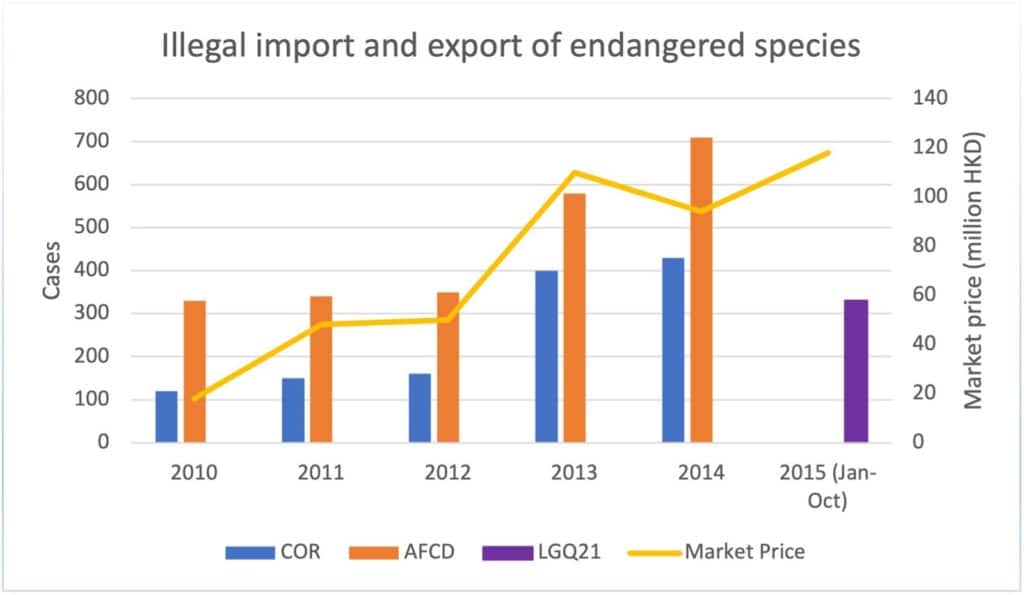
Similarly with wildlife trafficking, the aforementioned study published by ADM Capital Foundation in 2018 reports that the wildlife crimes have experienced an upward trend since 2010. And as of October 2015, the number of illegal wildlife products has increased up to 400% in comparison to the year previously, and has recorded more than 260 wildlife crime case convictions in 2014 alone. Yet the Hong Kong government continues to deny its reputation as an illegal wildlife trafficking hub.
Figure 1: A graph showing the number of endangered species being illegally imported and exported during 2010 to 2015. COR represented the data from the Environmental Bureau; AFCD represented the actual data recorded from the Agriculture, Fisheries and Conservation Department; LGQ 21 represented the reply to question 21 of the Legislative Council Question on November 25, 2015, from Chan, Kar Lok, member of Legislative Council.
Endangered Species Trafficked in Hong Kong
As of June 2021, news of wildlife trafficking and seizures are still prevalent in Hong Kong and the argument for stricter protection policies is stronger in order to tackle the ongoing problem.
Due to its valuable medicinal benefits, “as many as 200,000 pangolins are trafficked each year,” and it’s very common for the animal to be illegally exported from Hong Kong towards destinations like mainland China and Vietnam. Likewise, the Cuora trifasciata, or the Golden Coin Turtle, which was deemed critically endangered by the International Union for Conservation of Nature and Natural Resources, can be found sold on Hong Kong websites and social media with selling prices going as high as $15,000. Yet almost one fourth of the trades are conducted without license.
Other reptiles such as lizards and snakes have also suffered from wildlife crimes. In 2012, more than 130 breeds with 30% of lizards classified as endangered species were imported to Hong Kong and traded as pets.
Meanwhile, live reef fish are another victim of wildlife crime in Hong Kong. The demand for seafood is sky high in the city and mainland China and some species are considered as luxury products. Species like Epinephelus lanceolatus and Cheilinus undulatus are regarded as haute cuisine, and the lack of regulation has led to frequent illegal fishing and trafficking.
What Can Be Done to End Illegal Wildlife Trafficking?
It is critical to enact stricter policy in order to end illegal wildlife trafficking. Although the Hong Kong government has implemented policies to supervise the situation of wildlife trafficking, they have been ineffective to solve the problem as evident with the continued cases of wildlife seizures in Hong Kong. One of the ways to reform is for the government to bring wildlife crimes under The Organized and Serious Crimes Ordinance (OSCO), which increases stricter restrictions for wildlife seizures.
Another way to go forward is to ensure certification for products and refusing to purchase any animals that have been classified as endangered. Overfishing has brought many fish species to the brink of extinction. Although some species are now protected, many are still fished and sold legally. Consumption of sustainable seafood can also be a simple solution to save reef fishes.
On May 23, Hong Kong recorded the hottest day in May since records began in 1884, as temperatures hit 36.1℃ at the Observatory weather station.
—
What is Happening?
According to the Observatory, “under the influence of an anticyclone aloft, very hot weather will persist over the coast of Guangdong in the next couple of days.” The Centre for Health Protection warned Hongkongers to be wary of heat stroke.
May 23’s temperature dwarfed the previous record of 35.5℃ in 1963.
The past two years have been the hottest Hong Kong has seen records began.
As sea levels rise and climate change accelerates, super typhoons will begin to occur every decade by 2050, according to Greenpeace. Last year, the NGO warned that “about 28 square kilometres of Hong Kong coastal lands, equivalent to 147 Victoria Parks, will be under seawater, affecting nearly 100 000 human lives.”
Greenpeace Hong Kong is lobbying district councils to proactively tackle the climate crisis, urging the government to study the impacts of climate change, identify high-risk areas, create long-term response strategies, improve emergency response capabilities and propel the development of renewable energy and energy conservation in order to mitigate the climate crisis.
In 2020, Hong Kong saw 47 days with temperatures over 33℃, which is classified as “very hot” by the Observatory.
According to the Observatory, the heat wave is expected to continue into next week, with highs of 33℃ predicted for Monday through till Wednesday, while the city will see showers from Thursday onwards.
Hong Kong has set a carbon neutrality target for 2050. The government says that it aims to do so through a variety of means, including exploring new environmentally-friendly technology, enhancing the energy efficiency of buildings, promoting zero-carbon vehicles and building large-scale waste-to-energy facilities.
Environmental degradation and climate change are certainly not new phenomena; according to scientists, certain signs of global warming could be seen as early as the 1940s. However, it is only in recent times that these issues have gotten mainstream attention. This push for environmental awareness and conservation has been heavily led by youths, like Greta Thunberg and the Gen Z consumer market, which is redefining business by holding companies accountable for their part in climate change and demanding for more sustainable products. Young people all around the world are taking ownership of their future and insisting on creating a better tomorrow. One interesting result of a generation that is keen on leading positive action is young entrepreneurs focusing on socially responsible and sustainable business models. Research has suggested that more than half of Gen Z wants to start their own company and a major driver for these ambitions is the desire to create something beneficial for the planet. The young people of Hong Kong are no different. Here are 3 environmentally conscious and sustainable brands founded by the youth.
—
3 Hong Kong-based Environmentally Conscious and Sustainable Brands Founded by the Youth
1. BamPads!
Sakshi Vasudev, a second-year student from the City University of Hong Kong, started BamPads! soon after she received her first set of reusable sanitary pads from her father. Her product is made from materials such as bamboo, charcoal and microfleece and is a lot more biodegradable than the disposable sanitary pads or tampons used by most women. According to Vasudev, “A single (disposable) pad takes 500-800 years to decompose because it contains 90% plastic.” However, plastic is not the only problem associated with these single-use products; they often contain harmful chemicals that can cause irritation and infections. So BamPads! is not just good for the environment, but they are also healthier for women, which is an integral part of the vision behind the brand. With her company, Vasudev hopes to one day reach consumers in developing countries that struggle immensely with both period health and environmental issues but for now her products can be found on the BamPads! website.
Food waste is a major environmental issue that has been aggravated even more by the COVID-19 pandemic as supply chains are disrupted and outlets such as restaurants and bakeries struggle with lower demand and lockdowns. Anushka Purohit, Suyash Mohan, Naman Tekriwal and Deevansh Gupta from the Hong Kong University of Science and Technology identified this very problem when they saw bread from a local bakery being thrown into the trash. According to Gupta, a week after the incident, they realised that “bread and beer have the same constituent elements, and that there is a potential idea here.” Working closely with local breweries, the students eventually developed Breer, a craft beer that is not only environmentally friendly, but having swapped barley with waste bread, has a novel taste of its own with hints of citrus in the bread beers while the pizza crust beer is formulated using fruity hops. Such upcycling of food waste has also proven to be highly cost effective as the company told Green Queen that “within one year they will be able to save HK$75 000 in brewing costs (in comparison to normal craft beer), on top of the 9.2 tons of bread and 3 square kilometres of landfill space saved.”
3. Planeteers
Single-use cutlery made of plastic doesn’t only take a long time to decompose but is also not recyclable. In order to be recycled plastic needs to be sorted properly in a recycling facility but the small size of single use cutlery means that it often falls through the crevices of most machines and equipment running the risk of contaminating other plastics. This difficulty with recycling has led to the creation of more biodegradable options which often use wood instead of plastic, but what about deforestation? Aditi Deodhar from the Hong Kong University of Science and Technology came up with a solution that is a lot more sustainable and environmentally friendly than other options: vegan edible cutlery. Deodhar baked her first usable batch of cutlery with her partners, Swapnil Mishra, Srijan Saxena and Anhad Singh Chawla, which allowed them to consume a meal of hot ramen. The breadstick-like cutlery is baked using whole grain flour and water which makes it relatively tasteless and thus easily enjoyable with any meal. This young team behind Planeteers is now hoping to collaborate with members of the local restaurant industry and promote the use of sustainable and edible cutlery through events such as their first product test run on the 5th of April at a popular vegan restaurant in Central. Deodhar remarked that this event was a success with positive feedback from customers and a plethora of inquiries about when the cutlery might be available regularly.
These youth and the sustainable brands they have created have made it apparent that not only is the current generation coming up with innovative solutions to counter climate issues but they are willing to lead these efforts themselves. As these young entrepreneurs envision their future it is closely intertwined with the well being of the planet and their communities and as such it simply does not make sense to stand back as previous generations build that future. The fact of the matter is that the youth is no longer just our future as most would believe but they are actively creating the present and often walking side by side with much more experienced individuals in creating a better tomorrow so why should entrepreneurship be any different?
New research has shown the enormous benefits of restoring lost oyster reefs in Hong Kong. Once home to thriving reefs, the city has seen oyster populations decline drastically in recent decades due to overexploitation and pollution.
—
What Is Happening?
The research was produced jointly by The Swire Institute of Marine Science (SWIMS), Faculty of Science, The University of Hong Kong (HKU), and The Nature Conservancy (TNC).
Hong Kong was once home to thriving shellfish reefs, but due to overexploitation, coastal reclamation, and pollution, these populations have declined significantly in the past 150 years.
Benefits of Oyster Reefs
Oyster reefs are natural water purifiers. The research found that just seven square metres of Hong Kong oyster reefs can filter up to one Olympic-sized swimming pool of water a day; a single Hong Kong oyster (Crassostrea hongkongensis) can filter up to 30 litres of water per hour at summer temperatures, among the highest filtration rates recorded of any oyster species.
Additionally, oyster reefs provide habitat and nursery grounds for many native species that are otherwise lost from shores. Another recent SWIMS study conducted alongside TNC found that these reefs house six times more species than bare muddy shores. The research found over 80 species on intertidal muddy shores in Deep Bay, 95% of which were found in oyster reefs, and almost 60% of which were exclusively found in those reefs.
Restoring oyster reefs along urbanised coastlines can mitigate some of the environmental problems typical of coastal development, such as damage from storm surges and loss of biodiversity.
Another benefit of restored reefs is increased production of commercially and recreationally valuable fish and crabs.
“Globally, we have lost 85% of shellfish reefs, making it the most endangered marine habitat on earth. Most people associate oysters with food, but less well-known is that oysters create reef habitats that support coastal marine life. Only by restoring these lost habitats can we start to bring back some of the associated environmental benefits,” said Marine Thomas, Conservation Project Manager for TNC in Hong Kong.
“A previous SWIMS study found that Hong Kong is home to approximately 6 000 marine species and 26% of all marine species in China. This new research adds to that list, as we’ve identified a small crab previously not seen in Hong Kong. This shows us just how under-studied these ecosystems are,” explained Dr. Bayden D. Russell, an Associate Director of SWIMS and Associate Professor in the Research Division of Ecology and Biodiversity at the University of Hong Kong (HKU).
Demonstration of successful restoration in one of Asia’s coastal megacities can act as a model, providing evidence for the environmental and societal benefits of ecological restoration within the region.
In some parts of the world, oyster reef restoration has only been successful by transplanting juvenile oysters cultivated in hatcheries into the wild. However, this new research demonstrates that natural recruitment of oysters in Hong Kong is high, meaning that restoration could potentially be achieved without the need for hatchery-reared oysters.
“We were excited to find high natural recruitment levels which suggests that oyster reef restoration is possible without hatchery intervention. We think that this recruitment is because traditional oyster farming in the Pearl River Delta has maintained populations of native oysters in the system in spite of the loss of oyster reefs and these farms could potentially act as a source of larvae,” said Russel.
In assessing 10 sites in Hong Kong where small remnant shellfish habitats are found, the study also found that large oysters (beyond 1 year old) are very hard to find in the wild, due to on-going harvesting pressures.
“While we are excited by the biological feasibility of restoration, unfortunately the human aspect remains our biggest challenge to bring these habitats back at scale. Shellfish habitats are still severely under protected in Hong Kong, with very little public awareness of their ecological value. Wild harvesting is a huge problem – as soon as oysters or mussels are big enough to eat, someone will harvest them. We are working with the government on gaining more protection and recognition for these important ecosystems and hope to include them in the next Hong Kong Biodiversity Strategy and Action Plan (BSAP),” said Thomas.
In the evening of March 23, the Hong Kong Snakes Facebook group of 12 000-plus members saw a post from local police snake catcher William Sargent that a seven foot-long King Cobra was stuck inside a man-made drainage pipe. While human-snake encounters are far from uncommon, this raises the concern of whether- and how- similar conflicts could be navigated in the future to protect the wellbeing of the reptiles.
—
Despite his three decades of experience observing and interacting with snakes, this incident took the South Lantau-based snake catcher by surprise.
In avideo footage that captured the attempted rescue, Sargent can be seen lubricating the snake in an attempt to set it free, but to no avail. “It is not even shifting a millimetre,” he is heard saying. “I don’t know what to do.” The snake catcher then dragged the live snake out of the weephole by force. It, however, did not survive after a hydration attempt, Sargent later announced on the social media group.
The body of the King Cobra snake has since been handed over to the Science Department of Hong Kong’s Lingnan University, where the institution is reportedlybuilding a database of the territory’s snake species for research purposes.
Sightings of snakes are far from uncommon in Hong Kong. In a recent interview withEarth.Org, the snake catcher of six years credited the development of Hong Kong’s wilderness for allowing snakes to thrive, calling their habitats the “number one most important part of the equation in biodiversity and wildlife.”
The King Cobra isn’t the only reptile that can be found in Hong Kong. The city of 1,1108 square kilometres is home to 42 other snake species, from the more frequently encountered Bamboo Pit Vipers and Common Rat Snakes to the less common Banded Kraits and Beauty Rat Snakes; its population of over 7 million enjoys biodiversity that benefits from designated country parks and areas that provide “statutory protection for the habitats of diverse flora and fauna,” according to the government’swebsite.
This has, in effect, meant that incidents of snake predations are plentiful. Whether it’s a Burmese Pythonpreying on a wild boar, or a Redneck Keelback consuming a frog live, these fascinating animals show the food web in action while keeping the rodent population under control.
Speaking to Earth.Org, author of “A Field Guide to the Snakes of Hong Kong” and wildlife photographer Adam Francis described the role that snakes play in Hong Kong ’s wildlife as “constantly changing.”
Using the rat snakes — which includes the Common Rat Snakes, the Indo-Chinese Rat Snakes, and to a certain extent, the Beauty Rat Snakes — as examples, Francis pointed out “mammals, rodents, birds, certain amphibians, and little lizards” as the species’ main food sources, calling their food consumption habits “diverse.”
“Different weather patterns, influence, success or failure of certain species in certain seasons” carry an effect on animal populations and spreads — when the population of one goes down; the predator adapts by consuming more of the others.”
He also warned that “rapidly and irrevocably” disrupting aspects of nature that pertain to the snake food chain will result in less breeding activities, or worse, endangering a species and possibly rendering it extinct. “There are observable effects when you rapidly change the environment,” he said.
The Burmese Python — Hong Kong’s largest remaining predator — is the only snake species protected by the territory’s Wild Animals Protection Ordinance dating back to 1974. The limitation on possession, consumption, hunting, selling and buying also applied toall protected animals, including the Leopard Cats and the Romer’s Tree Frogs.
Prosecutions are rare, as Sargent admitted- though not unheard of. In 2019, a man in Cheung Chau — one of Hong Kong’s many outlying islands — was filmed capturing a python. In a story published by local tabloid Dimsum Daily, the 53-year old was said to have been arrested after cooking and eating the snake. Speaking about the incident, Sargent pointed out that the SAR government has not done nearly enough. “When people get prosecuted,” he said, “it’s a small fine, a small penalty.”
For snakes that are caught by police snake catchers, they are transported to Kadoorie Farm and Botanic Garden, where they undergo a series of checkups before being released back into the wild.
This practice, while “light years ahead“ of the old method that once involved “killing the snake in the not-so-distant past,” according to Francis, has room to improve — and there is work being done about it.
Because of the diverse local snake population, less common species reportedly spend more time at the farm than their more widespread counterparts, such as the Bamboo Pit Viper — also known as the bamboo snake — that has been responsible for the majority of snake bites in the city.
The risks come at their release. According to 2014 Hong Kong snake research by Elizabeth Anne Devan-Song of the University of Rhode Island, translocation — the assisted movement of conflict animals from their origin to another — of the study’s 90 Bamboo Pit Vipers concluded that the particular species was more prone to experience the negative impacts of such a relocation strategy.
In it, the researcher described the practice as “not a viable management or conservation option” and called for alternative management and conservation strategies to be made for the particular snake species, especially in the wake of more human-snake conflicts.
The study also found a nearly 20% spike in translocated snakes’ death rates under circumstances that were without a clear explanation. Compared to resident bamboo snakes, the survival rates of translocated snakes exhibited a 200-plus percent increase in mortality rate, going from as low as 0.063 up to 0.499 in 2013.
To correct this, Sargent is advocating for a snake catcher accreditation system that will be fully led and monitored by Kadoorie Farm, as Francis revealed. “The system will increase the removals that’s done in a professional way with the animal’s welfare as a top concern,” he said, adding that certain species tend to have limited survival abilities in environments different from where they are caught.
Through demonstrating an understanding of snakes, natural history, as well as habitats, removals would be conducted by snake catchers who release snakes in an area far away enough from the capture site, with little risk of the snake returning, and back in its natural environment over a shorter span of time.
“Some snakes are very habitat specific,” Sargent said. “More needs to be done to identify those areas and put the snakes back where they belong.”
More often than not, he said, using “a dozen police hours to transport a snake that is practically harmless” is at best, unnecessary. As human-snake conflicts become more common, its relocation system also needs to improve — by prioritising the animals’ welfare.
Featured image by: Adam Francis
The agriculture industry is responsible for up to 14% of global greenhouse gas emissions. It also causes a lot of food waste, from the production stage, to the transportation and then the retail stages. As such, more and more people are becoming more conscious of the food they eat and crucially, where they get it from. Local farms offer visitors a chance to consume healthier foods, free of fertilisers and pesticides, as well as support small businesses. Here are 7 local farms in Hong Kong that you should visit.
Living Farm allows you to rent your own plot of land and cultivate your own fruits, vegetables and herbs. They’ll provide the tools, fertilisers and seeds (they’ll even handle the garden care if you wish), so you can simply enjoy your harvest.
Living Farm, 199 Tai Hang Tsuen, Tai Wo Service Road West, Tai Po, New Territories, Hong Kong, 6999 8006, livingfarm@outlook.com, www.livingfarm.com.hk
This organic farm lets you choose from a range of fruits and vegetables, including watermelons and strawberries, lettuce, ginger, tomatoes and water spinach. There are also farming classes, sauce making classes or art jamming classes for kids. You can also rent your own plot of land and grow your own produce.
Fruitful Organic Farm, Si Pai Shek Village, Kam Sheung Road, Yuen Long, New Territories, Hong Kong, 9478 7797, info@fruitfulorganicfarm.com, www.fruitfulorganicfarm.com, www.facebook.com/fruitfulorganicfarm
This farm was founded by local villagers in 2010 and practices sustainable agriculture. It hosts markets, guided tours and workshops, where you can learn how to compost with your own kitchen waste. Alternatively, you can simply enjoy the freshly harvested produce. You can visit their Life Market and Farm Market held on most Wednesdays and Sundays.
Mapopo Community Farm, Ma Shi Po Village, Fanling by Ma Shi Po Road, 9777 4750, mapopo.work@gmail.com, https://mapopo.wordpress.com/, https://www.facebook.com/mapopo.page/
AuLaw Organic commons uses sustainable farming methods to yield fresh melons, along with beans and other organic fruits and vegetables. The crops are irrigated with clean water from underground wells and the varieties are adjusted seasonally. Additionally, the soil is regularly enriched with natural compost. The farm hosts guided tours every Sunday for visitors to try farming. Customers can place orders online or through their mobile app. Deliveries are made every day from Monday to Friday.
AuLaw Organic Commons, Tai Kong Po Village, Kam Tin, Yuen Long, 9108 1731, http://www.yuwing.com/, yuwingwong@yahoo.com.hk, https://www.facebook.com/aulawfarm
Grandpa’s Garden
This is a small organic garden run by an elderly couple in Nim Shue Wan, selling vegetables, herbs and fruits. They also rent plots of land to Discovery Bay residents.
Grandpa’s Garden, Nim Shue Wan, Lantau Island, Hong Kong, 9137 0640
Visitors can learn to compost and plant or go pond dipping. The farm also offers a wide range of fruits and vegetables from aubergines, beetroot and spearmint to curry leaves. They also deliver straight to your door.
Dragontail Farm Ltd., Luk Tei Tong, Mui Wo, Lantau Island, Hong Kong, 5422 2844, dragontail.lantau@gmail.com, www.leoying.wixsite.com/dragontail-farm
Here you’ll find a wide variety of carrots, heirloom tomatoes, sweet peppers and eggplants. A visit costs HKD$30 (which is redeemable in fresh produce), but you must contact them in advance as walk-ins are not accepted.
Zen Organic Farm, Ping Che, Ta Kwu Ling, New Territories, Hong Kong, 6692 2671, joey@zeno.com.hk, www.zeno.com.hk, www.facebook.com/zenorganic
Uncle Kun Fish Ponds
Last on our list of local farms in Hong Kong is Uncle Kun Fish Ponds. Since 1973, Uncle Kun has been providing healthy, steroid-free fish in Tai San Wai Village. As a wholesale business, it encourages bulk-buying to reduce excessive labour. Check out Fairview.com, a small enterprise that sells Uncle Kun’s fish seasonally, or contact district councillor To Ka-lun for more details regarding purchasing, volunteering or visiting the fish farm.
Subscribe to our newsletters
The best environmental stories of the week and month, handpicked by our Editor. Make sure you're on top of what's new in the climate.
Boost this article
By donating us $100, $50 or subscribe to Boosting $10/month – we can get this article and others in front of tens of thousands of specially targeted readers. This targeted Boosting – helps us to reach wider audiences – aiming to convince the unconvinced, to inform the uninformed, to enlighten the dogmatic.